

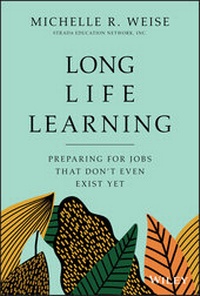
Long Life Learning
Description

A visionary guide for the future of learning and work
Long Life Learning: Preparing for Jobs That Don't Even Exist Yet offers readers a fascinating glimpse into a near-future where careers last 100 years, and education lasts a lifetime.¿The book makes the case that learners of the future are going to repeatedly seek out educational opportunities throughout the course of their working lives - which will no longer have a beginning, middle, and end. Long Life Learning focuses on the disruptive and burgeoning innovations that are laying the foundation for a new learning model that includes clear navigation, wraparound and funding supports, targeted education, and clear connections to more transparent hiring processes.
Written by the former chief innovation officer of Strada Education Network's Institute for the Future of Work, the book examines: ¿
- How will a dramatically extended lifespan affect our careers?¿
- How will more time in the workforce shape our educational demands?¿
- Will a four-year degree earned at the start of a 100-year career adequately prepare us for the challenges ahead?¿
Perfect for anyone with an interest in the future of education and Clayton Christensen's theories of disruptive innovation,¿Long Life Learning¿provides an invaluable glimpse into a future that many of us have not even begun to imagine.¿
More details
Other editions
Additional editions
Person
MICHELLE R. WEISE is a thought leader and author in the field of the future of work and education. Her writing has appeared in The Economist, The Wall Street Journal, and The Harvard Business Review. She previously served as the Chief Innovation Officer of Strada Education Network, which is a social impact organization dedicated to forging clearer and more purposeful pathways between education and employment for millions more Americans.
Content
Introduction: An Abiding Hope for the Future xi
Part I From a Rigged System 1
1 A 100-YearWork Life 3
2 The Theories Behind the End of College 23
3 The Future of Workers, the Future of Us 49
Part II To a New Learning Ecosystem 65
4 Seamless On- and Off-Ramps 67
5 Navigating Our Next Job Transition 77
6 Wraparound Supports 91
7 Targeted Education 109
8 Integrated Earning and Learning 139
9 Transparent and Fairer Hiring 159
10 Getting Started: Taking Root 181
Conclusion 191
Endnotes 197
Acknowledgments 231
About the Author 235
Index 237
2
The Theories Behind the End of College
In a 100-year work life, will we be going back to school? A public four-year education today can cost approximately $21,950 per year (including room and board), while a private nonprofit four-year college has skyrocketed to $49,870 per year (also including room and board).1 With student debt ballooning to $1.6 trillion, far exceeding credit card debt, it seems hard to imagine that more college or more graduate school will be the answer in a longer work life.2
At the same time, the academic terrain has shifted dramatically over the years. In 1949, there were only 1,851 colleges in the United States (including both two- and four-year schools).3 Since then, we've seen a vast proliferation of institutions of higher education as well as an increased number of learners enrolling in postsecondary education.4 In 2012-2013, the number of universities peaked at 4,726 degree-granting institutions5 with 70 percent of all graduating high schoolers enrolling in college.6
To fill those thousands of schools, there has to be a steady stream of learners coming through their doors to cover the rising cost of college. But the number of high school graduates peaked back in 2013. A Western Interstate Commission for Higher Education analysis revealed that the overall number of high school graduates will plateau over the next decade, leading to smaller college-graduating cohorts in the 2030s.7 Indeed, in markets in the Northeast and Midwest, the number of high school grads started to stagnate and decline as early as 2010. This trend is a result of the declining number of white high schoolers. At first, the number is counterbalanced by the growth in Hispanic and Asian/Pacific Islander high school grads, but then the overall trend of decline continues, especially as private religious and nonsectarian schools are expected to graduate even fewer students.
By the mid-2030s, the projections look even starker. In certain graphs, there is a dramatic dip in enrollment. Gen Z, the generation born roughly between 1995 and 2010, will not meet the enrollment growth goals of most universities. Researcher Nathan Grawe describes this as the "birth dearth," the downward trend that is "a consequence of fertility declines that began during the financial crisis."8
Colleges and universities will no longer be able to rely on traditional demographics to fill their classrooms and residence halls. According to an analysis by the consulting company EY-Parthenon, over 100 institutions "exhibit more than four [of a possible eight] risk factors for closing," such as deficit spending, debt payments in excess of 10 percent of expenses, and enrollment under 1,000.9 And that was pre-COVID.
In just the years between 2012 and 2018, various schools had already begun to merge, close, or create shared-services models to stay afloat. There had already been a noticeable contraction in the market with the number of degree-granting colleges and universities decreasing from over 4,700 institutions to 4,313.10 With the coronavirus pandemic, the fate of schools is even more uncertain than ever, with Moody's Investors Service downgrading the 2020 outlook for higher education from stable to negative and early models estimating a 15 percent drop in enrollments nationwide.11
Adult Learners to the Rescue?
Amid all of this flux, the demographics of college-going students has been shifting over the last few decades. According to latest data from the National Center for Education Statistics, 4 in 10 college students are over the age of 24.12 These learners do not live on campus; in fact, fewer than 2.7 million13 students out of the nearly 20 million14 who attend college in the United States go to school full-time and live on campus.
For years, we've been using the term "nontraditional" students, to contrast older and often part-time students with the younger 18- to 24-year-old student population that we tend to associate with residential college experiences. But "nontraditional" is a complete misnomer, as seven in ten students today display at least one of these nontraditional characteristics.15 They're not necessarily coming to college for the social or coming-of-age experience-dorm life, partying, drinking, clubs, or sports. They are part-time students with full-time or multiple part-time work responsibilities. They have kids or other caregiving duties and may be tied to a geographic area because of these responsibilities. They have a lot of "life" that gets in the way and are seeking affordable and flexible learning pathways. They are less willing to pay for what they will never use. They are the new consumers of education.
The natural assumption might be: Given the decline in traditional college-going students, institutions would be delighted to discover this untapped market of millions more older adult learners. It seems almost too obvious to redesign solutions around this new population when the current market is shrinking.
But the inertia is substantial. Kevin Carey, vice president for education policy and knowledge management at New America Foundation, writes about this in his book The End of College. He quotes Harvard biology professor Robert Lue, who explains that "higher education is an organism. Our environment is changing, so we need to evolve. We need to deconstrain, to redefine how our individual components relate to one another. Organisms go extinct when they cannot mutate."16 Most colleges and universities are not mutating; they are neither evolving their models nor tailoring their programs to attract and meet the needs of this growing population of new learners.
For all of these reasons, many have been in the business of predicting the disruption of college. Carey projects that schools will inevitably struggle to compete with upstart innovators and organizations that "take advantage of all those inefficiencies and drive the old business to extinction."17
Disrupting College
Like harbingers of doom, observers have claimed that this company or that start-up will undo higher education. The term "disruption" has become one of the most overused buzzwords out there. There's an elegance to the word-an elegance that also, unfortunately, leads to its broad misuse.
Clayton Christensen coined this term in his 1997 book The Innovator's Dilemma.18 He developed the idea of disruptive innovation while studying for his doctoral business degree at Harvard. At a basic level, he was trying to understand why it was so difficult for major corporations and businesses to sustain success. How was it that companies seemingly at the top of their game could collapse?
What Christensen discovered was the effect of innovations on the margins, which could transform a product or service that used to be very complicated and expensive, bring it to more people, improve it over time, and ultimately upend an industry. The dynamic of disruption helps people understand why major industries and companies have toppled over time-why, for instance, mini-mills disrupted integrated mills in the steel industry. It helps describe why so many newspapers have gone out of print today and why we no longer buy music CDs. Disruption is a compelling phenomenon, and it can help us empathize with the kinds of business decisions that leaders face as they try to figure out how to sustain success.
A stronger grasp of disruption can help us dismantle our assumptions as we confront new ideas, innovations, and models that appear unusual or perhaps even make us feel threatened, uncomfortable, or scornful at first. Indeed, it is precisely when we feel tempted to dismiss a new model that we should probably start paying attention, because it might be just "good enough" (Christensen's words) to gain traction with people whose alternative is nothing at all. Christensen called this population nonconsumers, and it is ultimately through this lens of nonconsumers that we will find ways to ease our journey through a longer work life and make more obvious and seamless links between education and work.
The Pull of the Sustaining Trajectory
Imagine that you have a set of concentric circles. (See Figure 2.1.) The centermost circle describes the customers who have the most money or the most skills in that industry. The circles on the outer edges represent larger populations of the country who don't have as much money or as many skills. Almost always, modern industries start in that centermost circle because the first iterations of products are complicated and expensive. The first users, therefore, are the rare few with the skills and money to use the innovation.
Figure 2.1 Populations of users.
Now, let's talk about the market in the context of that centermost circle. With most innovations, we witness improvements when it comes to the performance of a product or service over time. (See Figure 2.2.)
Some of the improvements that help companies move up this sustaining trajectory are just incremental changes from year to year, while others are dramatic, breakthrough innovations as companies pursue the creation of better and better products. The iPhone X or 11 are examples of products on a sustaining trajectory. Apple keeps making better and better versions of the...
