

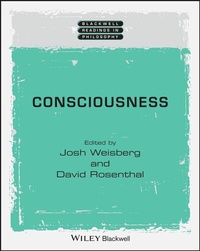
Consciousness
Description

Consciousness is a thought-provoking collection of classic and contemporary philosophical literature on consciousness, bringing together influential scholarship by seminal thinkers and the work of emerging voices who reflect the diversity of the field. Editors Josh Weisberg and David Rosenthal have selected discussions that animate modern debates and connect consciousness to broader philosophical topics.
Providing an expansive view of the philosophical landscape of consciousness studies, this carefully calibrated reader features classic work from the past four decades by seminal thinkers such as Thomas Nagel, David Lewis, Ned Block, Gilbert Harman, and Daniel Dennett, as well as important recent work from David Chalmers, Fiona Macperson, Joseph Levine, Kathleen Akins, and other contemporary philosophers.
Divided into five parts, Consciousness explores the nature of consciousness, consciousness and knowledge, qualitative consciousness, and theories of consciousness. A final section on agency and physicalism includes work by Galen Strawson and a previously unpublished article by Myrto Mylopoulos.
Philosophically challenging yet accessible to students, Consciousness is an ideal reader for many undergraduate and graduate courses on consciousness or philosophy of mind, as well as a useful supplementary text for general classes in philosophy and a valuable reference text for philosophers of mind, cognitive scientists, and psychologists.
Josh Weisberg is Associate Professor of Philosophy and Director of Graduate Studies at the University of Houston. His work focuses on the philosophy of mind and consciousness studies. He is the author of Consciousness: Key Concepts in Philosophy, an introductory book on the philosophical problem of consciousness, as well as numerous articles on a range of topics in philosophy of mind.
David Rosenthal is Professor of Philosophy at the Graduate Center of the City University of New York, and Coordinator of the Graduate Center's Interdisciplinary Concentration in Cognitive Science. The leading authority on higher-order theories of consciousness, Rosenthal's work focuses on philosophy of mind, philosophy of psychology, and cognitive science. Series Editor: Steven M. Cahn, City University of New York Graduate School
More details
Other editions
Additional editions
Persons
Josh Weisberg is Associate Professor of Philosophy and Director of Graduate Studies at the University of Houston. His work focuses on the philosophy of mind and consciousness studies. He is the author of Consciousness: Key Concepts in Philosophy, an introductory book on the philosophical problem of consciousness, as well as numerous articles on a range of topics in philosophy of mind.
David Rosenthal is Professor of Philosophy at the Graduate Center of the City University of New York, and Coordinator of the Graduate Center's Interdisciplinary Concentration in Cognitive Science. The leading authority on higher-order theories of consciousness, Rosenthal's work focuses on philosophy of mind, philosophy of psychology, and cognitive science. Series Editor: Steven M. Cahn, City University of New York Graduate School
Content
Acknowledgments vii
Introduction 1
JOSH WEISBERG AND DAVID ROSENTHAL
Part I Problems of Consciousness 15
1 What Is It Like to Be a Bat? 17
THOMAS NAGEL
2 What Is It Like to Be Boring and Myopic? 25
KATHLEEN AKINS
3 Consciousness and Its Place in Nature 52
DAVID J. CHALMERS
4 The Explanatory Gap 79
JOSEPH LEVINE
5 A Third-Person Approach to Consciousness 94
DANIEL C. DENNETT
Part II Consciousness and Knowledge 107
6 What Mary Didn't Know 109
FRANK JACKSON
7 In Defense of the Phenomenal Concept Strategy 113
KATALIN BALOG
8 What Experience Teaches 126
DAVID LEWIS
Part III Qualitative Consciousness 141
9 On a Confusion about a Function of Consciousness 143
NED BLOCK
10 The Intrinsic Quality of Experience 175
GILBERT HARMAN
11 How to Think about Mental Qualities 186
DAVID ROSENTHAL
Part IV Theories of Consciousness 203
12 Conscious Experience 205
FRED DRETSKE
13 The Same-Order Monitoring Theory of Consciousness 219
URIAH KRIEGEL
14 What Kind of Awareness is Awareness of Awareness? 237
MICHELLE MONTAGUE
15 Higher-Order Theories of Consciousness 249
JOSH WEISBERG
Part V Agency and Physicalism 263
16 Perceptual Consciousness as a Mental Activity 265
SUSANNA SCHELLENBERG
17 The Proprietary Nature of Agentive Experience 280
MYRTO MYLOPOULOS
18 Realistic Monism: Why Physicalism Entails Panpsychism 294
GALEN STRAWSON
19 Property Dualism and the Merits of Solutions to the Mind-Body Problem: A Reply to Strawson 311
FIONA MACPHERSON
Select Bibliography 322
Index 327
Introduction
Josh Weisberg and David Rosenthal
Right now, you are undergoing the conscious experience of reading this text, combined with a shifting background of sensory, emotional, and cognitive coloring. The conscious experience of the reading, together with the accompanying background feel of sensation, emotion, and thought, make up how things subjectively seem to you, how things appear, as best you can tell, from your own unique point of view. Consciousness is at once acutely familiar-it makes up the experienced moments of your waking (and perhaps your dreaming) life. But consciousness also raises deep and interesting philosophical questions, questions about how any mere physical subject could produce such a wonder, and questions about how there could be a seemingly private and isolated spot of personal subjectivity in an objective, impersonal world. Perhaps the challenge of developing a satisfying theoretical understanding of consciousness is beyond us-we have reached the limits of what we can comprehend. Or maybe today's shortcomings are only temporary barriers to an illuminating theory of consciousness, one properly embedding it in our scientific worldview. And possibly we already have the resources for a satisfactory theory from the way we think about things in commonsense terms.
This reader provides an entry point for considering these and related theoretical questions surrounding consciousness. This introductory section begins with a brief background survey of contemporary debates on consciousness. It then provides a characterization of the notion of consciousness at issue and considers why consciousness understood this way might be theoretically problematic. It follows with a survey of some of the major theoretical positions on consciousness and it closes with a synopsis of the sections of the book.
I General Background
The contemporary philosophical problem of consciousness has its roots in the traditional mind-body problem, the problem of fitting mentality into the mechanistic, mathematical worldview that emerged with the scientific revolution. Galileo, reflecting on the underpinnings of the new scientific thought, wrote that
The book [of Nature] is written in mathematical language, and the symbols are triangles, circles and other geometrical figures, without whose help it is impossible to comprehend a single word of it; without which one wanders in vain through a dark labyrinth.
(Galilei 1623/1957, 237-238)
The great breakthroughs of Galileo and his scientific successors turned in part on the "mathematization" of scientific theorizing. The key to knowing nature, according to modern science, is to capture it in mathematical language, language leading to clear, precise hypotheses to be checked by experiment. Mathematical thinking therefore sits squarely at the heart of modern science. Because of this, anything failing to fit into mathematical terms was in danger of being left out of the scientific story of nature altogether. This was especially pressing when it came to the qualities of conscious experience, like experienced color, sound, and taste. How does one capture basic sensory qualities in language compatible with the Galilean mathematical Book of Nature? Indeed, Galileo himself concluded there were no colors out there in the world at all; rather, color experiences were a reaction we have to the presence of certain mathematically characterizable features in the world, like the reflective surfaces of certain objects. Color and color experience seemed to be cut off from physical reality at the beginning of modern science.
Further, the emerging new science saw nature in mechanical terms. The human body and natural phenomena in general, like the motion of cannonballs and the orbits of the planets, were seen as actions of a great clockwork machine. But if the human body is just a machine governed by physical principles capturable in mathematical terms, as the new science suggests, how are we to account for the mind with its sensory qualities and rational capacities? It is unclear how mechanical theorizing can capture the distinctive qualities of conscious experience and the flexible, creative reasoning of the rational human mind. There seems to be no place for the mind in the theoretical picture of the new science.
René Descartes, often called the father of modern philosophy, developed an influential response to these worries: his famous mind-body dualism. A pressing worry facing the new science was that if our bodies are just machines embedded in a clockwork universe, there seemed to be no room for ideas that are central to the way we think about psychological functioning in commonsense terms, such as the soul and free will. Descartes tried to show that the new science was compatible with our commonsense conception of the mind. He argued that mind and body are fundamentally different substances. Body is extended, nonthinking matter, fully explicable in the terms of the new mechanistic science. But mind is an unextended, thinking substance, one that is not caught in the causal web of mathematical physics. Mechanistic science explains the realm of physical body, but the realm of mentality sits outside this framework, leaving open the possibility of a free and rational mind, able to survive the death of the body. Thus, science and common sense can coexist, on Descartes's theory.
But this leaves the mind outside the physical world. How is it able to connect with the physical body at all? This is known as the "interaction problem" for dualism. Descartes successfully carves off the mind from the clockwork machine, but it is unclear how to reconnect it in everyday life. When a piano drops on my foot, I will likely consciously experience a sharp pain. How does the damage in my physical foot impact my mind, particularly if my mind is unextended, and so takes up no space at all? This worry was pressed on Descartes by Princess Elizabeth of Bohemia. Descartes's answer was straightforward enough: occurrences in the unextended mind causally interact with occurrences in physical reality.
Fair enough; but a problem remains. Over the next few centuries, advances in physics, chemistry, engineering, and other sciences seemed to show that all causation eventually reduces to causation in physics. Chemical interactions can be explained by physics and biological functioning by chemistry. And over the eighteenth and nineteenth centuries, physiology, and eventually the new scientific disciplines of psychology and neuroscience, began to make similar inroads on the realm of the mind, hoping to develop a proper science of the mind. The explanatory successes of the physical sciences led to new attempts to integrate mind into the physical world.
Initial progress in the science of psychology involved the systematic correlation of changes in physical stimuli with changes in psychological reaction. This approach, known as "psychophysics," helped bridge the gap between mind and world, and it is a flourishing branch of psychology to this day. But as psychology moved to investigate more complex "higher" mental phenomena, methodological problems began to appear. Central to the approach of early psychology was the use to detailed introspective reports, reports about what was happening in the minds of subjects as they underwent psychological experiment. But disagreements between subjects about the nature and presence of what was being reported led to intractable problems. If one set of subjects claimed something was present in their experience during an experiment and another set of subjects claimed nothing was, how are we to decide who is correct? There seems to be no public, external check on experiment, a key component of scientific inquiry. The new discipline of psychology was in danger of failing to meet the rigorous standards of science.
In reaction, some psychologists proposed strongly restricting their methodology, developing a "behaviorist" psychology. For these behaviorists, only directly observable phenomena can be studied scientifically. Since we cannot directly observe inner mental states, they cannot be studied in a scientific psychology. However, behavior can be directly observed. So we can base a scientific psychology on observable behavior. In this way, we could avoid the intractable debates which plagued "introspectionist" psychology. Behaviorism of this sort became the dominant view in psychology for much of the first half of the twentieth century.
A parallel move occurred in philosophy around the same time. In the late nineteenth and early twentieth centuries, many in philosophy came to be suspicious of the appeals to our inner life that dominated much of post-Kantian, nineteenth-century philosophical thinking. But our inner psychological lives can be expressed in speech, and that observation led to what is now known, in Richard Rorty's useful term, as the "linguistic turn" in philosophy, a primary focus on the way philosophical issues emerge in the use of language.
Accompanying this shift was a restrictive claim about how much of language worked. Philosophers known as logical empiricists held that only terms have meaning and only if the sentences that they occur in can be verified. If there was no way to verify the sentences that a term occurs in, that term does not mean anything and does not pick anything out. And it was thought that applying this test for meaningfulness, echoing the methodology of David Hume several centuries earlier, could show that a range of philosophical problems are simply...
