

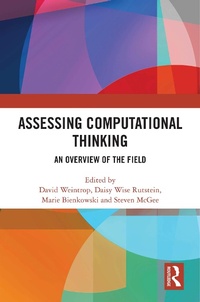
Assessing Computational Thinking
An Overview of the Field
1st Edition
Published on 12. September 2023
214 pages
978-1-000-95235-3 (ISBN)
Description

This book presents different approaches for answering the question: How do we assess computational thinking? The result is a snapshot of the current state of the field for assessing computational thinking.
The last decade has seen rapid growth in the presence of computational thinking (CT) in educational contexts. Those working to advance CT argue that the concepts and skills associated with CT are essential to succeed in an increasingly computational world. As a result of these efforts, there has been tremendous growth in curricula, learning environments, and innovations around CT education in K-12 classrooms and beyond. As CT grows in prominence, so too does the need to be able to effectively and equitably assess learners CT abilities. This volume is a collection of chapters pursuing different approaches for answering the question: How do we assess computational thinking? The answers provided span age ranges, formal and informal contexts, conceptual aspects of CT, and varying methodological and evaluative strategies. Collectively, the volume captures the current state of the field for assessing computational thinking and lays the groundwork for future CT assessment innovation.
Assessing Computational Thinking will be a key resource for academics, researchers, and advanced students of Education, Educational Assessment, Educational Research, Psychology and Research Methods. The chapters included in this book were originally published as a special issue of Computer Science Education.
The last decade has seen rapid growth in the presence of computational thinking (CT) in educational contexts. Those working to advance CT argue that the concepts and skills associated with CT are essential to succeed in an increasingly computational world. As a result of these efforts, there has been tremendous growth in curricula, learning environments, and innovations around CT education in K-12 classrooms and beyond. As CT grows in prominence, so too does the need to be able to effectively and equitably assess learners CT abilities. This volume is a collection of chapters pursuing different approaches for answering the question: How do we assess computational thinking? The answers provided span age ranges, formal and informal contexts, conceptual aspects of CT, and varying methodological and evaluative strategies. Collectively, the volume captures the current state of the field for assessing computational thinking and lays the groundwork for future CT assessment innovation.
Assessing Computational Thinking will be a key resource for academics, researchers, and advanced students of Education, Educational Assessment, Educational Research, Psychology and Research Methods. The chapters included in this book were originally published as a special issue of Computer Science Education.
More details
Edition
1. Auflage
Language
English
Place of publication
London
United Kingdom
Publishing group
Taylor & Francis Ltd
Target group
College/higher education
Product notice
Reflowable
ISBN-13
978-1-000-95235-3 (9781000952353)
Copyright in bibliographic data and cover images is held by Nielsen Book Services Limited or by the publishers or by their respective licensors: all rights reserved.
Schweitzer Classification
Other editions
Additional editions
David Weintrop | Daisy W. Rutstein | Marie Bienkowski
Assessing Computational Thinking
An Overview of the Field
Book
12/2024
1st Edition
Routledge
€61.40
Shipment within 10-20 days
David Weintrop | Daisy W. Rutstein | Marie Bienkowski
Assessing Computational Thinking
An Overview of the Field
Book
09/2023
1st Edition
Routledge
€207.50
Shipment within 10-20 days
Persons
David Weintrop is Assistant Professor at the University of Maryland.
Daisy Rutstein is Principal Education Researcher at SRI International.
Marie Bienkowski is Director of STEM Curriculum at the Academies of Math and Science.
Steven McGee is President of The Learning Partnership.
Daisy Rutstein is Principal Education Researcher at SRI International.
Marie Bienkowski is Director of STEM Curriculum at the Academies of Math and Science.
Steven McGee is President of The Learning Partnership.
Content
Introduction-Assessing computational thinking: an overview of the field 1. Developing a kindergarten computational thinking assessment using evidence-centered design: the case of algorithmic thinking 2. Design and validation of learning trajectory-based assessments for computational thinking in upper elementary grades 3. A principled approach to designing computational thinking concepts and practices assessments for upper elementary grades 4. Assessing computational thinking through the lenses of functionality and computational Fluency 5. Communicating about computational thinking: understanding affordances of portfolios for assessing high school students' computational thinking and participation practices 6. How do students develop computational thinking? Assessing early programmers in a maze-based online game 7. Assessing computational thinking in libraries
