

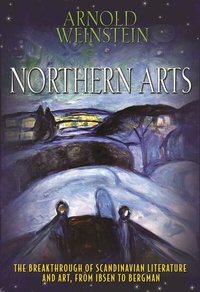
Northern Arts
The Breakthrough of Scandinavian Literature and Art, from Ibsen to Bergman
1st Edition
Published on 6. December 2021
544 pages
978-0-691-24025-1 (ISBN)
Description

Northern Arts is a magnificent and provocative exploration of Scandinavian literature and art. With intellectual power and deep emotional insights, writer and critic Arnold Weinstein guides us through the most startling works created by the writers and artists of Scandinavia over the past two centuries.
Here readers will gain new perspectives on canonical giants such as Søren Kierkegaard, Henrik Ibsen, August Strindberg, Edvard Munch, Knut Hamsun, and Ingmar Bergman. Readers will also encounter popular favorites like children's writer Astrid Lindgren, and come to know the work of lesser-known masters such as the novelist Tarjei Vesaas and the painters Ernst Josephson and Lena Cronqvist. Weinstein uses the concept of "breakthrough"--boundary smashing, restlessness, and the exploding of traditional forms and values--as a thematic lens through which to expose the roiling energies and violence that course through Scandinavian literature and art. Defying preconceptions of Scandinavian culture as depressive or brooding, Weinstein invites us to imagine anew this transformative and innovative tradition of art that continually challenges ideas about the sacred and the profane, family and marriage, children, patriarchy, and personal identity. Through these works he brings us face-to-face with our most hidden selves and urges, enriching our understanding of the emotions and forces that govern our lives.
Northern Arts is the essential introduction to Scandinavian literature and art, one that illuminates the fierce beauty and breathtaking reach of these incomparable works.
Here readers will gain new perspectives on canonical giants such as Søren Kierkegaard, Henrik Ibsen, August Strindberg, Edvard Munch, Knut Hamsun, and Ingmar Bergman. Readers will also encounter popular favorites like children's writer Astrid Lindgren, and come to know the work of lesser-known masters such as the novelist Tarjei Vesaas and the painters Ernst Josephson and Lena Cronqvist. Weinstein uses the concept of "breakthrough"--boundary smashing, restlessness, and the exploding of traditional forms and values--as a thematic lens through which to expose the roiling energies and violence that course through Scandinavian literature and art. Defying preconceptions of Scandinavian culture as depressive or brooding, Weinstein invites us to imagine anew this transformative and innovative tradition of art that continually challenges ideas about the sacred and the profane, family and marriage, children, patriarchy, and personal identity. Through these works he brings us face-to-face with our most hidden selves and urges, enriching our understanding of the emotions and forces that govern our lives.
Northern Arts is the essential introduction to Scandinavian literature and art, one that illuminates the fierce beauty and breathtaking reach of these incomparable works.
More details
Other editions
Additional editions
Arnold Weinstein
Northern Arts
The Breakthrough of Scandinavian Literature and Art, from Ibsen to Bergman
Book
11/2010
Princeton University Press
€36.60
Article not available at the moment
Arnold Weinstein
Northern Arts
The Breakthrough of Scandinavian Literature and Art, from Ibsen to Bergman
Book
09/2008
Princeton University Press
€64.48
Article exhausted; check different version
Person
Arnold Weinstein is the Edna and Richard Salomon Distinguished Professor of Comparative Literature at Brown University. His books include Recovering Your Story: Proust, Joyce, Woolf, Faulkner, Morrison and A Scream Goes Through the House: What Literature Teaches Us About Life (both Random House).
Content
- Cover Page
- Half-title Page
- Title Page
- Copyright Page
- Dedication Page
- Contents
- List of Illustrations
- Acknowledgments
- 1. Introduction
- 2. Power
- A. Speaking God: Kierkegaard and Lagerkvist
- B. The Play of Patriarchy: Ibsen and Strindberg
- i. Child's Play: The Cradle Song in Strindberg's The Father
- ii. Metamorphosis in Ibsen's Little Eyolf
- C. The Powers and the Self: Strindberg's Inferno and Gustafsson's Tennis Players
- 3. Boundary Smashing
- A. Going Through the Wall: Shakespeare, Strindberg, Josephson, Bergman
- B. The Child's Revenge: Kierkegaard, Ibsen, Lindgren, Cronqvist
- C. Hamsun's Hunger and Writing
- D. Stories of Fusion: Vesaas's The Ice Palace and Bergman's Persona
- 4. Graphing Power
- A. Breakthrough, Time, and Flux in Edvard Munch (the Cubist)
- B. The Case of Ernst Josephson
- 5. Concluding the Book: Introducing Strindberg the Painter
- Notes
- Index
