

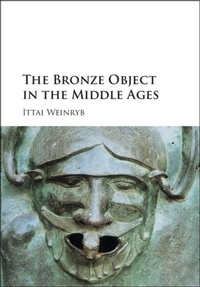
The Bronze Object in the Middle Ages
Published on 3. August 2016
978-1-316-54074-9 (ISBN)
Description

This book presents the first full length study in English of monumental bronzes in the Middle Ages. Taking as its point of departure the common medieval reception of bronze sculpture as living or animated, the study closely analyzes the practice of lost wax casting (cire perdue) in western Europe and explores the cultural responses to large scale bronzes in the Middle Ages. Starting with mining, smelting, and the production of alloys, and ending with automata, water clocks and fountains, the book uncovers networks of meaning around which bronze sculptures were produced and consumed. The book is a path-breaking contribution to the study of metalwork in the Middle Ages and to the re-evaluation of medieval art more broadly, presenting an understudied body of work to reconsider what the materials and techniques embodied in public monuments meant to the medieval spectator.
Reviews / Votes
'Ittai Weinryb's The Bronze Object in the Middle Ages gives us a study that comes close to being the gleeful opposite of a whistlestop tour of the masterpieces of medieval sculpture in bronze, for all that it examines a number of them en passant, and in a way it is only the choice of the word 'object' that ever so slightly gives the game away. For while statues may just about qualify as objects, things such as doors, fonts, fountains, reliquaries, bells and even mechanical clocks and other automata more truly fit the bill, and they soon emerge as the main heroes here.' David Ekserdjian, The Arts Newspaper 'Ittai Weinryb's The Bronze Object in the Middle Ages thus signals a welcome, provocative, occasionally challenging, and decidedly fruitful addition to the field. A corpus-specific survey it is not. Instead, Weinryb offers a sustained and many-faceted meditation on how bronze objects, broadly defined, were conceived, perceived, and experienced; how they interacted with their environments and their communities; how they embodied marvelous technologies and different practices of knowledge - in short, how the bronze object was significant.' Joseph Salvatore Ackley, CAA Reviews '... [A]mbitious in scope and philosophical and imaginative in its realization. ... both provocative and stimulating of further study along unexpected avenues of thought.' Cathy Oakes, History 'Ittai Weinryb has written an absorbing and stimulating book about the multivalent meanings of bronze in the Middle Ages and how those meanings are expressed in items created through the lost-wax bronze casting technique. ... the book's ambition, the originality of its approach, the richness of its arguments, and the verve with which it is written will undoubtedly ensure its lasting significance for anyone interested in medieval objects, bronze or otherwise.' Douglas Brine, The Medieval Review 'It is rarely said of an art historical study that it not only contributes interesting details to a specialized topic but also has the potential to change our awareness and understanding of the field.' Gerhard Lutz, Speculum 'This is a thought-provoking and ambitious study of monumental cast bronze objects produced through the lost wax process during the Middle Ages. Ittai Weinryb examines a wide range of objects and textual sources, and seeks to move beyond the questions of style and Romanitas that have traditionally dominated literature about medieval bronzes. ... The study encompasses doors, bells, fountains and figurative sculpture, concentrating mainly on the modern regions of Germany and Italy. The writing is engaging, and the arguments are supported by excellent illustrations.' L. Cleaver, The English Historical ReviewMore details
Language
English
Place of publication
Cambridge
United Kingdom
Publishing group
Cambridge University Press
Target group
Professional and scholarly
College/higher education
Illustrations
12 Halftones, unspecified; 108 Halftones, color; 12 Halftones, black and white
File size
24672,88 MB
ISBN-13
978-1-316-54074-9 (9781316540749)
Copyright in bibliographic data and cover images is held by Nielsen Book Services Limited or by the publishers or by their respective licensors: all rights reserved.
Schweitzer Classification
Other editions
Additional editions
Ittai Weinryb
The Bronze Object in the Middle Ages
Book
04/2016
Cambridge University Press
€151.40
Shipment within 15-20 days
Person
Ittai Weinryb is an Assistant Professor at the Bard Graduate Center, New York.
Content
Introduction: of bronze things; 1. Making; 2. Signification; 3. Acting; 4. Being; Appendix 1. Adhemar of Chabannes (988-1034); Appendix 2. Hugh of Fouilloy (c.1096-c.1172); Appendix 3. On the Benediction of Bells, excerpt from the Gellone Sacramentary.
