

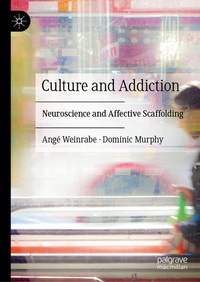
Culture and Addiction
Description

This book rethinks one of the most pressing issues of our time. Addiction is often framed solely as a brain disease, yet it reflects conditions that can touch anyone, shaped by culture, society, and the emotional worlds we inhabit. Culture and Addiction: Neuroscience and Affective Scaffolding suggests that a philosophical approach and critique of the reified addiction-as-disease concept is needed, before addressing the impact that non-evolutionary and evolutionary factors may have on human behavior. Presenting an ambitious interdisciplinary synthesis, this book challenges exclusively biomedical paradigms in addiction studies through what the authors term: "An Integrated Approach." It highlights the crucial role of affective, sensory, and spatial landscapes, while rigorously examining the cultural mechanisms that shape the emergence and remediation of addictive phenomena. By viewing addiction through the lens of scaffolding theory, cultural interaction, and social cognition, this book moves beyond conventional treatment models to reveal deeper, more nuanced ways of understanding compulsive behaviours and choices. The central aim is to integrate biological, psychological, and cultural dimensions, resisting the tendency to reduce addiction to either a purely medical condition or a purely social problem. Appealing to scholars, clinicians, policymakers, and advanced students in medicine, philosophy, and law, this book offers a transformative lens on one of society's most urgent challenges.
More details
Other editions
Additional editions
Persons
Angé Weinrabe
is a research affiliate at The University of Sydney, Australia.
Dominic Murphy is Professor of History and Philosophy of Science at The University of Sydney, Australia.
Content
Part I. Understanding Addiction and Its Explanatory Models .- 1. Presenting the Addiction Landscape.- 2. The Scaffolding and the Plumbing.- 3. Is Addiction a Disease?.- Part II. The Philosophical and Cultural Dimensions of Addiction .- 4. Redirecting the Addiction Debate.- 5. Culture-as-Interaction (CAI).- 6. Culture-as-Practice (CAP).- 7. Conclusion: Rethinking Addiction Through Culture and Scaffolding.
