

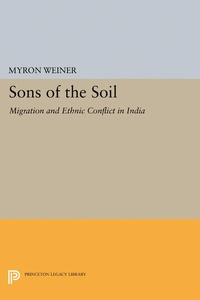
Sons of the Soil
Migration and Ethnic Conflict in India
1st Edition
Published on 19. May 2015
404 pages
978-1-4008-7171-1 (ISBN)
Description

Myron Weiner's study of the relationship between internal migration and ethnic conflict in India is exceptional for two reasons: it focuses on intercultural and interstate migration throughout the nation, rather than on merely local or provincial phenomena, and it examines both the social and the political consequences of India's interethnic migrations.
Professor Weiner examines selected regions of India in which migrants dominate the modern sector of the economy. He describes the forces that lead individual Indian citizens to move from one linguistic-cultural region to another in search of better opportunities, and he attempts to explain their emergence at the top of the occupational hierarchy. In addition, the author provides an account of the ways in which the indigenous ethnic groups ("sons of the soil") attempt to use political power to overcome their fears of economic defeat and cultural subordination by the more enterprising, more highly skilled, better educated migrants.
In addressing the fundamental clash between the migrants' claims to equal access to their country and the claims of the local groups to equal treatment and protection by the state, Professor Weiner considers some of the ways in which government policy makers might achieve greater equality among ethnic groups without simultaneously restricting the spatial and social mobility of some of its own people.
Originally published in 1978.
The Princeton Legacy Library uses the latest print-on-demand technology to again make available previously out-of-print books from the distinguished backlist of Princeton University Press. These editions preserve the original texts of these important books while presenting them in durable paperback and hardcover editions. The goal of the Princeton Legacy Library is to vastly increase access to the rich scholarly heritage found in the thousands of books published by Princeton University Press since its founding in 1905.
Professor Weiner examines selected regions of India in which migrants dominate the modern sector of the economy. He describes the forces that lead individual Indian citizens to move from one linguistic-cultural region to another in search of better opportunities, and he attempts to explain their emergence at the top of the occupational hierarchy. In addition, the author provides an account of the ways in which the indigenous ethnic groups ("sons of the soil") attempt to use political power to overcome their fears of economic defeat and cultural subordination by the more enterprising, more highly skilled, better educated migrants.
In addressing the fundamental clash between the migrants' claims to equal access to their country and the claims of the local groups to equal treatment and protection by the state, Professor Weiner considers some of the ways in which government policy makers might achieve greater equality among ethnic groups without simultaneously restricting the spatial and social mobility of some of its own people.
Originally published in 1978.
The Princeton Legacy Library uses the latest print-on-demand technology to again make available previously out-of-print books from the distinguished backlist of Princeton University Press. These editions preserve the original texts of these important books while presenting them in durable paperback and hardcover editions. The goal of the Princeton Legacy Library is to vastly increase access to the rich scholarly heritage found in the thousands of books published by Princeton University Press since its founding in 1905.
More details
Other editions
Additional editions
Book
04/2016
Princeton University Press
€134.10
Article not available at the moment

Book
03/2015
Princeton University Press
€52.20
Article not available at the moment

Book
11/1978
Princeton University Press
€49.52
Article exhausted; check different version
Person
Myron Weiner
Content
Frontmatter, pg. i
Preface, pg. ix
Contents, pg. xiii
List of Tables, pg. xvii
One. Introduction, pg. 1
Two. Migration and the Growth of Ethnic Diversity, pg. 19
Three. When Migrants Succeed and Natives Fail: Assam and Its Migrants, pg. 75
Four. Tribal Encounters: Tribals and Migrants in Chota Nagpur, Bihar, pg. 145
Five. Middle-Class Protectionism: Mulkis Against Migrants in Hyderabad, pg. 217
Six. Migration and the Rise of Nativism, pg. 265
Seven. Who is Local? Territorial versus Ethnic Identities, pg. 299
Eight. Citizenship and Internal Migration Laws, pg. 325
Nine. Conclusion: Trends and Consequences, pg. 349
Index, pg. 373
Preface, pg. ix
Contents, pg. xiii
List of Tables, pg. xvii
One. Introduction, pg. 1
Two. Migration and the Growth of Ethnic Diversity, pg. 19
Three. When Migrants Succeed and Natives Fail: Assam and Its Migrants, pg. 75
Four. Tribal Encounters: Tribals and Migrants in Chota Nagpur, Bihar, pg. 145
Five. Middle-Class Protectionism: Mulkis Against Migrants in Hyderabad, pg. 217
Six. Migration and the Rise of Nativism, pg. 265
Seven. Who is Local? Territorial versus Ethnic Identities, pg. 299
Eight. Citizenship and Internal Migration Laws, pg. 325
Nine. Conclusion: Trends and Consequences, pg. 349
Index, pg. 373
