

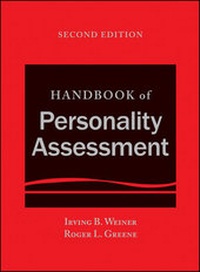
Handbook of Personality Assessment
Description

More details
Other editions
Additional editions
Persons
Roger L. Greene, PhD, is a professor at the Pacific Graduate School of Psychology in Palo Alto, California, where he served as Director of Clinical Training for twelve years. Dr. Greene has worked in a variety of clinical settings and with different types of patients in his clinical career. His particular area of interest is the assessment and treatment of alcohol and drug abuse. He has written a number of texts and articles on the use of the MMPI-2.
Content
Preface xiii
About the Authors xv
Part 1: Basic Considerations
Chapter 1 History of Personality Assessment 3
Early Events 3
Emergence of Personality Psychology 5
World War II and the Expansion of Clinical Psychology 5
Trends Over Time: Shrinkage and Growth 6
Concluding Comments 9
References 12
Chapter 2 The Personality Assessment Process 15
Purposes of Personality Assessment 15
Preparing for Personality Assessments 16
Conducting Personality Assessments 21
Interpreting Personality Assessment Data 23
Reporting Personality Assessment Findings 29
References 33
Chapter 3 Psychometric Foundations of Assessment 37
Reliability 37
Validity 41
Clinical Decision Making 43
Impediments to Accurate Decisions 53
Concluding Comments 55
References 56
Chapter 4 Ethical Considerations in Personality Assessment 59
Student Disclosure of Personal Information (7.04) 60
Bases for Assessments (9.01) 60
Use of Assessments (9.02) 60
Informed Consent in Assessments (9.03) 62
Release of Test Data (9.04) 63
Interpreting Assessment Results (9.06) 63
Assessment by Unqualified Persons (9.07) 64
Obsolete Tests and Outdated Test Results (9.08) 66
Test Scoring and Interpretation Services (9.09) 66
Explaining Assessment Results (9.10) 67
Maintaining Test Security (9.11) 68
Training Students in Personality Assessment 68
Diversity Issues 69
Concluding Comments 72
References 72
Part 2: Self-Report Inventories
Chapter 5 Overview 77
Nature of Self-Report Inventories 77
Item Characteristics 79
Administration and Scoring 85
Method of Scale Development 90
Validity Assessment 92
The Process of Interpretation 101
Future Directions for Assessment with Self-Report Inventories 102
Summary 103
References 103
Chapter 6 Minnesota Multiphasic Personality Inventory-2 105
History 105
Administration 109
Scoring 110
Validity 111
Interpretation 116
Applications 153
Psychometric Foundations 154
Concluding Comments 156
References 156
Chapter 7 Minnesota Multiphasic Personality Inventory-Adolescent 161
History 161
Administration 165
Scoring 165
Validity 166
Interpretation 170
Applications 190
Psychometric Foundations 192
Concluding Comments 193
References 193
Chapter 8 Minnesota Multiphasic Personality Inventory-2-Restructured Form 197
History 197
Administration 200
Scoring 200
Validity 201
Interpretation 207
Applications 220
Psychometric Foundations 223
MMPI-Adolescent-Restructured Form (MMPI-A-RF) 224
Concluding Comments 225
References 227
Chapter 9 Millon Clinical Multiaxial Inventory-IV 231
History 232
Administration 236
Scoring 236
Validity 238
Interpretation 241
Applications 253
Psychometric Foundations 254
Concluding Comments 254
References 255
Chapter 10 Personality Assessment Inventory 257
History 257
Administration 261
Scoring 261
Validity 262
Interpretation 267
Applications 281
Psychometric Foundations 282
Adolescent Version of the PAI 283
Concluding Comments 284
References 284
Chapter 11 NEO Personality Inventory-3 287
History 287
Administration 289
Scoring 289
Validity 291
Interpretation 295
Applications 303
Psychometric Foundations 304
Concluding Comments 306
References 306
Part 3: Performance-Based Measures
Chapter 12 Rorschach Comprehensive System 311
Nature of the Rorschach Comprehensive System 311
History 312
Administration 316
Coding and Scoring 318
Interpretation: Structural Variables 325
Interpretation: Thematic Variables 339
Interpretation: Behavioral Variables 341
Interpretation: Card Pull 344
Applications 348
Psychometric Foundations 355
References 363
Chapter 13 Rorschach Performance Assessment System 369
Nature of the Rorschach Performance Assessment System 369
History 370
Administration 370
Coding and Scoring 373
Interpretation 385
Applications 386
Psychometric Foundations 387
References 389
Chapter 14 Thematic Apperception Test 391
Nature of the Thematic Apperception Test 391
History 393
Administration 396
Coding 399
Interpretation: Card Pull 401
Interpretation: Story Meaning 417
Applications 422
Psychometric Foundations 425
References 427
Chapter 15 Figure-Drawing Methods 433
Nature and History of Figure-Drawing Methods 433
Administration and Scoring 436
Interpretation 439
Applications 447
Psychometric Foundations 450
References 455
Chapter 16 Sentence Completion Methods 459
Nature of Sentence Completion Methods 460
History 461
Administration 464
Scoring 465
Interpretation 466
Applications 471
Psychometric Foundations 474
References 475
Part 4: Appendices: Computer-Generated Interpretive Reports
Appendix A Minnesota Multiphasic Personality Inventory-2 481
Appendix B Minnesota Multiphasic Personality Inventory-Adolescent 537
Appendix C Minnesota Multiphasic Personality Inventory-2-Restructured Form 581
Appendix D Millon Clinical Multiaxial Inventory-IV 619
Appendix E Personality Assessment Inventory 631
Appendix F NEO Personality Inventory-3 673
Appendix G Rorschach Comprehensive System 697
Appendix H Rorschach Performance Assessment System 711
Subject Index 733
Author Index 741
Chapter 1
History of Personality Assessment
Personality assessment, as studied and practiced today, has evolved from long-standing recognition that people differ from each other in how they think, feel, and act and are generally disposed to behave in particular ways. Awareness of individual differences among people is almost as old as civilization itself, and the great literature of the world, from the Greek tragedies to modern fiction, contains vivid descriptions of men and women with distinctive personality characteristics. (Was there ever a meaner person than Dickens's Scrooge, or a more decent person after he underwent a change of heart?) Literary depictions of distinctive personality patterns predated by far the emergence of psychology as a recognized field of study, and attention to individual differences was brought early into the beginnings of formal psychological science and practice.
The advent of formal psychological science is customarily dated to the establishment of Wundt's laboratory in Leipzig in 1879 (see Fuchs & Evans, 2013). In 1883, James McKeen Cattell began working for Wundt as a graduate assistant and asked permission to do a doctoral dissertation on individual differences in reaction time. Being a nomothetic scientist interested in psychological processes, Wundt tended to look at differences among people as bothersome error variance, but he nevertheless acceded to Cattell's request. This was the beginning of a distinguished career for Cattell, in which he pioneered mental testing, generated widespread scientific interest in measuring individual differences with psychological tests, and became regarded as the father of assessment psychology (see Weiner, 2013).
Formal practical applications of psychological assessment also began over 100 years ago, when Alfred Binet was asked in 1904 to help develop a method for identifying intellectually limited children in the Paris public schools who were in need of special attention. In collaboration with Theodore Simon, Binet drew on prior research he had done on the nature of intelligence to construct the Binet-Simon scales, which in their expanded English version later became the well-known Stanford-Binet Intelligence Scale.
The early assessments of mental functions in the tradition of Cattell and Binet had relatively little to do with determining how people are likely to think, feel, and act. It was not until the second decade of the 20th century that events ushered in formal psychological testing to address individual differences in psychological adjustment and personality style. Later on, in the 1930s and 1940s, personality assessment received considerable impetus from the emergence of personality as a discrete field of study in psychology, the expanded needs for mental health services to the military during World War II, and the post-World War II formal doctoral training and Veterans Administration programs in clinical psychology.
Following a heyday as the major focus of clinical psychology that extended to the late 1960s, personality assessment passed through an era of both shrinkage and growth that continues to the present time. This introductory chapter reviews these historical developments and concludes with some observations on the implications of idiographic and nomothetic perspectives in personality assessment and on alternative terminology for categorizing different types of personality assessment measures.
Early Events
A seminal event in the history of applied personality assessment was the 1917 entry of the United States into World War I and the concerns it generated about the susceptibility of frontline soldiers to traumatic stress reactions (known then as "shell shock"). For help in identifying psychologically fragile draftees, the War Department turned to Robert Woodworth, a prominent experimental psychologist who had studied with Cattell. In response, Woodworth started working on a checklist of probable symptoms of psychological disturbance, to be answered yes or no (e.g., "Are you happy most of the time?"). The intent was to use this checklist as a screening device to deselect emotionally unstable draftees.
As matters turned out, the war ended before Woodworth finished constructing his measure, and it was never used for its original purpose. Following the war, however, Woodworth wrote about his checklist in a 1919 journal article and then published the list as the Personal Data Sheet (Woodworth, 1919, 1920). The Personal Data Sheet found civilian use as a measure of adjustment, and it was the first formal self-report personality assessment questionnaire to become generally available. Woodworth's measure was limited in scope, providing only a single score for overall level of adjustment and no other information about personality characteristics. His Personal Data Sheet nevertheless served as a model for later generations of similar but more complex checklists.
The first noteworthy advance over Woodworth's unidimensional measure was a multidimensional self-report personality inventory published by Robert Bernreuter in 1931. The Bernreuter Personality Inventory comprised scales for several different personality characteristics, including neurotic tendencies, ascendance-submission, and introversion-extroversion. Highly respected and widely used in its day, Bernreuter's measure was the forerunner of many currently prominent multidimensional personality inventories, including the Minnesota Multiphasic Personality Inventory (MMPI), the Minnesota Multiphasic Personality Inventory-Adolescent (MMPI-A), the Millon Clinical Multiaxial Inventory (MCMI), the Personality Assessment Inventory (PAI), and the NEO-Personality Inventory (NEO-PI). The individual histories of these self-report inventories are discussed in Chapters 6 through 11.
A second significant event in the early history of formalized personality assessment was also contemporaneous with World War I, but unrelated to it. Hermann Rorschach, a Swiss psychiatrist working in a mental hospital, became interested in using reports of what patients saw in inkblots as indicators of their mental state and personal dispositions. Rorschach's experimental testing of several hundred nonpatients and patients with various disorders resulted in the 1921 publication of Psychodiagnostics (Rorschach, 1921/1942). In this book, Rorschach presented guidelines for administering, scoring, and interpreting responses to a set of 10 inkblots that has subsequently become known as the Rorschach Inkblot Method (RIM). Chapter 11 elaborates Rorschach's personal history and the subsequent embellishment of his method by Rorschach practitioners who followed in his wake.
Although much more complex than Woodworth's checklist, Rorschach's inkblots were similarly intended more as a tool for identifying disorder than for describing personality. Rorschach's Psychodiagnostics is subtitled A Diagnostic Test Based on Perception, and he explicitly stated about his measure, "It is to be understood that the test is primarily an aid to clinical diagnosis" (Rorschach, 1921/1942, p. 121). Nevertheless, Rorschach did posit numerous relationships between certain inkblot findings and particular personality characteristics, and later generations of Rorschach clinicians and scholars developed his method into a rich source of information about how people are likely to perceive events, experience emotion, manage stress, and relate to other people (see Chapter 12).
Rorschach's approach to assessing people differed markedly from the methods used by Woodworth and by other developers of self-report inventories for measuring personality. The self-report method asks people to describe themselves (e.g., "I am a very sociable person" answered as true or false) and then infers fairly directly from this response some personality characteristic or behavioral tendency (e.g., being an outgoing person who enjoys being around other people, or a reclusive person who is more comfortable when alone than when in the company of others). Rorschach instead asked people to report what inkblots might be and then, from the manner in which they performed this task, inferred certain behavioral dispositions (e.g., taking their manner of responding to the color in the blots as a clue to whether they were likely to be reserved or excitable in expressing emotions).
Based on Rorschach's approach, other personality assessment measures were developed in which the critical data similarly comprised not what people said about themselves but how they performed on various tasks. In addition to the Rorschach Comprehensive System (RCS) discussed in Chapter 12, an alternate inkblot method, the Rorschach Performance Assessment System (R-PAS), is presented in Chapter 13. Along with these two inkblot methods, three similar techniques methods became commonly used: (a) asking people to make up stories about pictures, as exemplified by the Thematic Apperception Test (TAT) discussed in Chapter 14; (b) having people draw figures and tell stories about what they have drawn, as is done with the Draw-A-Person, House-Tree-Person, and Kinetic Family Drawing tests described in Chapter 15; and (c) asking people to extend words or phrases into complete sentences, as illustrated by the Rotter Incomplete Sentences Blank (RISB) and the Washington University Sentence Completion Test (WUSCT) presented in Chapter 16.
Emergence of Personality Psychology
Personality assessment received its next important impetus from the emergence in the...
