

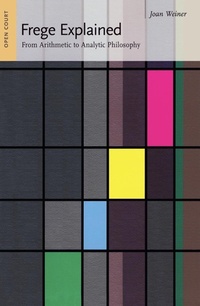
Frege Explained
Published on 15. April 2011
176 pages
978-0-8126-9752-0 (ISBN)
Description

What is the number one? How can we be sure that 2+2=4? These apparently ssimple questions have perplexed philosophers for thousands of years, but discussion of them was transformed by the German philosopher Gottlob Frege (1848-1925).
Frege (pronounced Fray-guh)believed that arithmetic and all mathematics are derived from logic, and to prove this he developed a completely new approach to logic and numbers. Joan Weiner presents a very clear outline of Frege's life and ideas, showing how his thinking evolved through successive books and articles.
More details
Other editions
Additional editions
Joan Weiner
Frege Explained
Book
01/2005
Open Court Publishing Co ,U.S.
€25.50
Shipment within 10-20 days
Person
Joan Weiner
Contributor residences (city, state or country if outside the US or Canada):Joan Weiner is Professor of Philosophy at Indiana University.
Contributor residences (city, state or country if outside the US or Canada):Joan Weiner is Professor of Philosophy at Indiana University.
Content
- Intro
- IDEAS EXPLAINEDT
- Title Page
- Dedication
- Preface
- A Note on References
- 1 - Frege's Life and Character
- 2 - The Project
- The Problem with the Empiricist Account of Arithmetic
- An Advance: Kantian Epistemology and the Synthetic A Priori
- The Problem with Kantian Epistemology: Generality and Sources of Knowledge
- What Logic Does
- Analyticity, Analysis of Concepts, and Aristotelian Logic
- Why Think the Truths of Arithmetic Are Analytic?
- Mathematical Induction and Generality
- 3 - Frege's New Logic
- Uniting the Two Logics
- A Logically Perfect Language
- Expressing Inferences in Begriffsschrift
- The Assertion Stroke and the Content Stroke
- The Condition Stroke and the Negation Stroke
- The Triple Bar
- Function-Argument Analysis
- The Problem with Subject-Predicate Analysis
- Quantifier Notation
- Mathematical Induction as a Logical Principle
- 4 - Defining the Numbers
- Three Fundamental Principles
- Numbers Are Not Properties of External Objects
- Numbers Are Not Subjective or Psychological
- Ascriptions of Number Are Assertions about Concepts
- Concepts Are Not Psychological
- Numbers Are Objects
- Numerical Identity as One-One Correspondence
- The Julius Caesar Problem
- Extensions of Concepts
- Defining Zero and One
- But Are Numbers Really Extensions of Concepts?
- Systematic Science
- 5 - Reconception of the Logic I: "Function and Concept"
- The New Characterization of Functions
- The New Characterization of Identity
- Concepts as Functions
- Extensions of Concepts as Value-Ranges
- Second-Level Functions
- Sentences and Names
- 6 - Reconception of the Logic II: "On Sense and Meaning" and "On Concept and Object"
- Sense, Meaning, and Value for Knowledge
- Why Do Sentences Designate Truth-Values?
- A Potential Problem
- Indirect Meaning as a Solution
- Sentences Do Not Always Designate Truth-Values
- Ambiguity and Presupposition
- The Concept Horse
- Why Can't Object-Expressions Be Predicates?
- Why Can't the Concept Horse Be the Meaning of a Predicate?
- The Trouble with Predicating Concepthood
- Elucidation in Natural Language
- 7 - Basic Laws, the Contradiction, and Its Aftermath
- Systematizing Mathematics and 'Piecemeal Definition'
- Hints and Primitive Terms
- The Contradiction
- 8 - "The Foundations of Geometry"
- The Parallels Axiom
- Interpretation and Primitive Truths
- Second-Level Concepts
- When Defining Comes to an End: Elucidation and Primitive Terms
- Proving the Independence of Axioms
- 9 - Logical Investigations
- Laws of Logic as Laws of Truth
- What Are Thoughts?
- The Third Realm
- Thoughts and the Topic of Logic
- Truth-functionally Complex Thoughts
- Frege's Final Thoughts
- 10 - Frege's Influence on Recent Philosophy
- The Use of Logic to Clarify Argument
- Neologicism
- Frege and the Linguistic Turn
- Frege and Ontological Commitments
- Frege and the Origin of Mathematical Logic
- Frege and the Workings of Language
- Suggestions for Further Reading
- Index
- Copyright Page
