

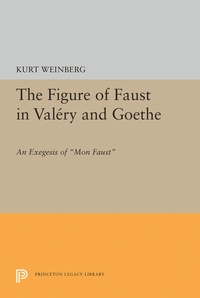
Figure of Faust in Valery and Goethe
An Exegesis of Mon Faust
1st Edition
Published on 16. June 2015
276 pages
978-1-4008-7168-1 (ISBN)
Description

This book interprets Mon Faust and explores the differences between Valéry's and Goethe's treatments of the Faust figure. The author shows by close analysis how Valéry opposes a Cartesian, anti-Pascalian Faust to Goethe's romantically flawed hero. The title of the project conceived by Valéry's Faust, The Mind's Body-part autobiography, part metaphysical treatise-embodies the Cartesian dilemma ironically illustrated by the Mon Faust fragments: the misfortunes of the thinking essence, the cogito, in its subjugation to the body.
The first three chapters examine the Cartesian character of a Faust engaged in superhuman but vain attempts to reconcile the intellect and the libido. A fourth chapter discusses the differences between Goethe's and Valéry's protagonists and as well between Goethe and his Faust. Throughout the book the author explores Valéry's linguistic experimentation, which, through charades, paranomasia, onomastics, and etymological puns, brings into full play the mystifying and mythologizing aspects of language. To resolve the stylistic problems associated with this fragmentary work the author adapts the tone of his exegesis to the diverse stylistic levels of Mon Faust. His analysis illuminates the Cartesian potential inherent in Valéry's protagonist.
Originally published in 1976.
The Princeton Legacy Library uses the latest print-on-demand technology to again make available previously out-of-print books from the distinguished backlist of Princeton University Press. These editions preserve the original texts of these important books while presenting them in durable paperback and hardcover editions. The goal of the Princeton Legacy Library is to vastly increase access to the rich scholarly heritage found in the thousands of books published by Princeton University Press since its founding in 1905.
The first three chapters examine the Cartesian character of a Faust engaged in superhuman but vain attempts to reconcile the intellect and the libido. A fourth chapter discusses the differences between Goethe's and Valéry's protagonists and as well between Goethe and his Faust. Throughout the book the author explores Valéry's linguistic experimentation, which, through charades, paranomasia, onomastics, and etymological puns, brings into full play the mystifying and mythologizing aspects of language. To resolve the stylistic problems associated with this fragmentary work the author adapts the tone of his exegesis to the diverse stylistic levels of Mon Faust. His analysis illuminates the Cartesian potential inherent in Valéry's protagonist.
Originally published in 1976.
The Princeton Legacy Library uses the latest print-on-demand technology to again make available previously out-of-print books from the distinguished backlist of Princeton University Press. These editions preserve the original texts of these important books while presenting them in durable paperback and hardcover editions. The goal of the Princeton Legacy Library is to vastly increase access to the rich scholarly heritage found in the thousands of books published by Princeton University Press since its founding in 1905.
More details
Other editions
Additional editions
Book
04/2016
Princeton University Press
€89.00
Article not available at the moment
Book
03/2015
Princeton University Press
€35.60
Shipment within 10-20 days
Book
08/1976
Princeton University Press
€43.40
Article exhausted; check different version
Person
Kurt Weinberg
Content
Frontmatter, pg. i
Contents, pg. vii
Preface. IN DEFENSE OF A PARTI PRIS, pg. ix
Abbreviations, pg. xv
One. LUST, LA DEMOISELLE DE CRISTAL, pg. 1
Two. LE SOLITAIRE, OU LES MALÉDICTIONS D'UNIVERS. ACT ONE, pg. 39
Three. LES FÉES, pg. 94
Four. POETIC SEMI-REALITIES: SELFPERCEPTION AND SELF-DECEPTION IN GOETHE'S AND VALÉRY'S FAUST, pg. 152
SELECTED BIBLIOGRAPHY, pg. 247
Index, pg. 251
Contents, pg. vii
Preface. IN DEFENSE OF A PARTI PRIS, pg. ix
Abbreviations, pg. xv
One. LUST, LA DEMOISELLE DE CRISTAL, pg. 1
Two. LE SOLITAIRE, OU LES MALÉDICTIONS D'UNIVERS. ACT ONE, pg. 39
Three. LES FÉES, pg. 94
Four. POETIC SEMI-REALITIES: SELFPERCEPTION AND SELF-DECEPTION IN GOETHE'S AND VALÉRY'S FAUST, pg. 152
SELECTED BIBLIOGRAPHY, pg. 247
Index, pg. 251
