

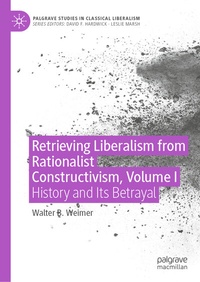
Retrieving Liberalism from Rationalist Constructivism, Volume I
History and Its Betrayal
1st Edition
Published on 7. May 2022
XXI, 316 pages
978-3-030-94858-0 (ISBN)
Description

This first volume, History and its Betrayal , traces the development of major themes of liberalism from the increase in human population beyond the limits of the face-to-face society of tribalism and small groups up until the present day. It shows that the principles underlying liberalism are the evolutionary development of social organizations that have resulted from the complexity of human action rather than any conscious design or purpose.
This book draws out the differences between the classical liberalism dependent upon spontaneous and tacit ordering as a result of evolution, and the explicit or conscious or directed version of progressivism. It shows that the most important recent developments in the philosophy of rationality and the methodology of scientific research, as well as in evolutionary epistemology and the philosophy of biology, actually stem from the theories of complex social organization of the moralists such as Hume, Ferguson, and Smith. The book shows clearly that classical liberalism was never refuted-indeed, no attempt to do so has been offered-it has simply been ignored in favour of programs which sound beneficial and soothing but which cannot be instituted without returning to tribalism.More details
Series
Language
English
Place of publication
Cham
Switzerland
Publishing group
Springer International Publishing
Target group
Professional and scholarly
Product notice
Reflowable
Illustrations
XXI, 316 p. 1 illus.
File size
2,97 MB
ISBN-13
978-3-030-94858-0 (9783030948580)
DOI
10.1007/978-3-030-94858-0
Schweitzer Classification
Other editions
Additional editions
Walter B. Weimer
Retrieving Liberalism from Rationalist Constructivism, Volume I
History and Its Betrayal
Book
05/2022
Palgrave Macmillan
€149.79
Shipment within 7-9 days
Person
Walter B. Weimer
is Emeritus Professor of Psychology at the Pennsylvania State University. He was instrumental in bringing Hayek's philosophical psychology both to a psychology audience and to an economics audience.
Content
Chapter 1: Introduction.- Chapter 2: The history of the conflict: from the Greeks to the Middle Ages.- Chapter 3: The history of the conflict: Descartes, the Enlightenment, and positivism.- Chapter 4: History rewritten: the 20th century constructivist interpretation of classic liberalism.- Chapter 5: The new enlightenment: Russell on organization and socialism.- Chapter 6: The new enlightenment: Chomsky on Cartesian linguistics and anarchist socialism.- Chapter 7: The new enlightenment: Skinner and the search for system.- Chapter 8: The new enlightenment: The abandoned road.- Chapter 9: Rationalist constructivism in protest song rhetoric.- Chapter 10: Retrieving history: liberalism and the study of spontaneous social orders.- Chapter 11: Retrieving history: the legacy of David Hume.- Chapter 12: Toward a rational theory of tradition: order, knowledge, tradition.- Chapter 13: Toward a rational theory oftradition: methodological and conceptual issues.
