

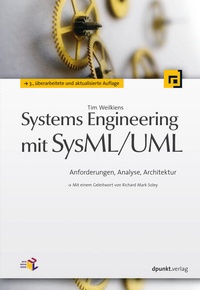
Systems Engineering mit SysML/UML
Anforderungen, Analyse, Architektur. Mit einem Geleitwort von Richard Mark Soley
3rd Edition
Published on 3. September 2014
512 pages
978-3-86491-543-7 (ISBN)
Available for download
Description

Systeme bestehen aus Bausteinen unterschiedlicher Disziplinen wie Hardware, Software oder Mechanik. Der Fortschritt ermöglicht immer komplexere Systeme, der Markt fordert immer schnellere Entwicklungszeiten, und die Globalisierung führt zu international verteilten Entwicklungsteams. Das Systems Engineering mit seiner ganzheitlichen, disziplinenübergreifenden Sichtweise hat in diesem Umfeld eine herausragende Bedeutung.
Das Buch zeigt anhand des pragmatischen Modellierungsvorgehens SYSMOD und eines durchgängigen Fallbeispiels die Methoden der Systemmodellierung mit der Systems Modeling Language (OMG SysML (TM)).
Den Sprachen SysML und UML (TM) (auf der SysML basiert) ist jeweils ein eigenes Kapitel gewidmet, das alle Sprachelemente behandelt. Ein weiteres Kapitel beschreibt die Spracherweiterung der SysML (Profil) für SYSMOD. Im Anhang befinden sich eine Übersetzung der englischen Begriffe und ein umfangreiches Glossar.
Die 3. Auflage basiert auf der aktuellen SysML-Version 1.4, die einige Neuerungen mitbringt. Ebenso enthält sie auch die Elemente der Vorgängerversion 1.3, die es zum Zeitpunkt der 2. Auflage noch nicht gegeben hat. SYSMOD adressiert jetzt explizit die Architekturtypen: Basisarchitektur, logische Architektur, physische Produktarchitektur und funktionale Architektur. Weiter wurde ein neues Kapitel zur Vorbereitung auf die OCSMP-(OMG Certified Systems Modeling Professional-)Zertifizierung der OMG aufgenommen.
"Zusammen mit der weltweiten Systems-Engineering-Zertifizierung (inklusive SysML) ist jetzt ein guter Zeitpunkt, um geradewegs zu starten, die SysML zu lernen und anzuwenden. Dieses Buch ist eine fantastische Unterstützung für dieses Vorhaben." (Aus dem Geleitwort von Richard Mark Soley, OMG)
More details
Other editions
Additional editions
Tim Weilkiens
Systems Engineering mit SysML/UML
Anforderungen, Analyse, Architektur (Mit einem Geleitwort von Richard Mark Soley)
Book
06/2014
3rd Edition
dpunkt
€42.90
No shipping information available
Person
Tim Weilkiens ist Bereichsleiter Systems-Engineering bei der Beratungsfirma oose Innovative Informatik GmbH. Seine Schwerpunkte sind die Modellierung und Entwicklungsprozesse. Er ist für oose GmbH Repräsentant bei der OMG, arbeitet dort u. a. aktiv an der UML-Spezifikation und ist Koautor der SysML-Spezifikation. Junior Ben hat ihn tatkräftig beim Schreiben der 2. Auflage des Buches unterstützt.
Sie erreichen beide unter twe@system-modellierung.de.
Content
- Cover
- Titel
- Impressum
- Vorwort zur 3. Auflage
- Vorwort zur 2. Auflage
- Geleitwort von Richard Mark Soley
- Inhaltsverzeichnis
- 1 Einleitung
- 1.1 Vorweg
- 1.1.1 Passt das Buch zu mir?
- 1.1.2 Was bietet mir das Buch?
- 1.1.3 Wie ist das Buch entstanden? Und danke!
- 1.1.4 Wie lese ich das Buch?
- 1.1.5 Wohin geht der Weg?
- 1.2 Systems Engineering
- 1.2.1 Was ist Systems Engineering?
- 1.2.2 Systems-Engineering-Prozesse
- Anforderungsmodell erstellen (State the problem)
- Alternative Lösungen prüfen (Investigate alternatives)
- Systemmodell erstellen (Model system)
- System einbetten (Integrate)
- System implementieren (Launch the system)
- Technische Messwerte prüfen (Assess performance)
- Projektergebnisse überprüfen (Re-evaluate)
- 1.2.3 Der Systems Engineer
- 1.2.4 Historie des Systems Engineering
- 1.2.5 International Council on Systems Engineering
- 1.2.6 Systems Engineering in Deutschland
- 1.3 Modellbasiertes Systems Engineering (MBSE)
- 1.3.1 Die Sprachen UML und OMG SysML
- 1.3.2 BPMN
- 1.3.3 MATLAB/Simulink
- 1.3.4 Modelica
- 1.3.5 Specification and Description Language (SDL)
- 1.4 Randnotizen
- 1.4.1 AUTOSAR
- 1.4.2 Capability Maturity Model Integration (CMMI)
- 1.4.3 Industrie 4.0
- 1.4.4 ISO/IEC 15288
- 1.4.5 Product Lifecycle Management (PLM)
- 1.4.6 Requirement Interchange Format (ReqIF)
- 1.4.7 STEP
- 1.4.8 V-Modell® XT
- 2 Pragmatischer Modellierungsprozess SYSMOD
- 2.1 Fallbeispiel
- 2.2 Die Systemidee
- 2.3 Systemidee und Systemziele beschreiben
- 2.4 Basisarchitektur festlegen
- 2.5 Anforderungen ermitteln
- 2.5.1 Stakeholder identifizieren
- 2.5.2 Anforderungen aufnehmen
- 2.6 Systemkontext modellieren
- 2.6.1 Systemakteure identifizieren
- 2.6.2 System/Akteur-Objektfluss modellieren
- 2.6.3 Systeminteraktionspunkte identifizieren
- 2.7 Anwendungsfälle modellieren
- 2.7.1 Anwendungsfälle identifizieren
- 2.7.2 Anwendungsfälle essenziell beschreiben
- 2.7.3 Systemprozesse beschreiben
- 2.7.4 Anwendungsfälle redundanzfrei modellieren
- 2.7.5 Anwendungsfallabläufe modellieren
- 2.7.6 Objektfluss modellieren
- 2.8 Fachwissen modellieren
- 2.9 Logische Architektur modellieren
- 2.9.1 System/Akteur-Interaktion modellieren
- 2.9.2 Systemschnittstellen ableiten
- 2.9.3 Systemstrukturen modellieren
- 2.9.4 Zustandsmodell erstellen
- 2.9.5 Physische Produktarchitektur modellieren
- 2.10 Randnotizen
- 2.10.1 Modellmanagement
- 2.10.2 Variantenmanagement
- 2.10.3 SYSMOD-Zickzackmuster
- 2.10.4 Funktionale Architektur
- 2.10.5 Agiles Systems Engineering
- 2.10.6 Datenaustauschformate
- 2.10.7 SYSMOD-Intensitätsmodell
- 2.10.8 Modellsimulation
- 2.10.9 Testen
- 2.10.10 System of Systems (SoS)
- 2.10.11 Modellierungsmuster
- Umgehungsmuster
- Erfolgsmuster
- Abbruchsmuster
- Indirekter Objektfluss
- 2.10.12 Tod des Akteurs! Lang lebe der Akteur!
- 3 UML - Unified Modeling Language
- 3.1 Historie
- 3.2 Aufbau und Konzepte
- 3.3 Das Klassendiagramm
- 3.3.1 Classifier
- Semantik, Notation und Beispiel
- 3.3.2 Klasse
- Semantik, Notation und Beispiel
- 3.3.3 Eigenschaft
- Semantik, Notation und Beispiel
- 3.3.4 Operation
- Semantik, Notation und Beispiele
- 3.3.5 Assoziation
- Semantik, Notation und Beispiele
- Blick über den Tellerrand
- 3.3.6 Aggregation und Komposition
- Semantik, Notation und Beispiele
- 3.3.7 Objektspezifikation
- Semantik, Notation und Beispiele
- 3.3.8 Abhängigkeitsbeziehung
- Semantik, Notation und Beispiele
- 3.3.9 Abstraktionsbeziehung
- Semantik, Notation und Beispiele
- 3.3.10 Generalisierung
- Semantik, Notation und Beispiele
- Blick über den Tellerrand
- 3.3.11 Signal
- Semantik, Notation und Beispiele
- 3.3.12 Datentypen
- Semantik, Notation und Beispiel
- 3.3.13 Assoziationsklasse
- Semantik, Notation und Beispiele
- 3.4 Das Kompositionsstrukturdiagramm
- 3.4.1 Eigenschaft
- 3.4.2 Konnektor
- Semantik, Notation und Beispiel
- 3.4.3 Port
- Semantik, Notation und Beispiel
- 3.5 Das Anwendungsfalldiagramm
- 3.5.1 Anwendungsfall
- Notation, Semantik und Beispiele
- Blick über den Tellerrand
- 3.5.2 Akteur
- Notation, Semantik und Beispiele
- Blick über den Tellerrand
- 3.5.3 Enthältbeziehung
- Semantik, Notation und Beispiele
- Blick über den Tellerrand
- 3.5.4 Erweiterungsbeziehung
- Semantik, Notation und Beispiele
- 3.6 Das Aktivitätsdiagramm
- 3.6.1 Aktivität
- Semantik, Notation und Beispiele
- 3.6.2 Aktion und Pin
- Semantik, Notation und Beispiele
- Blick über den Tellerrand
- 3.6.3 Aktivitätskante
- Semantik, Notation und Beispiele
- 3.6.4 Aktivitätspartition
- Semantik, Notation und Beispiele
- 3.6.5 Parametermenge
- Semantik, Notation und Beispiele
- 3.6.6 Entscheidung und Zusammenführung
- Semantik, Notation und Beispiele
- 3.6.7 Mengenverarbeitung
- Semantik, Notation und Beispiele
- 3.6.8 Splitting und Synchronisation
- Semantik, Notation und Beispiele
- 3.6.9 Start- und Endknoten
- Semantik, Notation und Beispiele
- 3.6.10 Unterbrechbarer Aktivitätsbereich
- Semantik, Notation und Beispiele
- 3.6.11 Zentralpuffer und Datenspeicher
- Semantik, Notation und Beispiele
- 3.7 Das Zustandsdiagramm
- 3.7.1 Zustandsautomat
- Notation, Semantik und Beispiele
- 3.7.2 Zustand
- Semantik, Notation und Beispiele
- 3.7.3 Transition
- Semantik, Notation und Beispiele
- 3.7.4 Auslöser und Ereignis
- Semantik, Notation und Beispiele
- 3.7.5 Start- und Endzustand
- Semantik, Notation und Beispiele
- 3.7.6 Pseudozustand
- Semantik, Notation und Beispiele
- 3.8 Die Interaktionsdiagramme
- 3.8.1 Interaktion
- Semantik, Notation und Beispiele
- Blick über den Tellerrand
- 3.8.2 Lebenslinie
- Semantik, Notation und Beispiele
- 3.8.3 Nachricht
- Semantik, Notation und Beispiele
- 3.8.4 Kombiniertes Fragment
- Semantik, Notation und Beispiele
- 3.8.5 Interaktionsreferenz
- Semantik, Notation und Beispiele
- 3.8.6 Zustandsinvariante
- Semantik, Notation und Beispiele
- 3.8.7 Zeitliche Zusicherungen
- 3.9 Das Paketdiagramm
- 3.9.1 Paket
- Semantik, Notation und Beispiele
- 3.9.2 Importbeziehung
- Semantik, Notation und Beispiele
- 3.10 Sonstige Modellelemente
- 3.10.1 Diagrammrahmen
- 3.10.2 Erweiterungsmechanismus Stereotyp
- Semantik, Notation und Beispiel
- 3.10.3 Informationsfluss
- Semantik, Notation und Beispiele
- 3.10.4 Kommentar
- Semantik, Notation und Beispiele
- 3.10.5 Modell
- Semantik, Notation und Beispiele
- 3.10.6 Zusicherung
- Semantik, Notation und Beispiele
- 4 SysML - Systems Modeling Language
- 4.1 Historie
- 4.2 Aufbau und Konzepte
- 4.3 Das Anforderungsdiagramm
- 4.3.1 Anforderung
- Semantik, Notation und Beispiel
- Blick über den Tellerrand
- 4.3.2 Ableitungsbeziehung
- Semantik, Notation und Beispiel
- 4.3.3 Enthältbeziehung
- Semantik, Notation und Beispiel
- 4.3.4 Erfüllungsbeziehung
- Semantik, Notation und Beispiel
- 4.3.5 Kopiebeziehung
- Semantik, Notation und Beispiel
- 4.3.6 Prüfbeziehung
- Semantik, Notation und Beispiel
- 4.3.7 Verfeinerungsbeziehung
- Semantik, Notation und Beispiel
- 4.3.8 Verfolgungsbeziehung
- Semantik, Notation und Beispiel
- 4.3.9 Testfall
- Semantik, Notation und Beispiel
- 4.3.10 Tabellennotation
- 4.4 Die Zuteilung
- 4.4.1 Zuteilungsbeziehung
- Semantik, Notation und Beispiel
- 4.4.2 Zuteilungspartition
- Semantik, Notation und Beispiel
- 4.4.3 Tabellennotation
- 4.5 Die Blockdiagramme
- 4.5.1 Systembaustein
- Semantik, Notation und Beispiel
- 4.5.2 Port
- Semantik, Notation und Beispiel
- 4.5.3 Assoziationsbaustein
- Semantik, Notation und Beispiel
- 4.5.4 Bindungskonnektor
- Semantik, Notation und Beispiel
- 4.5.5 Einheit und Basisgröße
- Semantik, Notation und Beispiel
- 4.5.6 Einschränkende Referenz und Pfadendemultiplizität
- Semantik, Notation und Beispiel
- 4.5.7 Objektfluss
- Semantik, Notation und Beispiel
- 4.5.8 Schnittstellenbaustein
- Semantik, Notation und Beispiel
- 4.5.9 Werteverteilung
- Semantik, Notation und Beispiel
- 4.5.10 Wertetyp
- Semantik, Notation und Beispiel
- 4.6 Das Zusicherungsdiagramm
- 4.6.1 Zusicherungsbaustein
- Semantik, Notation und Beispiel
- 4.7 Das Anwendungsfalldiagramm
- 4.8 Das Aktivitätsdiagramm
- 4.8.1 Aktivitätsbaum
- 4.8.2 Kontrolloperator
- Notation, Semantik und Beispiele
- 4.8.3 Rate
- Notation, Semantik und Beispiele
- 4.8.4 Spezielle Objektknoteneigenschaften
- Notation, Semantik und Beispiele
- 4.8.5 Wahrscheinlichkeit
- Notation, Semantik und Beispiele
- 4.8.6 Zeitliche Zusicherungen
- 4.9 Das Zustandsdiagramm
- 4.10 Die Interaktionsdiagramme
- 4.11 Allgemeine Modellierungselemente
- 4.11.1 Begründung
- Semantik, Notation und Beispiel
- 4.11.2 Diagrammrahmen
- 4.11.3 Gruppe
- Semantik, Notation und Beispiel
- 4.11.4 Modellsicht und Standpunkt
- Semantik, Notation und Beispiel
- 4.11.5 Problem
- Semantik, Notation und Beispiel
- 4.11.6 Stakeholder
- Semantik, Notation und Beispiel
- 5 Systems-Engineering-Profil SYSMOD
- 5.1 Akteurskategorien
- Semantik, Notation und Beispiel
- 5.2 Aktivitäten
- Semantik, Notation und Beispiel
- 5.3 Erweiterte Anforderung
- Semantik, Notation und Beispiel
- 5.4 Spezielle Anwendungsfälle
- Semantik, Notation und Beispiel
- 5.5 Benutzerschnittstelle
- Semantik, Notation und Beispiel
- 5.6 Disziplinenspezifische Elemente
- 5.7 Gewichtete Beziehungen
- Semantik, Notation und Beispiel
- 5.8 Erweiterter Stakeholder
- Semantik, Notation und Beispiel
- 5.9 System und Subsystem
- Semantik, Notation und Beispiel
- 5.10 Spezielle Systembausteine
- Semantik, Notation und Beispiel
- 5.11 System- und Zusicherungskontextelement
- Semantik, Notation und Beispiel
- 5.12 Systemprozess
- Semantik, Notation und Beispiel
- 5.13 Varianten
- Semantik, Notation und Beispiel
- 5.14 Ziel
- Semantik, Notation und Beispiel
- 6 OMG Certified Systems Modeling Professional (OCSMP)
- 6.1 Sinn und Unsinn von Zertifizierungen
- 6.2 Der Zertifizierungsprozess
- 6.3 Das OCSMP-Zertifizierungsprogramm
- 6.4 Andere Zertifizierungsprogramme
- 6.5 OCSMP Model User
- 6.5.1 OCSMP-Basiselemente der SysML
- 6.5.2 Coverage-Map OCSMP Model User
- 6.5.3 Referenzen
- 6.5.4 Beispielfragen
- 6.6 OCSMP Model Builder Fundamental
- 6.6.1 Coverage-Map OCSMP Model Builder Fundamental
- 6.6.2 Referenzen
- 6.7 OCSMP Model Builder Intermediate
- 6.7.1 Coverage-Map OCSMP Model Builder Intermediate
- 6.7.2 Referenzen
- 6.8 OCSMP Model Builder Advanced
- 6.8.1 Coverage-Map OCSMP Model Builder Advanced
- 6.8.2 Referenzen
- A Anhang
- A.1 Glossar
- A.2 SysML auf Deutsch
- A.3 Veraltete Konzepte der SysML
- A.3.1 Standardport und Objektflussport
- Semantik, Notation und Beispiel
- A.3.2 Modellsicht und Standpunkt
- Semantik, Notation und Beispiel
- A.3.3 Einheit
- Semantik, Notation und Beispiel
- A.4 Lösungen
- Literaturverzeichnis
- Index
- Fußnoten
- Geleitwort von Richard Mark Soley
- 1 Einleitung
- 2 Pragmatischer Modellierungsprozess SYSMOD
- 3 UML - Unified Modeling Language
- 4 SysML - Systems Modeling Language
- 5 Systems-Engineering-Profil SYSMOD
- 6 OMG Certified Systems Modeling Professional (OCSMP)
