

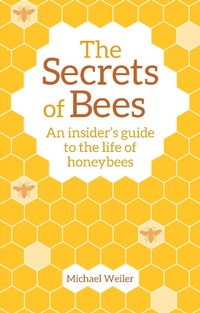
The Secrets of Bees
An Insider's Guide to the Life of Honeybees
2nd Edition
Published on 21. February 2019
160 pages
978-1-78250-583-9 (ISBN)
Description

Bees make honey; we all know that. But what happens between the bee buzzing around our backyard, and the sticky knife in the jar, is a mystery to most of us. How many bee-hours does it take to make just one jar of honey? What do the honeybees' waggling dances really mean? Why do bees swarm? What is a 'house bee'?
From exploring their life cycle and development, to revealing their societies and behaviour, expert biodynamic beekeeper Michael Weiler answers these questions and many more.
Combining poetic observations with scientific detail, The Secrets of Bees uncovers the incredible world of these remarkable insects.
Bees make honey; we all know that. But what happens between the bee buzzing around our backyard, and the sticky knife in the jar, is a mystery to most of us. How many bee-hours does it take to make just one jar of honey? What do the honeybees' waggling dances really mean? Why do bees swarm? What is a 'house bee'?
From exploring their life cycle and development, to revealing their societies and behaviour, expert biodynamic beekeeper Michael Weiler answers these questions and many more.
Combining poetic observations with scientific detail, The Secrets of Bees uncovers the incredible world of these remarkable insects.
From exploring their life cycle and development, to revealing their societies and behaviour, expert biodynamic beekeeper Michael Weiler answers these questions and many more.
Combining poetic observations with scientific detail, The Secrets of Bees uncovers the incredible world of these remarkable insects.
Bees make honey; we all know that. But what happens between the bee buzzing around our backyard, and the sticky knife in the jar, is a mystery to most of us. How many bee-hours does it take to make just one jar of honey? What do the honeybees' waggling dances really mean? Why do bees swarm? What is a 'house bee'?
From exploring their life cycle and development, to revealing their societies and behaviour, expert biodynamic beekeeper Michael Weiler answers these questions and many more.
Combining poetic observations with scientific detail, The Secrets of Bees uncovers the incredible world of these remarkable insects.
Reviews / Votes
'The author is not only an experienced beekeeper who looks after fifty colonies but also a committed teacher who possesses a great passion for bees and a deep understanding of their behaviour and nature...The text conveys the reader smoothly through this refreshing insight into the bees' world, the photographs, various biological illustrations, line drawings and tables are all designed to enhance the learning process from this book. On a literary note, there are also two delightful poems...to add to the reader's pleasure...Good value for money.'--Bee Keeping
'Michael Weiler is an experienced beekeeper who looks after fifty colonies. He is a teacher with a great passion for bees and deep understanding of their nature. I had already begun to apply organic principles within my own beekeeping and I am now convinced that the biodynamic route is the one I shall take.'
-- Philip Chandler of the Wholesome Food Association, in Star and Furrow, after participating in a day-course on 'The Nature of Bees and Biodynamic Beekeeping' with Michael Weiler organised by the BDAA
'Informed by a Goethean perspective, this fascinating book about the life cycle of a bee tells the reader all they need to know about the subject.'
--Scientific and Medical Network Review
'This delightful and detailed little book takes us on a wonderful journey through the beekeeping year...The outline of the Demeter Beekeeping Guidelines at the back of the book will be especially useful to beekeepers considering how they can best work with their bees.'
-- Sue Peat, The Anthroposophical Society in Great Britain Newsletter
'If you're an experienced bee-keeper wishing to know your bees better, and more so if you're one that likes to share the art of bee keeping with fellow human beings, then this little book shows how!! The writer, Co-director of the Demeter association in Germany, takes us by the hand on a wonderful journey through the beekeeping year.'
--Star and Furrow
'From poetic opening lines to a royal jelly finale this wonderful book has been written from the heart-mind of a man who truly loves his bees. Readers may feel themselves transported to stand beside the beekeeper, accompanying him as he tends to his hive. Which is of course the book's defining strength. Well illustrated with excellent photographs and clear diagrams.'
-- Harvests Magazine
'The author is not only an experienced beekeeper who looks after fifty colonies but also a committed teacher who possesses a great passion for bees and a deep understanding of their behaviour and nature...The text conveys the reader smoothly through this refreshing insight into the bees' world, the photographs, various biological illustrations, line drawings and tables are all designed to enhance the learning process from this book. On a literary note, there are also two delightful poems...to add to the reader's pleasure...Good value for money.'
--Bee Keeping
'Michael Weiler is an experienced beekeeper who looks after fifty colonies. He is a teacher with a great passion for bees and deep understanding of their nature. I had already begun to apply organic principles within my own beekeeping and I am now convinced that the biodynamic route is the one I shall take.'
-- Philip Chandler of the Wholesome Food Association, in Star and Furrow, after participating in a day-course on 'The Nature of Bees and Biodynamic Beekeeping' with Michael Weiler organised by the BDAA
'Informed by a Goethean perspective, this fascinating book about the life cycle of a bee tells the reader all they need to know about the subject.'
--Scientific and Medical Network Review
'This delightful and detailed little book takes us on a wonderful journey through the beekeeping year...The outline of the Demeter Beekeeping Guidelines at the back of the book will be especially useful to beekeepers considering how they can best work with their bees.'
-- Sue Peat, The Anthroposophical Society in Great Britain Newsletter
'If you're an experienced bee-keeper wishing to know your bees better, and more so if you're one that likes to share the art of bee keeping with fellow human beings, then this little book shows how!! The writer, Co-director of the Demeter association in Germany, takes us by the hand on a wonderful journey through the beekeeping year.'
--Star and Furrow
'From poetic opening lines to a royal jelly finale this wonderful book has been written from the heart-mind of a man who truly loves his bees. Readers may feel themselves transported to stand beside the beekeeper, accompanying him as he tends to his hive. Which is of course the book's defining strength. Well illustrated with excellent photographs and clear diagrams.'
-- Harvests Magazine
More details
Edition
2nd Revised edition
Language
English
Place of publication
Edinburgh
United Kingdom
Edition type
Revised edition
Product notice
Reflowable
Illustrations
60 b/w illustrations
ISBN-13
978-1-78250-583-9 (9781782505839)
Copyright in bibliographic data and cover images is held by Nielsen Book Services Limited or by the publishers or by their respective licensors: all rights reserved.
Schweitzer Classification
Other editions
Additional editions
Book
02/2019
2nd Edition
Floris Books
€13.00
Shipment within 3-4 weeks
Persons
Michael Weiler has been a beekeeper for twenty-five years and runs courses and conferences on ecological beekeeping in Germany and the UK. David Heaf is a translator and biodynamic expert. He lives in Wales, UK.
Michael Weiler has been a beekeeper for twenty-five years and runs courses and conferences on ecological beekeeping in Germany and the UK. David Heaf is a translator and biodynamic expert. He lives in Wales, UK.
Michael Weiler has been a beekeeper for twenty-five years and runs courses and conferences on ecological beekeeping in Germany and the UK. David Heaf is a translator and biodynamic expert. He lives in Wales, UK.
Content
- Intro
- Title Page
- Contents
- Foreword by Horst Kornberger
- I. OBSERVING BEES
- 1. Foraging
- 2. In-Flight Observations
- The orientation flight of young bees
- The flight of the drones
- A hive swarms
- The flight of the Queen
- Drone congregation areas
- 3. The Swarm
- The swarm cluster
- Catching a swarm
- Hiving the bees in a new home
- II. INSIDE THE HIVE
- 4. Building Comb
- Shaping space
- Beehives
- 5. Bee Development
- Egg laying
- Larvae
- Pupation
- Drone brood
- Hatching bees
- 6. Bee Life
- House bees and flying bees
- Development from the inside.
- .to the outside
- Metamorphosis of the glands
- Interpenetration
- 7. Summer Impressions
- Bee dances
- Drone developments
- 8. Queen Development
- III. WINTER IS COMING
- 9. Maturity
- The drones depart
- Wintering
- 10. Winter Inspections
- Reading the debris
- Losing a queen
- 11. Varroa Destructor
- 12. Bee Christmas
- IV. BUILD-UP
- 13. Awakening
- Cleansing flight
- 14. Surviving Spring
- Dangers
- 15. From Winter Bees to Summer Bees
- How a beekeeper can help
- 16. Preparing for the Honey Harvest
- 17. Summer Inspections
- Swarm mood
- Swarm control
- V. GIFTS FROM THE BEES
- 18. Honey
- Gathering nectar
- How bees turn nectar into honey
- 19. Pollen, Bee Bread and Royal Jelly
- The value of pollen for bees
- Pollen and people
- Royal jelly
- 20. The Power of Honey for Bees and People
- Summer honey for bees
- Winter honey for bees
- Rudolf Steiner on honey
- Harvesting honey
- Storing honey
- What should honey really cost?
- Appendix: Demeter Beekeeping
- About the author
- Acknowledgements
- End Notes and Picture Credits
- Bibliography and Further Reading
- Useful Organisations
- Copyright
