

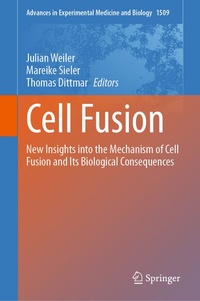
Cell Fusion
Description

This book sheds new light on the complex phenomenon of cell fusion, a vital process in various physiological and pathophysiological contexts, including fertilization, placentation, myogenesis, and cancer. While the merging of cells may seem straightforward, it involves a sophisticated interplay of biological mechanisms that are not yet fully understood.
In this new edition, readers will discover insights into the interplay of lipids and peptides in membrane fusion, the role of cell fusion in fertilization and placentation, and the implications of fusion deficiencies in pregnancy diseases. The book also examines the transformation of non-fusogenic cells, such as macrophages and cancer cells, under extrinsic conditions, and the potential link between cell fusion and cancer malignancy through genetic/epigenetic instability. Contributions from leading experts provide a thorough analysis of these topics, inviting readers to explore critical questions about the role of cell fusion in physiology and pathophysiology.
This volume is an essential resource for researchers, scholars, and students in the fields of cell biology, oncology, and virology, offering valuable insights into the mechanisms and implications of cell fusion.
More details
Other editions
Additional editions
Persons
Dr. rer. nat. Julian Weiler studied biology at Heinrich Heine University in Düsseldorf, where he graduated with a focus on immunology and wound healing. For his PhD thesis he joined the Institute of Immunology at Witten/Herdecke University, where his research focused on the investigation of fusion-relevant factors and signaling pathways that are upregulated under inflammatory conditions, such as those found in the tumor microenvironment. Since 2020, he has been working as a postdoctoral researcher, deciphering the relationship between aberrant cell fusion and tumor development.
Dr. rer. nat. Mareike Sieler studied Chemical Biology at the Technical University of Dortmund and went to the institute of Immunology at Witten/Herdecke University for her Dr. rer. nat thesis in 2019. Her research focused primarily on characterizing cell fusion in breast cancer cells and the role of fusogenic proteins. After completing her doctorate in 2023, she spent another two years as a postdoctoral researcher investigating the mechanisms of cell fusion, but with a focus on the role of the cell membrane and lipid-distributing proteins.
Prof. Dr. rer. nat. Thomas Dittmar studied chemistry at the Ruhr-University at Bochum and in 1995 he went to the Institute of Immunology at Witten/Herdecke University for his Dr. rer. nat. thesis, which he received in 1999. In 2003 he became a Junior Professor of Tumor Biology and since 2010 he is a full professor at Witten/Herdecke University. His main focus of research is breast cancer with a special emphasis on the role of cell-cell fusion events in (breast) cancer progression.
Content
A Brief Introduction into the Biological Phenomenon of Cell-Cell Fusion.- The interplay of lipids and peptides in Membrane Merger.- Membrane Merger Dynamics in Exocytosis and Endocytosis.- Membrane Fusions During Mammalian Fertilization.- Biophysical Considerations in Cell Fusion.- Trophoblast Fusion Deficiency in Placenta-Related Pregnancy Disorders.- Pathogen-Mediated Cell Fusion and Actin Cytoskeleton.- Cell Fusion in Reprogramming and Regeneration.- How Do Cancer Cells Fuse and Why?.- Polyploidy and Senescence of Cancer Cells - Impact of Cell Fusion.- Cell Fusion-Mediated Induction of Polyploidy, Aneuploidy and Genomic Instability in Cancer Cells.- Genomic Reshuffling After Cell Fusion - Catalyst for Cancer Evolution and Progression.- Cell-cell Fusion as a Mechanism of Immune Evasion and Metastatic Progression.- Implications of Heterotypic Cell Fusion in Cancer.- Investigating the Consequences of Aneuploidy in Cancer and Normal Tissue.- Nano- and Microtubes - Tiny Fusion Events, but Not Overall Plasma Membrane Merger for Exchanging Intracellular Components.- Mathematical Modeling of Cell-cell Fusion Assays to Characterize Virus-Mediated Cell Fusion.
