

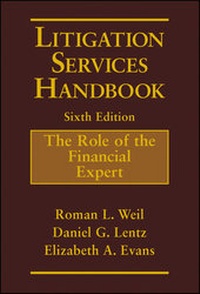
Litigation Services Handbook
Description

More details
Other editions
Additional editions
Persons
Roman L. Weil (Chicago, IL), PhD, CPA, CMA is V. Duane Rath Professor of Accounting at the University of Chicago.?Weil is director of the Chicago/Stanford/Tuck Directors' Consortium, which he co-founded. Weil has also designed and implemented continuing education programs for partners at the accounting firms of Andersen and PricewaterhouseCoopers as well as for employees at Goldman Sachs, Montgomery Wards, Merck, and William Blair and for business executives in Great Britain, Singapore, and Hong Kong. He also has been a visiting professor at Harvard Law School, Princeton Economics Department, and NYU Stern School.
Daniel G. Lentz (Washington, DC) is Partner and National Leader of Ernst & Young's Dispute Services team within E&Y Fraud Investigation and Dispute Services practice. He is co author of The Business Interruption Book: Coverage, Claims and Recovery. Lentz has worked with numerous companies in developing their business interruption claims related to the 9/11 terrorist attacks in New York, as well as losses sustained in natural disasters. His experience, across all industries, encompasses business interruption and lost profits claims, product liability, merger and acquisition disputes, reinsurance disputes, fraud investigations, class action lawsuits.
Content
Preface xi
Part I: The Litigation Environment
1. A Dispute Resolution Primer 1.1 Elizabeth A. Evans , Daniel G. Lentz, Roman L. Weil
2. Serving as a Financial Expert in Litigation 2.1 Elizabeth A. Evans, Roman L. Weil
3. Testimony Considerations 3.1
Part A: Daubert Criteria Douglas E. Branch, Saleema K. Damji
Part B: The Art of Testimony Daniel G. Lentz
Part II: Developing A Damages Analysis
4. Damages Theories and Causation Issues 4.1 Elizabeth A. Evans, Phil J. Innes, Daniel G. Lentz
5. Ex Ante versus Ex Post Damages Calculations 5.1 Elizabeth A. Evans, Roman L. Weil
6. Use of Statistical Sampling in Litigation 6.1 Mark A. Gustafson, Peter P. Simon
7. Survey Research in Litigation 7.1 Paul J. Lavrakas, Jeffery A. Stec
8. Statistical Estimation of Incremental Cost from Accounting Data 8.1 M. Laurentius Marais, William E. Wecker, Roman L. Weil
9. Econometric Analysis 9.1 Anna C. King, Mohan P. Rao, Christian D. Tregillis
10. Estimating the Cost of Capital 10.1 R. Jeffrey Malinak, Justin McLean
11. Business Valuation 11.1 Joseph J. Galanti
12. Business Interruption Insurance Claims 12.1 Daniel G. Lentz, Robert M. Reeves
13. Lost Earnings of Persons 13.1 Daniel G. Lentz, Elizabeth B. Sandza
14. Expert Analysis of Class Certifi cation Issues 14.1 Christopher Chorba, Mark A. Gustafson, D. Lee Heavner, Peter P. Simon
Part III: Litigation Tools And Techniques
15. Data Management 15.1 Karen M. Cheek, Erik W. Gibson, Cathy Hasenzahl, Matthew P. Jennings, Russell L. Miller, Vincent M. Walden
Part IV: Ancillary Issues In Damages Matters
16. Prejudgment Interest 16.1 Jeffrey M. Colón, Michael S. Knoll
17. Punitive Damages 17.1 Peter A. Bicks, Rachel M. McKenzie, Shasha Y. Zou
18. Tax Treatment of Damages Awards 18.1 Jill Kennedy, Tim Sherman
Part V: Civil Litigation
Intellectual Property
19. Economic Analysis of Nonpatent Intellectual Property Rights and Damages Measures 19.1 Elizabeth A. Evans, Peter P. Simon
20. Patent Infringement Damages 20.1 Landan J. Ansell, John W. Holzwarth, Vincent E. O'Brien, William B. Scally
21. Role of Financial Experts in ITC Section 337 Investigations 21.1 Ryan N. Herrington, Brendan P. Rogers
22. Calculating Infringer's Profi ts in Trademark, Copyright, and Design Patent Cases 22.1 Christopher P. Gerardi, Dawn R. Hall, Juli Saitz
23. Royalty Audits and Contract Compliance Investigations 23.1 Ben W. Sheppard
Ownership and Business Failure
24. Merger and Acquisition Transaction Disputes 24.1 Elizabeth K. Gulapalli, Christen L. Morand, Gregory E. Wolski
25. The Troubled Business and Bankruptcy 25.1 Daniel G. Lentz, Grant W. Newton, Lynda H. Schwartz
26. Alter Ego 26.1 Elizabeth A. Evans, Daniel G. Lentz,
Regulatory Litigation
27. Federal Securities Acts and Areas of Expert Analysis 27.1 Kevin L. Gold, Eric Korman, Ahmer Nabi
28. Economic Analysis in Securities Class Certification 28.1 Michal A. Malkiewicz, Cathy M. Niden, Mohan Rao
29. Monitorships and Deferred Prosecution Agreements: History, Process, and Recent Trends 29.1 Norman J. Harrison
30. Securities Finance Disputes 30.1 Edmon W. Blount, Eric B. Poer, Tiko V. Shah
31. Antitrust 31.1 Amy W. Ray, Christopher D. Wall
32. Federal Contract Disputes 32.1 Andrew G. Artz, Sajeev D. Malaveetil
Construction and Real Property Disputes
33. Construction Claims 33.1 Bilge Astarlioglu, Stephen P. Lechner
34. Real Estate Litigation 34.1 Mariano S. Borges, Steven A. Klett, Mark R. Molepske, Michael E. Straneva
Other Civil Litigation
35. Accountant Liability 35.1 Mark A. Carlson, Thomas H. L. Selby
36. Executive Compensation in the Litigation Setting 36.1 Eli Bartov, Lynda H. Schwartz
37. Covenants Not to Compete ("Noncompete Agreements"or "NCAs") 37.1 Elizabeth A. Evans, Kevin F. Rasmussen, Roman L. Weil
38. Employment Litigation 38.1 Christopher Haan, Elaine Reardon, Ali Saad
39. Fair Lending Litigation 39.1 Joshua Garcia, Valerie L. Hletko, H Joshua Kotin, Benjamin P. Saul
Part VI: Criminal Matters And Investigations
40. Tax Fraud: Criminal Cases 40.1 Edward M. Robbins Jr.
41. Financial Statement Investigations 41.1 Dean C. Bunch, Karen M. Cheek, Desi Ivanova
42. Health Care Fraud and False Claims Act Damages 42.1 Frank E. Correll Jr. Thomas A. Gregory, Gregory M. Luce, Karen A. Makara
43. International Investigations: Successful Planning and Execution 43.1 Sergio P. Negreira
Part VII: Family Law
44. Family Law Services 44.1 Donald A. Glenn, Charles A. Burak,
About the Editors
About the Contributors
Index
CHAPTER 1
A DISPUTE RESOLUTION PRIMER*
Elizabeth A. Evans
Daniel G. Lentz
Roman L. Weil
CONTENTS
- 1.1 Introduction
- 1.2 The Civil Court System
- 1.3 The Legal Process
- (a) Overview of a Lawsuit
- (b) Legal Pleadings
- (c) Discovery-Introduction
- (d) Discovery-Written Reports
- (e) Discovery-Interrogatories
- (f) Discovery-Requests for Production of Documents
- (g) Discovery-Requests for Admissions
- (h) Discovery-Depositions
- (i) Discovery-Subpoenas
- (j) Trial
- (k) Types of Outcomes
- (l) Appeal
- 1.4 The Alternative Dispute Resolution Process
- 1.5 Forms of Alternative Dispute Resolution
- 1.6 Domestic ADR
- 1.7 International Arbitration
- 1.8 Conclusion
- NOTES
- REFERENCES
1.1 INTRODUCTION
(a) Rationale for the Book
Anyone who considers undertaking the role of an expert will find this book valuable. It will help novice and experienced practitioners stay abreast of current methods and case law and will guide them in other areas in which they can apply their experience.
This book is a current reference for certified public accountants (CPAs) and other experts involved in typical litigation cases and includes technical approaches and case-specific tools in use today. Although not exhaustive on any topic, it addresses the roles that experts play in litigation in commonly encountered cases. We incorporate advice from practitioners with extensive experience in litigation services.
(b) Expert Opinions and Admissibility: The Rules of the Road
Over time, the role of experts has expanded in the American legal system. Originally, courts allowed expert testimony only when the facts became too complex for an average juror to understand, and no expert could express an opinion on the ultimate issue. The Federal Rules of Evidence have liberalized this and other rules applying to experts, thereby increasing their roles. Rule 702, Testimony by Experts, states:
If scientific, technical, or other specialized knowledge will assist the trier of fact to understand the evidence or to determine a fact in issue, a witness qualified as an expert by knowledge, skill, experience, training, or education may testify thereto in the form of an opinion or otherwise, if (1) the testimony is based upon sufficient facts or data, (2) the testimony is the product of reliable principles and methods, and (3) the witness has applied the principles and methods reliably to the facts of the case.1
Rules 703 through 705 of the Federal Rules of Evidence also relate to expert testimony. Rule 703 allows experts in reaching their opinion to rely on otherwise inadmissible facts or data if they are "of a type reasonably relied upon by experts in the particular field in forming opinions or inferences upon the subject." Experts can, for example, rely on hearsay evidence, posing the risk that their testimony will expose jurors to evidence from which the Rules of Evidence aim to insulate them. For this reason, Rule 703 requires judges to guard against the expert acting as a "smuggler of hearsay" to the jury: "Facts or data that are otherwise inadmissible shall not be disclosed to the jury by the proponent of the opinion or inference unless the court determines that their probative value in assisting the jury to evaluate the expert's opinion substantially outweighs their prejudicial effect."
Rule 704 allows experts to give an opinion on the issue that the trier of fact will ultimately decide. (The only exception relates to an alleged criminal's mental state.) Thus, an expert can give an opinion on such issues as liability or the amount of damages.
The U.S. Supreme Court guided federal trial court judges as to the admissibility of expert testimony in Daubert v. Merrell Dow Pharmaceuticals, 113 S. Ct. 2796 (1993). The trial judge has broad discretion to act as a gatekeeper to forbid expert testimony based on mere subjective belief or unsupported speculation. Although the Court decided Daubert in the context of scientific expert testimony, the decision applies to any expert testimony, including financial, economic, and accounting testimony; the Court provided this clarity in Kumho Tire Co. v. Carmichael, 526 U.S. 137 (1999). For an in-depth discussion of the effects of the Daubert case, see Chapter 3.
Although Daubert and its progeny provide no exclusive list or set of tests that the expert's testimony must meet to be admissible-and thus survive the judge's gatekeeping function-one does well to consider the factors that the decision enumerates:
- Is the theory or technique testable? Has it been tested?
- Has it been subjected to peer review or publication?
- Is the potential rate of error known?
- Is it generally accepted within the relevant community of experts?
These Daubert-originated factors, bowing to the scientific method, reflect the scientific nature of the expert evidence at issue in that case. We reiterate that these are only examples; they are neither mandatory tests nor a checklist, and one's testimony can flunk a given test yet be judged admissible by the court. Similarly, a court will exclude testimony that meets all the factors if it lacks relevance, doesn't relate to the facts of the case, or otherwise proves unreliable. The Advisory Committee's Note to Amendment (to Rule 702) effective December 1, 2000, includes some bases for excluding testimony, as well as good standards to apply when evaluating one's own prospective testimony (Chapter 3 includes an extended discussion of this topic and related court cases):
- Whether testimony is based on research conducted independent of the litigation or was expressly undertaken for the purpose of the testimony;
- Whether the expert has unjustifiably extrapolated from an accepted premise to an unfounded conclusion;
- Whether the expert has adequately accounted for obvious alternative explanations;
- Whether the expert applies the same degree of intellectual rigor within the courtroom as without;
- Whether the field of expertise claimed by the expert is known to reach reliable results (for example, astrologers observe some principles generally accepted within their community but not accepted, per the Advisory Committee, within the courtroom).
Diligent, experienced attorneys with adequate time and funding will take the time and care needed to maximize the likelihood of the testimony's admissibility. Many cases lack such resources, and the experts must then apply care and thoughtfulness to avoid exclusion. In the short term, admissibility will avoid the prejudice to the client (and embarrassment to the expert) of a testimony's exclusion. Excluded testimony will also have long-run repercussions: The misfortune will become a topic of discussion in future depositions and voir dire2 proceedings. It will also require a "yes" answer to one of the first questions that most attorneys will ask an expert whom they consider retaining: "Has a court ever excluded your testimony?"
Before one can confront the perils of qualifying to testify in the courtroom, the court must allow the expert to enter. Federal Rules of Civil Procedure Rule 26(a)(2) provides the requirements for federal cases:
(2) Disclosure of Expert Testimony.
(A) In addition to the disclosures required by paragraph (1), a party shall disclose to other parties the identity of any person who may be used at trial to present evidence under Rules 702, 703, or 705 of the Federal Rules of Evidence.
(B) Except as otherwise...
