

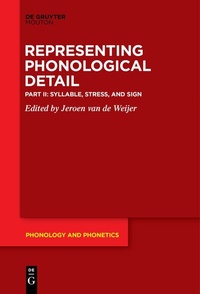
Syllable, Stress, and Sign
Description

Part I: Segmental Structure and Representations
Part II: Syllable, Stress and Sign
Part II of Representing Phonological Detail focuses on the latest phonological research on suprasegmental structure and sign language. The first main theme in this volume is syllable structure, touching on phonotactics, syllabification, gemination, syllable weight, diphthongization, and other rules. The other main theme is tone and stress, including issues in data collection, the assignment of primary and secondary stress, resolution of stress clashes, lexical accent, and syntax-tone interaction. The final section is on sign language, with special attention paid to iconicity, phonological processes, and the relation between phonetic and phonological representation.
More details
Other editions
Additional editions
Person
Content
The Status of /m/ in #/m/C Sequences in Georgian
Marika Butskhrikidze AAB College
Note: I am indebted to Jeroen van de Weijer for his careful reading of the paper and many useful suggestions. I am very grateful to an anonymous reviewer for his helpful comments. The usual disclaimers apply.
Abstract
Consonant co-occurrence in Georgian largely complies to phonological principles such as the SSP and the OCP. However, these principles are violated in #/m/C sequences, because the sonorant m can precede any consonant, without any restriction. This raises questions concerning the status of /m/: are these #/m/C sequences true clusters or are they secondary, for instance, the result of morphological derivation or analogy? We consider various types of evidence: 1) synchronic constraints on consonant co-occurrence; 2) comparative and dialectal data; 3) diachronic studies involving /m/C sequences; and 4) reduplication data. Based on the findings the paper argues that the /m/ in #/m/C sequences should be analysed as a prefix. Henceforth, /m/ and C in #/m/C sequences belong to different morphemes and do not form true clusters.
Keywords: true clusters, consonant co-occurrence, phonological principles, morphological derivation, Georgian,The paper addresses various ways of analysing surface consonant sequences. In particular, it focuses on the case when an apparent consonant sequence does not form a true cluster, but a secondary/fake one. This occurs when constituents of the cluster belong to different morphemes. The data is drawn from the Georgian language.
There are four possible ways of analysis, to my mind, to consider when two consonants appear together. First, those two consonants could constitute a true cluster (obeying phonological principles, e.g. the SSP and the OCP). Secondly, the two consonants could constitute a complex segment (usually demonstrated by syllabification, peculiar behavior in phonological processes, the existence of minimal pairs, phonetic experiments, etc.). Thirdly, the first consonant could be syllabic (usually demonstrated by phonetic factors and participation in stress assignment). Finally, the two consonants might seem monomorphemic, but in actual fact are not. In this case, the sequences could be referred to as "secondary"1 or "fake" clusters (see also on the notion of "bogus" clusters in van der Hulst (1984). Interestingly, to establish the status of consonant sequences, the kind of evidence used is unique for each. To illustrate the distinct nature of the fourth type, one needs to consider a wide range of linguistic evidence, both in terms of time and space: historical and dialectal/comparative data can be used to check the status of certain constructions, and what are the core and peripheral syllabic structures within the language system. All four kinds of clusters can be demonstrated based on Georgian data, but the focus of the present paper is on the last one.
The sonorant m is the only consonant that can precede any consonant in Georgian (see examples in (1) below). To restate this observation, there are no co-occurrence restrictions on the sequence #/m/C. While it is very odd not to have co-occurrence restrictions on clusters belonging to one morpheme, such freedom of co-occurrence might be less surprising if the consonants belong to different morphemes. Besides, #/m/C sequences violate phonological principles such as the Sonority Sequencing Principle (SSP) and the Obligatory Contour Principle (OCP). The domain of these principles is the stem/root (Butskhrikidze 2002; see also Clements (1990) and Selkirk (1984), who suggest that the syllable is the relevant domain). Consider the following examples:
(1)Word-initial consonant clusters
a. CC mparveli 'patron' b. CCC mk'lavi 'arm' mtvare 'moon' c. CCCC msxvili 'thick' d. CCCCC msxvreva 'breaking'The consonant sequence mp in mparveli violates the OCP as both, m and p, are bilabial consonants, while all the above-listed sequences violate the SSP as in all examples, the more sonorous consonant m precedes less sonorous ones, such as p, k', t and s.
This paper argues that the /m/ in #/m/C sequences should be analysed as a prefix. Thus, m and C belong to different morphemes. Consequently #/m/C sequences do not form true clusters. To substantiate this claim, the Georgian phonological inventory, and the synchronic patterns of consonant clustering in general and specifically those of /m/C type will be considered in Section 1. Some typological observations and morpho-phonological patterns of Georgian are discussed in Section 2. Comparative data on dialectal forms of Georgian and another Kartvelian language, Megrelian, are considered in Section 3. Historical studies on #mC sequences are considered in Section 4. Reduplication data and aspects of child language development are considered as relevant pieces of evidence concerning this issue in Section 5. Finally, some tentative conclusions are drawn.
1 The Phonemic Inventory and the Synchronic Patterns of Consonant Clustering
Georgian belongs to the Kartvelian (South Caucasian) language family. The name of the language group is related to the ethnonym kartveli 'Georgian'. Georgian is the official state language of Georgia, with more than four million speakers. Outside Georgia, there are Georgian-speaking populations in Azerbaijan (Saingilo),2 Turkey (Shavsheti, Imerkhevi), Iran (Fereidan) and the North Caucasus (Sochi, Kizlar-Mozdok, Orjonikidze). Besides Georgian, the Kartvelian language family comprises three other languages, Megrelian (Mingrelian), Laz (Chan) and Svan. According to Shanidze's (1973) classification, which is mainly based on geographical factors, there are six groups of Georgian dialects: 1. Pkhouri (Khevsuruli, Mokheuri, Tushuri); 2. Mtiulur-Pshauri (Mtiulur-Gudamakruli, Pshauri); 3. Kartlur-Kakhuri (Kartluri, Kakhuri, Javakhuri, Meskhuri, Kizikuri); 4. Dasavluri (Imeruli, Guruli, Rachuli, Lechkhumuri); 5. Samkhret-Dasavluri (Acharuli, Imerkheuli); and 6. Ingilouri.
Georgian has 28 consonants in its phonemic inventory. To account for the syntagmatic patterns of consonant combinations, it is convenient to classify them according to place and manner of articulation, as in (2):
(2)Consonants grouped according to the place of articulation and manner.
Manner Place Stop Nasal Fricative/affricate Liquid Bilabial/labio-dental b p p' m v ... Alveolar d t t' n ? ?