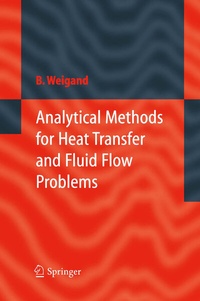
Analytical Methods for Heat Transfer and Fluid Flow Problems
Description

Although the solution of Partial Differential Equations by numerical methods is the standard practice in industries, analytical methods are still important for the critical assessment of results derived from advanced computer simulations and the improvement of the underlying numerical techniques. Literature devoted to analytical methods, however, often focuses on theoretical and mathematical aspects and is therefore useless to most engineers. Analytical Methods for Heat Transfer and Fluid Flow Problems addresses engineers and engineering students. It describes useful analytical methods by applying them to real-world problems rather than solving the usual over-simplified classroom problems. The book demonstrates the applicability of analytical methods even for complex problems and guides the reader to a more intuitive understanding of approaches and solutions.
Reviews / Votes
From the reviews:
"The main aim of the present book is to show the usefulness of analytical methods, in a world, which focuses more and more on numerical methods. . The book is written for graduate students and engineers. . At the end of every chapter, problems are shown, which the reader may solve to check his/her knowledge." (Claudia-Veronika Meister, Zentralblatt MATH, Vol. 1073, 2005)
"The intention of the author of this modest little book is to provide a guide for analytic methods for the solution of heat transfer problems. . A list of symbols is provided at the start, some 200 references are cited, and there is a shortish index. . The author intends his book for graduate students and engineers. . It will mainly serve as a reference for those interested in technical heat transfer calculations." (A. C. Fowler, Journal of Fluid Mechanics, Vol. 547, 2006)
"The main aim of this book is to 'show the usefulness of analytical methods in a world which focuses more and more on numerical methods (in heat transfer and fluid flow)'. The intended readership is researchers from the relevant engineering community and their students. . the mathematician can use the book as an entrée to selected parts of the engineering literature, both theoretical and experimental." (J. R. Ockendon, Mathematical Reviews, Issue 2005 h)
"Analytical methods for heat transfer and fluid flow problems is designed to show the usefulness of analytical methods for solving problems . . The book's target audience is engineers and engineering students, people with a good understanding of basic engineering mathematics. . The book is laid out clearly, making good use of tables and graphs when necessary. All problems are solved in clear steps . . It's a useful reference for those working in this field . ." (Ragan Nelson, The Chemical Engineer, October, 2006)
More details
Other editions
New editions
Additional editions