

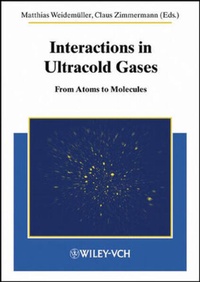
Interactions in Ultracold Gases
From Atoms to Molecules
1st Edition
Published on 20. January 2011
X, 509 pages
978-3-527-63507-8 (ISBN)
Description

Arising from a workshop, this book surveys the physics of ultracold atoms and molecules taking into consideration the latest research on ultracold phenomena, such as Bose Einstein condensation and quantum computing. Several reputed authors provide an introduction to the field, covering recent experimental results on atom and molecule cooling as well as the theoretical treatment.
Reviews / Votes
"The intention of addressing readers beyond the community of insiders is definitely fulfilled. ... The editors intention in aiming at advanced students and young researchers, as well at experienced researchers with different backgrounds is perfectly fulfilled."Alkwin Slenczka, Uni Regensburg
ChemPhysChem, 2003, Vol. 4, No. 11
More details
Other editions
Additional editions
Matthias Weidemueller | Claus Zimmermann
Interactions in Ultracold Gases - From Atoms to Molecules
Software
01/2005
Wiley-VCH
€338.70
No shipping information available
Book
03/2003
1st Edition
Wiley-VCH
€245.00
Article exhausted; check different version
Persons
Editors:
Matthias Weidemüller is head of the Laser Cooling Group at the Max-Planck-Institute for Nuclear Physics and Lecturer of Physics at the University of Heidelberg. After studying Physics in Bonn, Munich and Paris he attained his doctorate in 1995 at the Max-Planck-Institute for Quantum Optics. He spent two years as a Postdoc at the University of Amsterdam and the FOM-Institute for Atomic and Molecular Physics, before entering the Max-Planck-Institute for Nuclear Physics in Heidelberg. His group experimentally explores the physics of ultracold atomic and molecular gases in very different environments ranging from tiny optical traps to large-scale heavy-ion storage rings.
Claus Zimmermann is Professor for Experimental Physics at the University of Tübingen in Germany. In 1990 he attained his doctorate at the Max-Planck Institut for Quantum Optics in Munich in the research group of Prof. T. Hänsch. He was appointed full Professor at the University of Tübingen in 1998. His scientific activities range from laser development, non-linear optics and precision spectroscopy to optical cooling and ultra cold quantum gases.
Authors:
Peter van der Straten, Universiy of Utrecht, The Netherlands
John Weiner, Universiy Paul Sabatier, Toulouse, France
Allard Mosk, FOM, Rijnhuizen, The Netherlands
Klaus Sengstock, University of Hamburg, Germany
Eberhard Tiemann, University of Hannover, Germany
Rudi Grimm, University of Innsbruck, Austria
Phil Gould, University of Connecticut, USA
Giovanni Modugno, LENS, Florence, Italy
Daniel Comparat, Laboratory Aimé Cotton, Orsay, France
Daniel Zajfman, Weizmann Institute, Rehovot, Israel
Immanuel Bloch, University of Munich, Germany
Neill Claussen, JILA, Boulder, USA
Ben Sauer, SCOAP, Brighton, UK
Gerard Meijer, FOM Rijnhuizen, The Netherlands
Matthias Weidemüller is head of the Laser Cooling Group at the Max-Planck-Institute for Nuclear Physics and Lecturer of Physics at the University of Heidelberg. After studying Physics in Bonn, Munich and Paris he attained his doctorate in 1995 at the Max-Planck-Institute for Quantum Optics. He spent two years as a Postdoc at the University of Amsterdam and the FOM-Institute for Atomic and Molecular Physics, before entering the Max-Planck-Institute for Nuclear Physics in Heidelberg. His group experimentally explores the physics of ultracold atomic and molecular gases in very different environments ranging from tiny optical traps to large-scale heavy-ion storage rings.
Claus Zimmermann is Professor for Experimental Physics at the University of Tübingen in Germany. In 1990 he attained his doctorate at the Max-Planck Institut for Quantum Optics in Munich in the research group of Prof. T. Hänsch. He was appointed full Professor at the University of Tübingen in 1998. His scientific activities range from laser development, non-linear optics and precision spectroscopy to optical cooling and ultra cold quantum gases.
Authors:
Peter van der Straten, Universiy of Utrecht, The Netherlands
John Weiner, Universiy Paul Sabatier, Toulouse, France
Allard Mosk, FOM, Rijnhuizen, The Netherlands
Klaus Sengstock, University of Hamburg, Germany
Eberhard Tiemann, University of Hannover, Germany
Rudi Grimm, University of Innsbruck, Austria
Phil Gould, University of Connecticut, USA
Giovanni Modugno, LENS, Florence, Italy
Daniel Comparat, Laboratory Aimé Cotton, Orsay, France
Daniel Zajfman, Weizmann Institute, Rehovot, Israel
Immanuel Bloch, University of Munich, Germany
Neill Claussen, JILA, Boulder, USA
Ben Sauer, SCOAP, Brighton, UK
Gerard Meijer, FOM Rijnhuizen, The Netherlands
Content
Tutorial Lectures:
Peter van der Straten, Harold Metcalf: The Quest for Bose-Einstein Condensation
John Weiner: Quantum Collisions
Klaus Sengstock, Kai Bongs: Quantum Degenerate Gases
Eberhard Tiemann: Cold Molecules
Allard Mosk: Experimental Techniques for Ultracold Gases
Topical Reports:
Rudi Grimm et al.: Two-Dimensional Gas of Cesium Atoms Confined by Evanescent Waves
Phil Gould et al.: Ultracold Rydberg Gases and Plasmas
Giovanni Modugno, Giacomo Roati: Interactions in Ultracold Atomic Mixtures
Immanuel Bloch et al.: Bose Einstein Condensates in Optical Lattice
Neill Claussen et al.: Atom-Molecule Coherence in 85 Rb BEC
Daniel Comparat et al.: Formation and Trapping of Cold Molecules
Gerard Meijer: Declaration and Trapping of Polar Molecules
Daniel Zajfman, et al.: Physics with Cold Molecular Ions
Ben Sauer: Cold Molecules as a Laboratory for Particle Physics
Peter van der Straten, Harold Metcalf: The Quest for Bose-Einstein Condensation
John Weiner: Quantum Collisions
Klaus Sengstock, Kai Bongs: Quantum Degenerate Gases
Eberhard Tiemann: Cold Molecules
Allard Mosk: Experimental Techniques for Ultracold Gases
Topical Reports:
Rudi Grimm et al.: Two-Dimensional Gas of Cesium Atoms Confined by Evanescent Waves
Phil Gould et al.: Ultracold Rydberg Gases and Plasmas
Giovanni Modugno, Giacomo Roati: Interactions in Ultracold Atomic Mixtures
Immanuel Bloch et al.: Bose Einstein Condensates in Optical Lattice
Neill Claussen et al.: Atom-Molecule Coherence in 85 Rb BEC
Daniel Comparat et al.: Formation and Trapping of Cold Molecules
Gerard Meijer: Declaration and Trapping of Polar Molecules
Daniel Zajfman, et al.: Physics with Cold Molecular Ions
Ben Sauer: Cold Molecules as a Laboratory for Particle Physics
