

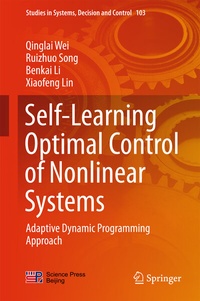
Self-Learning Optimal Control of Nonlinear Systems
Description

This book presents a class of novel, self-learning, optimal control schemes based on adaptive dynamic programming techniques, which quantitatively obtain the optimal control schemes of the systems. It analyzes the properties identified by the programming methods, including the convergence of the iterative value functions and the stability of the system under iterative control laws, helping to guarantee the effectiveness of the methods developed. When the system model is known, self-learning optimal control is designed on the basis of the system model; when the system model is not known, adaptive dynamic programming is implemented according to the system data, effectively making the performance of the system converge to the optimum.
With various real-world examples to complement and substantiate the mathematical analysis, the book is a valuable guide for engineers, researchers, and students in control science and engineering.
Reviews / Votes
"Book contains various real-world examples to illustrate the developed mathematical analysis. Thus, it is a valuable and important guide for engineers, researchers, and students in systems, decision and control science." (Savin Treanta, zbMATH 1403.49002, 2019)More details
Other editions
Additional editions
Persons
Qinglai Wei received his B.S. degree in Automation and Ph.D. degree in Control Theory and Control Engineering from the Northeastern University, Shenyang, China, in 2002 and 2009, respectively. From 2009 to 2011, he was a postdoctoral fellow with The State Key Laboratory of Management and Control for Complex Systems, Institute of Automation, Chinese Academy of Sciences, Beijing, China and is currently a professor there. He has authored one book and published over 70 international journal papers. His research interests include adaptive dynamic programming, neural-networks-based control, optimal control, nonlinear systems and their industrial applications.
Dr. Wei is an associate editor of IEEE Transactions on Systems Man, and Cybernetics: Systems, Information Sciences, Neurocomputing, Optimal Control Applications and Methods, and Acta Automatica Sinica, and held the same position for IEEE Transactions on Neural Networks and Learning Systems from 2014 to 2015. He has been the secretary of the IEEE Computational Intelligence Society (CIS) Beijing Chapter since 2015. He was registration chair of the 12th World Congress on Intelligent Control and Automation (WCICA 2016), the IEEE World Congress on Computational Intelligence (WCCI 2014), the International Conference on Brain Inspired Cognitive Systems (BICS 2013), and the 8th International Symposium on Neural Networks (ISNN 2011). He was the publication chair of the 5th International Conference on Information Science and Technology (ICIST 2015) and the 9th International Symposium on Neural Networks (ISNN 2012). He was the finance chair of the 4th International Conference on Intelligent Control and Information Processing (ICICIP 2013) and the publicity chair of the International Conference on Brain Inspired Cognitive Systems (BICS 2012). He has been the guest editor for several international journals. He was a recipient of the Acta Automatica Sinica Outstanding Paper Award in 2011 and the Chinese Control, DecisionConference (CCDC) Zhang Siying Outstanding Paper Award in 2015, and Young Researcher Award of Asia Pacific Neural Network Society (APNNS) in 2016.
Ruizhuo Song received his Ph.D. degree in Control Theory and Control Engineering from Northeastern University, Shenyang, China, in 2012. She is currently an associate professor at the School of Automation and Electrical Engineering, University of Science and Technology Beijing, Beijing, China. Her research interests include optimal control, neural-network-based control, nonlinear control, wireless sensor networks, adaptive dynamic programming and their industrial application.
