

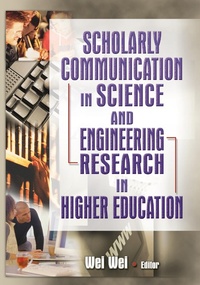
Scholarly Communication in Science and Engineering Research in Higher Education
Published on 11. January 2013
208 pages
978-1-136-41456-5 (ISBN)
Description

Stay on top with the latest developments in scientific and technical journal publications!
In Scholarly Communication in Science and Engineering Research in Higher Education, experts in the academic community propose cost-effective alternatives to commercial publications in the face of increased journal prices and reduced budgets. This book discusses recent technological innovations that can maintain the needs of researchers who need to stay on the cutting edge of science and technology as well as scholars who must be published and peer-reviewed in order to achieve tenure and promotion. This text also examines the latest developments in information retrieval that will effectively cut time and costs for academic researchers in the library.
Scholarly Communication in Science and Engineering Research in Higher Education focuses on the need for the academic community to accept new, economical methods of producing and making available publications such as peer reviews, research papers, letters, technical and experiment reports, preprints, and conference papers. This volume also emphasizes that scientists and engineerswhether graduate students or professionalsmust have access to the latest relevant research in their fields and rely on libraries to provide it. Several chapters in this book examine the problem areas of information technology that will need to be fixed, such as bottlenecks to the flow of information, difficulties using information retrieval systems, and the challenges with archiving electronic journals.
Using research and case studies, this book offers strategies for obtaining benefits such as:
more efficient and inexpensive ways to access and navigate information
more cost-effective means of authentication and quality control
new initiative programs in electronic theses and dissertations to assist graduate students
increased dissemination and access for conference papers at significantly less cost
alternative and more effective approaches for solving underlying problems within the scholarly communication circuit of scientists
activities for librarians to help expand utilization of digital technologies at the local level
accurate and reliable retrieval of citation data from online sources
Using Scholarly Communication in Science and Engineering Research in Higher Education, you can play an important role in improving the means and methods in this area of academics. This important guide will help librarians, science and engineering faculty and students, researchers, and publishers maintain funding, improve efficiency, and offer new methods for scientific studies.
In Scholarly Communication in Science and Engineering Research in Higher Education, experts in the academic community propose cost-effective alternatives to commercial publications in the face of increased journal prices and reduced budgets. This book discusses recent technological innovations that can maintain the needs of researchers who need to stay on the cutting edge of science and technology as well as scholars who must be published and peer-reviewed in order to achieve tenure and promotion. This text also examines the latest developments in information retrieval that will effectively cut time and costs for academic researchers in the library.
Scholarly Communication in Science and Engineering Research in Higher Education focuses on the need for the academic community to accept new, economical methods of producing and making available publications such as peer reviews, research papers, letters, technical and experiment reports, preprints, and conference papers. This volume also emphasizes that scientists and engineerswhether graduate students or professionalsmust have access to the latest relevant research in their fields and rely on libraries to provide it. Several chapters in this book examine the problem areas of information technology that will need to be fixed, such as bottlenecks to the flow of information, difficulties using information retrieval systems, and the challenges with archiving electronic journals.
Using research and case studies, this book offers strategies for obtaining benefits such as:
more efficient and inexpensive ways to access and navigate information
more cost-effective means of authentication and quality control
new initiative programs in electronic theses and dissertations to assist graduate students
increased dissemination and access for conference papers at significantly less cost
alternative and more effective approaches for solving underlying problems within the scholarly communication circuit of scientists
activities for librarians to help expand utilization of digital technologies at the local level
accurate and reliable retrieval of citation data from online sources
Using Scholarly Communication in Science and Engineering Research in Higher Education, you can play an important role in improving the means and methods in this area of academics. This important guide will help librarians, science and engineering faculty and students, researchers, and publishers maintain funding, improve efficiency, and offer new methods for scientific studies.
More details
Language
English
Place of publication
London
United Kingdom
Publishing group
Taylor & Francis Ltd
Target group
College/higher education
File size
1,44 MB
ISBN-13
978-1-136-41456-5 (9781136414565)
Copyright in bibliographic data and cover images is held by Nielsen Book Services Limited or by the publishers or by their respective licensors: all rights reserved.
Schweitzer Classification
Other editions
Additional editions
Book
04/2004
1st Edition
Routledge
€230.65
Shipment within 10-20 days
Book
03/2004
1st Edition
Routledge
€85.71
Shipment within 10-20 days
Person
Wei, Wei
Content
Introduction
SCHOLARLY PUBLISHING
Can Peer Review Be Better Focused?
The Future of Scientific and Technical Journals
The eScholarlship Repository: A University of California Response to the Scholarly Communication Crisis
Conference Proceedings at Publishing Crossroads
Electronic Theses and Dissertations: Enhancing Scholarly Communication and the Graduate Student Experience
Chemistry Journals: Cost-Effectiveness, Seminal Titles and Exchange Rate
SCHOLARLY COMMUNICATION
The Role of Scientific Literature in Electronic Scholarly Communication
Scholarly Communication in Flux: Entrenchment and Opportunity
DIGITAL ARCHIVE AND RETRIEVAL
Issues and Concerns with the Archiving of Electronic Journals
User Expectations and the Complex Reality of Online Research Efforts
BIBLIOMETRIC ANALYSIS OF CITATION DATA
Bibliometric and Bibliographic Analysis in an Era of Electronic Scholarly Communication
Citation Patterns of Advanced Undergraduate Students in Biology, 2000-2002
Index
Reference Notes Included
SCHOLARLY PUBLISHING
Can Peer Review Be Better Focused?
The Future of Scientific and Technical Journals
The eScholarlship Repository: A University of California Response to the Scholarly Communication Crisis
Conference Proceedings at Publishing Crossroads
Electronic Theses and Dissertations: Enhancing Scholarly Communication and the Graduate Student Experience
Chemistry Journals: Cost-Effectiveness, Seminal Titles and Exchange Rate
SCHOLARLY COMMUNICATION
The Role of Scientific Literature in Electronic Scholarly Communication
Scholarly Communication in Flux: Entrenchment and Opportunity
DIGITAL ARCHIVE AND RETRIEVAL
Issues and Concerns with the Archiving of Electronic Journals
User Expectations and the Complex Reality of Online Research Efforts
BIBLIOMETRIC ANALYSIS OF CITATION DATA
Bibliometric and Bibliographic Analysis in an Era of Electronic Scholarly Communication
Citation Patterns of Advanced Undergraduate Students in Biology, 2000-2002
Index
Reference Notes Included
