

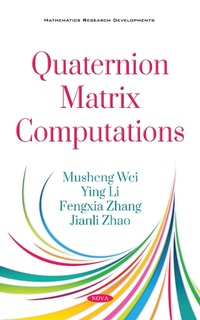
Quaternion Matrix Computations
Published on 1. August 2018
227 pages
978-1-5361-4122-1 (ISBN)
Description

In this monograph, the authors describe state-of-the-art real structure-preserving algorithms for quaternion matrix computations, especially the LU, the Cholesky, the QR and the singular value decomposition of quaternion matrices, direct and iterative methods for solving quaternion linear systems, generalized least squares problems, and quaternion right eigenvalue problems. Formulas of the methods are derived, and numerical codes are provided which utilize advantages of real structure-preserving of quaternion matrices and high-level performance of vector pipelining arithmetic operations, using Matlab software. These algorithms are very efficient and stable. This monograph can be used as a reference book for scientists, engineers and researchers in color image processing, quaternionic quantum mechanics, information engineering, information security and scientific computing. It can also act as a textbook at the graduate level in related areas.
More details
Other editions
Additional editions
Musheng Wei | Ying Li | Fengxia Zhang
Quaternion Matrix Computations
Book
09/2018
Nova Science Publishers Inc
€276.30
Shipment within 15-20 days
Content
- Intro
- QUATERNION MATRIXCOMPUTATIONS
- QUATERNION MATRIXCOMPUTATIONS
- Contents
- Preface
- Acknowledgments
- Notations
- Chapter 1Preliminaries
- 1.1. Introduction
- 1.2. Quaternions
- 1.3. QuaternionMatrices
- 1.4. Eigenvalue Problem
- 1.5. Norms
- 1.5.1. Vector Norms
- 1.5.2. Matrix Norms
- 1.6. Generalized Inverses
- 1.7. Projections
- 1.7.1. Idempotent Matrices and Projections
- 1.7.2. Orthogonal Projections
- 1.7.3. Geometric Meanings of AA┼ and A┼A
- 1.8. Properties of Real RepresentationMatrices
- Chapter 2Computing MatrixDecompositions
- 2.1. ElementaryMatrices
- 1. Gauss Transformation Matrices
- 2. GivensMatrices
- (1) The Real GivensMatrix
- (2) The JRSGivensMatrix
- (3) The qGivensMatrix
- 3. Householder Based Transformations
- (1) The Real Householder Transformation
- (2) Quaternion Householder Based Transformations
- 2.2. The Quaternion LU Decomposition
- 1. The Quaternion LU Decomposition
- 2. The Partial Pivoting Quaternion LU Decomposition
- 2.3. The Quaternion LDLH and CholeskyDecompositions
- 2.4. The Quaternion QR Decomposition
- 2.4.1. The Quaternion Householder QRD
- 2.4.2. The Givens QRD
- 2.4.3. The Modified Gram-Schimit Scheme
- 2.4.4. Complete Orthogonal Decomposition
- 2.5. The Quaternion SVD
- Chapter 3Linear System and GeneralizedLeast Squares Problems
- 3.1. Linear System
- 1. Homogeneous Linear System
- 2. Nonhomogeneous Linear System
- 3.2. The Linear Least Squares Problem
- 3.2.1. The LS Problem and Its Equivalent Problems
- 1. The Normal Equation
- 2. The KKT Equation
- 3.2.2. The Regularization of the LS Problem
- 1. The Truncated LS Problem
- 2. The Tikhonov Regularization
- 3.2.3. Some Matrix Equations
- 3.3. The Total Least Squares Problem
- 3.4. The Equality Constrained Least Squares Problem
- 1. The KKT Equation
- 2. The Unitary Decomposition Method
- 3. The Q-SVD Method
- 4. The Weighted LS Method
- 5. Unconstrained LS Method
- Chapter 4Direct Methods for SolvingLinear System and GeneralizedLS Problems
- 4.1. DirectMethods for Linear System
- 4.2. DirectMethods for the LS Problem
- 1. The QR Decomposition Method
- 2. The Normal EquationMethod
- 3. The Complete Orthogonal Decomposition Method
- 4. The SVD Method
- 4.3. DirectMethods for the TLS Problem
- 1. Basic SVD Method
- 2. The Complete Orthogonal Decomposition Method
- 3. The Cholesky DecompositionMethod
- 4.4. DirectMethods for the LSE Problem
- 1. Null Space Method
- 2. The Weighted LS Method
- 3. Direct EliminationMethod
- 4. The QR Decomposition and the Q-SVDMethods
- 4.5. Some Matrix Equations
- 1. Special Solutions to the QuaternionMatrix Equation AX = B
- 2. Special Solutions to the QuaternionMatrix EquationAXB+CXD = E
- Chapter 5Iterative Methods for SolvingLinear System and GeneralizedLS Problems
- 5.1. Basic Knowledge
- 5.1.1. The Chebyshev Polynomials
- 5.1.2. The Range of Eigenvalues of Real Symmetric TridiagonalMatrices
- 5.2. Iterative Methods for Linear System
- 5.2.1. Basic Theory of Splitting IterativeMethod
- 1. The Jacobi Iteration
- 2. The Gauss-Seidel Iteration
- 3. The Successive over Relaxation Iteration (SOR)
- 4. The Chebyshev Semi-IterativeMethod
- 5.2.2. The Krylov Subspace Methods
- 1. The Conjugate GradientMethod (CG)
- 5.3. Iterative Methods for the LS Problem
- 5.3.1. Splitting IterativeMethods
- 1. The Jacobi Iteration
- 2. The Gauss-Seidel Iteration
- 4. The Chebyshev Semi-Iterative Acceleration
- 3. The Successive over Rrelaxation Iteration (SOR)
- 5.3.2. The Krylov Subspace Methods
- 1. The Conjugate GradientMethod (CGLS)
- 2. The QR Least SquaresMethod (LSQR)
- 5.3.3. Preconditioning Hermitian-Skew Hermitian Splitting Itera-tionMethods
- 5.4. Iterative Methods for the TLS Problem
- 5.4.1. The Partial SVD Method
- 5.4.2. BidiagonalizationMethod
- 5.5. Some Matrix Equations
- Chapter 6Computations of QuaternionEigenvalue Problems
- 6.1. Quaternion Hermitian Right Eigenvalue Problem
- 6.1.1. The Power Method and Inverse Power Method forQuaternion Hermitian Right Eigenvalue Problem
- 1. The Power Method for Quaternion Hermitian Right EigenvalueProblem
- 2. The Inverse Power Method for Quaternion Hermitian RightEigenvalue Problem
- 6.1.2. Real Structure-Preserving Algorithm of Hermitian QRAlgorithm for Hermitian Right Eigenvalue Problem
- 6.1.3. Real Structure-Preserving Algorithm of the Jacobi Methodfor Hermitian Right Eigenvalue Problem
- 6.1.4. Subspace Methods
- 1. The Rayleigh-Ritz Projection Method
- 2. The Hermitian Lanczos Method
- 6.2. Quaternion Non-Hermitian Right EigenvalueProblem
- 6.2.1. The Power Method and the Inverse Power Method
- 1. The Power Method for Quaternion Non-Hermitian RightEigenvalue Problem
- 2. The Inverse Power Method for Quaternion Non-Hermitian RightEigenvalue Problem
- 6.2.2. The Quaternion QR Algorithm for QuaternionNon-Hermitian Right Eigenvalue Problem
- 3. Implicit Double Shift Trick
- References
- About the Authors
- Index
- Blank Page
