

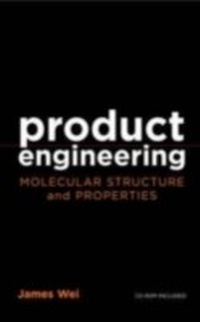
Product Engineering
Molecular Structure and Properties
1st Edition
Published on 4. January 2007
376 pages
978-0-19-534792-0 (ISBN)
Description

The current chemical engineering curriculum concentrates on process: the efficient manufacturing in quantity of traditional chemical products such as ammonia and benzene. However, many chemical companies now invent and manufacture specialty products with particular properties such as pharmaceuticals, cosmetics, and electronic coatings, and their employees need to know how to design the products as well as manufacture them. James Wei, a famous chemical engineer, is writing this book to provide theories and case studies in product engineering the design of new, useful products with desired properties. The first section relates historical case studies of successful product invention and development by individuals and companies. The second part of the book describes the toolbox of molecular structure-property relations. A desired product needs to have certain properties (for example, phase transition or thermal properties) and the chemist must find or design a molecular structure with the required properties This section will instruct chemists in the analysis of structure and property information. The third section is concerned with the next stage: product research and design. It will discuss improving the desired product by additives and blending, among other strategies. It will also cover future challenges in product engineering.
More details
Other editions
Additional editions
Book
01/2007
Oxford University Press Inc
€166.80
Shipment within 15-20 days
Content
- Intro
- Contents
- Part I: Product Innovations
- 1 Product Exploration and Discovery
- 1.1 Freon CFC, 1928
- 1.2 Market-Pull, Search for Technology
- 1.3 Technology-Push, Search for Market
- 2 Product Development to Business
- 2.1 Nylon: Centralized Development
- 2.2 Penicillin: Distributed Development
- 2.3 Taxol: Distributed Development
- 2.4 Tasks and Skills in Product Innovation
- Part II: Molecular Structure-Property Relations
- 3 Search Challenges and Methods
- 3.1 Forward Search from Material to Property
- 3.2 Reverse Search from Properties to Material
- 3.3 Searches from Technology to Markets
- 3.4 Literature and Databases
- 4 Theory and Quantitative Predictions
- 4.1 Single Molecules
- 4.2 Statistical Thermodynamics
- 4.3 Gases, Solids, and Liquids
- 5 Predictions by Correlations
- 5.1 Populations, Predictors, and Functions
- 5.2 Regression with a Single Predictor
- 5.3 Regression with Several Predictors
- 5.4 Group Contribution Methods
- 5.5 Mixtures and Composite Materials
- 6 Estimation by Associations and Trends
- 6.1 Empirical Structure-Property Relations
- 6.2 Structure Effects and Ambient Influences on Properties
- 6.3 Risk Assessment
- 7 Random Searches
- 7.1 Strategies of Random Searches
- 7.2 Combinatorial Chemistry
- 8 Research Frontiers
- 8.1 Synthesis and Discovery
- 8.2 Measurement and Discovery
- 8.3 Understanding of Molecular Structure-Property Relationships
- 8.4 Prediction of Molecular Structure-Property Relationships
- Part III: Product Engineering
- 9 Product Marketing
- 9.1 The Sellers: The Chemical Processing Industries
- 9.2 The Buyers
- 9.3 Marketing Gasoline: A Mature Product
- 9.4 Marketing Ink for Inkjet Printers
- 10 Safety, Health, and Environment
- 10.1 The Responsibilities of the Chemical Processing Industries
- 10.2 Health and Safety Problems
- 10.3 Environmental Problems
- 10.4 Green Engineering
- 11 Product Design
- 11.1 Bottled Drinking Water: Fluid Compound
- 11.2 Missile Fuel: Homogeneous Fluid Solution
- 11.3 Adsorbents for Separation: Solid Material
- 11.4 Controlled Drug Release: Composite Solid
- 11.5 Evaluation, Selection, and Business Plan
- 12 Product Innovation Opportunities
- 12.1 Market-Pull Opportunities
- 12.2 Technology-Push Opportunities
- Appendix
- Index
- A
- B
- C
- D
- E
- F
- G
- H
- I
- J
- K
- L
- M
- N
- O
- P
- Q
- R
- S
- T
- V
- W
- Z
