

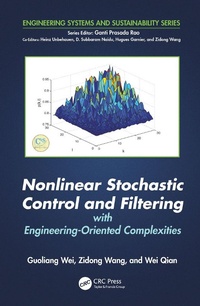
Nonlinear Stochastic Control and Filtering with Engineering-oriented Complexities
Published on 15. September 2016
272 pages
978-1-315-35066-0 (ISBN)
Description

Nonlinear Stochastic Control and Filtering with Engineering-oriented Complexities presents a series of control and filtering approaches for stochastic systems with traditional and emerging engineering-oriented complexities. The book begins with an overview of the relevant background, motivation, and research problems, and then:
Discusses the robust stability and stabilization problems for a class of stochastic time-delay interval systems with nonlinear disturbances
Investigates the robust stabilization and H? control problems for a class of stochastic time-delay uncertain systems with Markovian switching and nonlinear disturbances
Explores the H? state estimator and H? output feedback controller design issues for stochastic time-delay systems with nonlinear disturbances, sensor nonlinearities, and Markovian jumping parameters
Analyzes the H? performance for a general class of nonlinear stochastic systems with time delays, where the addressed systems are described by general stochastic functional differential equations
Studies the filtering problem for a class of discrete-time stochastic nonlinear time-delay systems with missing measurement and stochastic disturbances
Uses gain-scheduling techniques to tackle the probability-dependent control and filtering problems for time-varying nonlinear systems with incomplete information
Evaluates the filtering problem for a class of discrete-time stochastic nonlinear networked control systems with multiple random communication delays and random packet losses
Examines the filtering problem for a class of nonlinear genetic regulatory networks with state-dependent stochastic disturbances and state delays
Considers the H? state estimation problem for a class of discrete-time complex networks with probabilistic missing measurements and randomly occurring coupling delays
Addresses the H? synchronization control problem for a class of dynamical networks with randomly varying nonlinearities
Nonlinear Stochastic Control and Filtering with Engineering-oriented Complexities describes novel methodologies that can be applied extensively in lab simulations, field experiments, and real-world engineering practices. Thus, this text provides a valuable reference for researchers and professionals in the signal processing and control engineering communities.
Discusses the robust stability and stabilization problems for a class of stochastic time-delay interval systems with nonlinear disturbances
Investigates the robust stabilization and H? control problems for a class of stochastic time-delay uncertain systems with Markovian switching and nonlinear disturbances
Explores the H? state estimator and H? output feedback controller design issues for stochastic time-delay systems with nonlinear disturbances, sensor nonlinearities, and Markovian jumping parameters
Analyzes the H? performance for a general class of nonlinear stochastic systems with time delays, where the addressed systems are described by general stochastic functional differential equations
Studies the filtering problem for a class of discrete-time stochastic nonlinear time-delay systems with missing measurement and stochastic disturbances
Uses gain-scheduling techniques to tackle the probability-dependent control and filtering problems for time-varying nonlinear systems with incomplete information
Evaluates the filtering problem for a class of discrete-time stochastic nonlinear networked control systems with multiple random communication delays and random packet losses
Examines the filtering problem for a class of nonlinear genetic regulatory networks with state-dependent stochastic disturbances and state delays
Considers the H? state estimation problem for a class of discrete-time complex networks with probabilistic missing measurements and randomly occurring coupling delays
Addresses the H? synchronization control problem for a class of dynamical networks with randomly varying nonlinearities
Nonlinear Stochastic Control and Filtering with Engineering-oriented Complexities describes novel methodologies that can be applied extensively in lab simulations, field experiments, and real-world engineering practices. Thus, this text provides a valuable reference for researchers and professionals in the signal processing and control engineering communities.
More details
Series
Language
English
Place of publication
London
United Kingdom
Publishing group
Taylor & Francis Ltd
Target group
College/higher education
Professional and scholarly
Product notice
Reflowable
Illustrations
1 Tables, black and white; 47 Illustrations, black and white
File size
2,42 MB
ISBN-13
978-1-315-35066-0 (9781315350660)
Copyright in bibliographic data and cover images is held by Nielsen Book Services Limited or by the publishers or by their respective licensors: all rights reserved.
Schweitzer Classification
Other editions
Additional editions
Guoliang Wei | Zidong Wang | Wei Qian
Nonlinear Stochastic Control and Filtering with Engineering-oriented Complexities
Book
06/2020
1st Edition
CRC Press
€74.60
Shipment within 15-20 days
Guoliang Wei | Zidong Wang | Wei Qian
Nonlinear Stochastic Control and Filtering with Engineering-oriented Complexities
Book
08/2016
1st Edition
CRC Press
€267.50
Shipment within 15-20 days
Persons
Guoliang Wei received his Ph.D in control engineering from Donghua University, Shanghai, China. He is currently a professor in the Department of Control Science and Engineering at the University of Shanghai for Science and Technology, China. He has conducted and assisted in research at the University of Duisburg-Essen, Germany; Brunel University, Uxbridge, UK; University of Hong Kong; and City University of Hong Kong. His research interests include nonlinear systems, stochastic systems, and bioinformatics. He is an active reviewer of, and has published more than 20 papers in, international journals.
Zidong Wang received his Ph.D in electrical and computer engineering from Nanjing University of Science and Technology, China. He is currently a professor of dynamical systems and computing at Brunel University London, UK. He has conducted research at Ruhr-University Bochum, Germany and Coventry University, UK; and lectured at the University of Kaiserslautern, Germany. His research interests include dynamical systems, signal processing, bioinformatics, and control theory and applications. Widely published and highly decorated, Professor Wang is a fellow of the Institute of Electrical and Electronics Engineers (IEEE) and an active reviewer and editor of international journals.
Wei Qian received his Ph.D from the College of Control Science and Engineering at Zhejiang University, Hangzhou, China, and conducted research in the college's State Key Laboratory of Industrial Control Technology. He is currently an associate professor in the School of Electrical Engineering and Automation at Henan Polytechnic University, Jiaozuo, China. His research interests include time-delay systems, stochastic systems, and networked control systems.
Zidong Wang received his Ph.D in electrical and computer engineering from Nanjing University of Science and Technology, China. He is currently a professor of dynamical systems and computing at Brunel University London, UK. He has conducted research at Ruhr-University Bochum, Germany and Coventry University, UK; and lectured at the University of Kaiserslautern, Germany. His research interests include dynamical systems, signal processing, bioinformatics, and control theory and applications. Widely published and highly decorated, Professor Wang is a fellow of the Institute of Electrical and Electronics Engineers (IEEE) and an active reviewer and editor of international journals.
Wei Qian received his Ph.D from the College of Control Science and Engineering at Zhejiang University, Hangzhou, China, and conducted research in the college's State Key Laboratory of Industrial Control Technology. He is currently an associate professor in the School of Electrical Engineering and Automation at Henan Polytechnic University, Jiaozuo, China. His research interests include time-delay systems, stochastic systems, and networked control systems.
Content
Introduction. Robust Stabilization for Stochastic Time-Delay Interval Systems. Robust H? Control for Markov Systems with Nonlinear Disturbance. H? Filtering and Control for Markov Systems with Sensor Nonlinearities. H? Analysis for Stochastic Differential Systems by Razumikhin Theory. Robust Filtering with Nonlinearities and Multiple Missing Measurements. Probability-Dependent Control with Randomly Occurring Nonlinearities. Probability-Dependent Filtering with Missing Measurements. Controller Design for 2-D Stochastic Nonlinear Roesser Model. Filtering for Networked Control Systems with Multiple Delays. State Estimation for Stochastic Delayed Gene Regulatory Networks. State Estimation for Complex Networks with ROCD. H? Synchronization for Complex Networks with RVN.
