

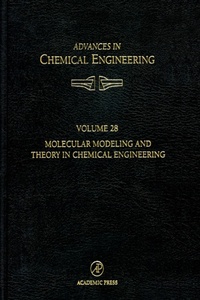
Molecular Modeling and Theory in Chemical Engineering
Published on 18. December 2001
493 pages
978-0-08-048826-4 (ISBN)
Description

In recent years chemical engineers have become increasingly involved in the design and synthesis of new materials and products as well as the development of biological processes and biomaterials. Such applications often demand that product properties be controlled with precision. Molecular modeling, simulating chemical and molecular structures or processes by computer, aids scientists in this endeavor. Volume 28 of Advances in Chemical Engineering presents discussions of theoretical and computational methods as well as their applications to specific technologies.
More details
Other editions
Additional editions
James Wei | Morton M. Denn | John H. Seinfeld
Molecular Modeling and Theory in Chemical Engineering: Volume 28
Book
12/2001
Academic Press
€210.46
Withdrawn from sale
Persons
Gregory Stephanopoulos is a Professor of Chemical Engineering at MIT. He received his B.S. from the National Technical University of Athens, his M.S. from the University of Florida and his Ph.D. from the University of Minnesota, all in Chemical Engineering. Upon graduation, he joined the Chemical Engineering Faculty of the California Institute of Technology, where he served as Assistant and Associate Professor until 1985. In 1985 he was appointed Professor of Chemical Engineering at MIT where he has been ever since.Stephanopoulos' work has appeared in more than 150 publications and 7 patents. He has been recognized with the Dreyfus Foundation Teacher Scholar Award (1982), Excellence in Teaching Award (1984), and Technical Achievement Award of the AIChE (1984). He has been a Presidential Young Investigator and the Chairman of the Food Pharmaceutical & Bioengineering Division of the American Institute of Chemical Engineers (1992). In 1992 he was a Visiting Professor at the International Research Center for Biotechnology at Osaka University and was elected a Founding Fellow of the American Institute for Medical and Biological Engineering. In 1996 he chaired the first Conference on Metabolic Engineering and gave the inaugural Bayer Lecture on Biochemical Engineering at the University of California at Berkeley. He was honored with the FPBE Division Award at AIChE in 1997.
Content
- Cover
- Contents
- Contributors
- Preface
- Chapter 1. Hyperparallel Tempering Monte Carlo and Its Applications
- I. Introduction
- II. Methodology
- III. Applications
- IV. Discussion and Conclusion
- References
- Chapter 2. Theory of Supercooled Liquids and Glasses: Energy Landscape and Statistical Geometry Perspectives
- I. Introduction
- II. The Energy Landscape
- III. Statistical Geometry and Structure
- IV. Landscape Dynamics and Relaxation Phenomena
- V. Thermodynamics
- VI. Conclusion
- References
- Chapter 3. A Statistical Mechanical Approach to Combinatorial Chemistry
- I. Introduction
- II. Materials Discovery
- III. Protein Molecular Evolution
- IV. Summary
- References
- Chapter 4. Fluctuation Effects in Microemulsion Reaction Media
- I. Introduction
- II. Reactions in the Bicontinuous Phase
- III. Reactions in the Droplet Phase
- References
- Chapter 5. Molecular Dynamics Simulations of Ion-Surface Interactions with Applications to Plasma Processing
- I. Introduction
- II. Use of Molecular Dynamics to Study Ion-Surface Interactions
- III. Mechanisms of Ion-Assisted Etching
- IV. Concluding Remarks
- References
- Chapter 6. Characterization of Porous Materials Using Molecular Theory and Simulation
- I. Introduction
- II. Disordered Structure Models
- III. Simple Geometric Pore Structure Models
- IV. Conclusions
- References
- Chapter 7. Modeling of Radical-Surface Interactions in the Plasma-Enhanced Chemical Vapor Deposition of Silicon Thin Films
- I. Introduction
- II. Computational Methodology
- III. Surface Chemical Reactivity with SiHx Radicals
- IV. Plasma-Surface Interactions during Silicon Film Growth
- V. Summary
- References
- Chapter 8. Nanostructure Formation and Phase Separation in Surfactant Solutions
- I. Introduction
- II. Simulation Details
- III. Results
- IV. Discussion
- V. Conclusions
- References
- Chapter 9. Some Chemical Engineering Applications
- I. Introduction
- II. Ab Initio Interaction Potentials and Molecular Simulations
- III. Infinite Dilution Activity Coefficients and Partition Coef.cients from Quantum Mechanical Continuum Solvation Models
- IV. Use of Computational Quantum Mechanics to Improve Thermodynamic Property Predictions from Group Contribution Methods
- V. Use of ab Initio Energy Calculations for Phase Equilibrium Predictions
- VI. Conclusions
- References
- Chapter 10. Car-Parrinello Methods in Chemical Engineering: Their Scope and Potential
- I. Introduction
- II. Objectives and Description of This Article
- III. Objectives of Car-Parrinello Methods and Classes of Problems to Which They Are Best Applicable
- IV. Methodology
- V. Applications
- VI. Advances in Methodology
- VII. Concluding Remarks
- References
- Chapter 11. Theory of Zeolite Catalysis
- I. Introduction
- II. The Rate of a Catalytic Reaction
- III. Zeolites as Solid Acid Catalysts
- IV. Theoretical Approaches Applied to Zeolite Catalysis
- V. Concluding Remarks
- References
- Chapter 12. Morphology, Fluctuation, Metastability, and Kinetics in Ordered Block Copolymers
- I. Introduction
- II. Anisotropic Fluctuations in Ordered Phases
- III. Kinetic Pathways of Order-Order and Order-Disorder Transitions
- IV. The Nature and Stability of Some Nonclassical Phases
- V. Long-Wavelength Fluctuations and Instabilities
- VI. Morphology and Metastability in ABC Triblock Copolymers
- VII. Conclusions
- References
- Index
- Contents of Volumes in this Serial
