

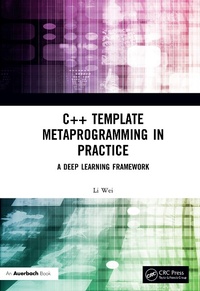
C++ Template Metaprogramming in Practice
A Deep Learning Framework
1st Edition
Published on 1. December 2020
338 pages
978-1-000-21973-9 (ISBN)
Description

Using the implementation of a deep learning framework as an example, C++ Template Metaprogramming in Practice: A Deep Learning Framework explains the application of metaprogramming in a relatively large project and emphasizes ways to optimize systems performance. The book is suitable for developers with a basic knowledge of C++. Developers familiar with mainstream deep learning frameworks can also refer to this book to compare the differences between the deep learning framework implemented with metaprogramming and compile-time computing with deep learning frameworks using object-oriented methods.
Consisting of eight chapters, the book starts with two chapters discussing basic techniques of metaprogramming and compile-time computing. The rest of the book's chapters focus on the practical application of metaprogramming in a deep learning framework. It examines rich types and systems, expression templates, and writing complex meta-functions, as well as such topics as:
Heterogeneous dictionaries and policy templates
An introduction to deep learning
Type system and basic data types
Operations and expression templates
Basic layers
Composite and recurrent layers
Evaluation and its optimization
Metaprogramming can construct flexible and efficient code. For C++ developers who are familiar with object-oriented programming, the main difficulty in learning and mastering C++ metaprogramming is establishing the thinking mode of functional programming. The meta-programming approach involved at compile time is functional, which means that the intermediate results of the construction cannot be changed, and the impact may be greater than expected. This book enables C++ programmers to develop a functional mindset and metaprogramming skills. The book also discusses the development cost and use cost of metaprogramming and provides workarounds for minimizing these costs.
Consisting of eight chapters, the book starts with two chapters discussing basic techniques of metaprogramming and compile-time computing. The rest of the book's chapters focus on the practical application of metaprogramming in a deep learning framework. It examines rich types and systems, expression templates, and writing complex meta-functions, as well as such topics as:
Heterogeneous dictionaries and policy templates
An introduction to deep learning
Type system and basic data types
Operations and expression templates
Basic layers
Composite and recurrent layers
Evaluation and its optimization
Metaprogramming can construct flexible and efficient code. For C++ developers who are familiar with object-oriented programming, the main difficulty in learning and mastering C++ metaprogramming is establishing the thinking mode of functional programming. The meta-programming approach involved at compile time is functional, which means that the intermediate results of the construction cannot be changed, and the impact may be greater than expected. This book enables C++ programmers to develop a functional mindset and metaprogramming skills. The book also discusses the development cost and use cost of metaprogramming and provides workarounds for minimizing these costs.
More details
Edition
1. Auflage
Language
English
Place of publication
London
United Kingdom
Publishing group
Taylor & Francis Ltd
Target group
Professional and scholarly
Illustrations
2 Tables, black and white; 10 Halftones, black and white
ISBN-13
978-1-000-21973-9 (9781000219739)
Copyright in bibliographic data and cover images is held by Nielsen Book Services Limited or by the publishers or by their respective licensors: all rights reserved.
Schweitzer Classification
Other editions
Additional editions
Book
12/2020
1st Edition
CRC Press
€154.50
Shipment within 15-20 days
Person
Li Wei graduated from Tsinghua University in 2011 and has been engaged in the development and maintenance of the online prediction section of the deep learning machine translation system at Baidu's Natural Language Processing Department. He currently works for Microsoft Advanced Technology Center and has more than ten years of relevant development experience, with a strong interest in C++ template meta-programming and compile-time computing.
Content
Part I. Introduction 1. Basic Tips 2. Heterogeneous Dictionaries and Policy Templates Part II. The Deep Learning Framework 3. A Brief Introduction to Deep Learning 4. Type System and Basic Data Types 5. Operations and Expression Templates 6. Basic Layers 7. Composite and Recurrent Layers 8. Evaluation and Its Optimization. Postscript.
