

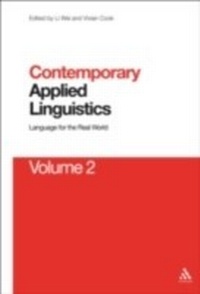
Contemporary Applied Linguistics Volume 2
Volume Two Linguistics for the Real World
1st Edition
Published on 23. June 2009
264 pages
978-1-4411-2075-5 (ISBN)
Description

Written by internationally renowned academics, this volume provides a snapshot of the field of applied linguistics, and illustrates how linguistics is informing and engaging with neighbouring disciplines.
Chapters in this second volume present an overview of new (and interdisciplinary) applications of linguistics to such diverse fields as economics, law, religion, tourism, media studies and health care. Both volumes represent the best of current practice in applied linguistics, and will be invaluable to students and researchers looking for an overview of the field.
Chapters in this second volume present an overview of new (and interdisciplinary) applications of linguistics to such diverse fields as economics, law, religion, tourism, media studies and health care. Both volumes represent the best of current practice in applied linguistics, and will be invaluable to students and researchers looking for an overview of the field.
Reviews / Votes
"These volumes take their mission seriously: to build the future of applied linguistics, grounded in language but with a broad concern for real-world issues. The volumes make for rewarding reading and demonstrate the continuing and renewed relevance of applied linguistics."More details
Series
Edition
1. Auflage
Language
English
Place of publication
New York
United States
ISBN-13
978-1-4411-2075-5 (9781441120755)
Copyright in bibliographic data and cover images is held by Nielsen Book Services Limited or by the publishers or by their respective licensors: all rights reserved.
Schweitzer Classification
Other editions
Additional editions
Li Wei | Vivian Cook
Contemporary Applied Linguistics Volume 2
Volume Two Linguistics for the Real World
Book
05/2011
Continuum Publishing Corporation
€52.30
Shipment within 15-20 days
Persons
Li Wei is Professor of Applied Linguistics at IOE, UCL's Faculty of Education and Society, University College London, UK.
Content
Introduction: Language in the globalized world
1. Multilingualism, gender and globalisation (Aneta Pavlenko, Temple University, USA & Ingrid Pillar, University of Sydney, Australia)
2. Language and economy (Florian Coulmas, German Institute for Japanese Studies, Tokyo)
3. Linguistic diversity, biodiversity and poverty (Suzanne Romaine, University of Oxford, UK)
4. Discourse in organisations and workplace (Britt-Louise Gunnarsson, Uppsala University, Sweden)
5. Multimodal discourses (Gu Yueguo, The Chinese Academy of Social Sciences, Beijing, China)
6. Language and culture (Nick Enfield, UCLA, USA)
7. Language in legal contexts/forensic linguistics (John Gibbons, University of New South Wales, Australia)
8. Translation and politics (Christina Schaeffner, Aston University, UK)
9. Religious language management (Bernard Spolsky, Bar-Ilan University, Israel)
10. Language and the Brain (Marjorie Lorch, Birbeck College University of London, UK)
11. Clinical linguistics (Martin Ball, University of Louisiana at Lafayette, USA and Nicole Mueller, University of Louisiana at Lafayette, USA)
12. Sign linguistics, sign language learning and sign bilingualism (Gary Morgan, University College London, UK and Bencie Woll, University College London, UK)
1. Multilingualism, gender and globalisation (Aneta Pavlenko, Temple University, USA & Ingrid Pillar, University of Sydney, Australia)
2. Language and economy (Florian Coulmas, German Institute for Japanese Studies, Tokyo)
3. Linguistic diversity, biodiversity and poverty (Suzanne Romaine, University of Oxford, UK)
4. Discourse in organisations and workplace (Britt-Louise Gunnarsson, Uppsala University, Sweden)
5. Multimodal discourses (Gu Yueguo, The Chinese Academy of Social Sciences, Beijing, China)
6. Language and culture (Nick Enfield, UCLA, USA)
7. Language in legal contexts/forensic linguistics (John Gibbons, University of New South Wales, Australia)
8. Translation and politics (Christina Schaeffner, Aston University, UK)
9. Religious language management (Bernard Spolsky, Bar-Ilan University, Israel)
10. Language and the Brain (Marjorie Lorch, Birbeck College University of London, UK)
11. Clinical linguistics (Martin Ball, University of Louisiana at Lafayette, USA and Nicole Mueller, University of Louisiana at Lafayette, USA)
12. Sign linguistics, sign language learning and sign bilingualism (Gary Morgan, University College London, UK and Bencie Woll, University College London, UK)
