

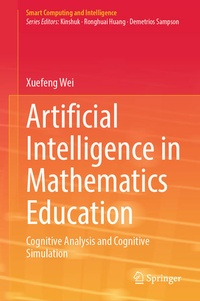
Artificial Intelligence in Mathematics Education
Description

This book focuses on the analysis and application of cognitive simulation in problem solving. It constructs a cognitive model of mathematical problem solving, and based on this model, analyses typical mathematical problems, programs using Lisp language, and subsequently simulates the problem-solving process in Adaptive Control of Thought-Rational (ACT-R). This book introduces the method and process of one-on-one cognitive diagnosis, and designs and implements experiments following the method and process. It serves as a stepping stone for both researchers and practitioners who are interested in using cognitive simulation for students learning.
More details
Other editions
Additional editions
Person
Dr. Xuefeng Wei is the Dean of the College of Education and Full Professor of Educational Technology at the Ludong University, China. He received his Ph.D. from Beijing Normal University, China, and completed his postdoctoral researcher fellow in Learning Technology at the College of Information, University of North Texas, the United States of America. His research interests include artificial intelligence in education, cognitive analysis and simulation, and technology enhanced learning. He has published about 50 international conference papers (as first author), books, and articles in refereed journals, including Computers & Education and Educational Technology Research and Development (ETR&D). Professor Wei also serves as an associate editor of the journal Smart Learning Environments, a peer reviewer for Computers & Education and Open Education Research , a member of the IEEE (Institute of Electrical and Electronics Engineers) Technical Committee on Learning Technologies, and a member of the 2016 and 2017 Horizon Project China Expert Panels.
Content
Preface. Part one: Introduction & Background .-m Chapter 1: Introduction.- Chapter 2: Mathematical Problem solving-a historical perspective.- Chapter 3: Methods and Research Design.- Part two: Cognitive Model and Cognitive Simulation .- Chapter 4: Cognitive Model of Primary School Mathematical Problems Solving.- Chapter 5: Primary School Mathematics Problem Solving Cognitive Simulation.- Part three: Application of Cognitive Simulation .- Chapter 6: Design of Mathematical Inquiry Problems in Primary Schools Based on Cognitive Process.- Chapter 7: "One on one" Cognitive Diagnosis.- Chapter 8: Implication of "One on One" Cognitive Diagnosis.- Chapter 9: Cognitive Simulation of Interaction Process in Math's Class.- Conclusion.
