

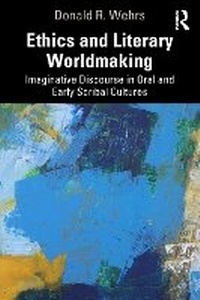
Ethics and Literary Worldmaking
Imaginative Discourse in Oral and Early Scribal Cultures
1st Edition
Published on 9. February 2026
322 pages
978-1-040-80452-0 (ISBN)
Description

Considering poetry, narrative, and performances from diverse oral societies and the earliest scribal cultures, Ethics and Literary Worldmaking traces ways that both oral and written genres participate in communal shaping and reshaping of affectivity, sociality, deliberation, and evaluation.
The study views delineation and revision of shared imagined "worlds" as itself an evolutionary adaptive activity, one through which humans, like other species, adjust behavior and modify their environments to enhance their flourishing. Donald R. Wehrs argues that discursive heritages of oral societies from Africa, Australia, Asia, and the Americas not only delineate diverse ontologies but also seek to negotiate tensions between individual desires and communal interests, and disjunctions between what seems socially or prudentially optimal and what is felt to be right or just. The earliest scribal traditions, Sumerian and Akkadian poetry, draw on patterns of ethically charged worldmaking resembling those featured prominently in heterogeneous surviving oral traditions. Imaginative discourse, whether oral or written, returns incessantly to questioning egocentric and ethnocentric norms and self-privileging assumptions in ways that hierarchical, authoritarian societies cannot completely contain or co-opt.
Ethics and Literary Worldmaking establishes unexpected contexts for addressing literary theory and history relevant to humanities scholarship generally, particularly for those working on ethics and/or science and literature, literary theory, literary history, cognitive literary studies, or comparative studies, but also for teachers of World Literature.
The study views delineation and revision of shared imagined "worlds" as itself an evolutionary adaptive activity, one through which humans, like other species, adjust behavior and modify their environments to enhance their flourishing. Donald R. Wehrs argues that discursive heritages of oral societies from Africa, Australia, Asia, and the Americas not only delineate diverse ontologies but also seek to negotiate tensions between individual desires and communal interests, and disjunctions between what seems socially or prudentially optimal and what is felt to be right or just. The earliest scribal traditions, Sumerian and Akkadian poetry, draw on patterns of ethically charged worldmaking resembling those featured prominently in heterogeneous surviving oral traditions. Imaginative discourse, whether oral or written, returns incessantly to questioning egocentric and ethnocentric norms and self-privileging assumptions in ways that hierarchical, authoritarian societies cannot completely contain or co-opt.
Ethics and Literary Worldmaking establishes unexpected contexts for addressing literary theory and history relevant to humanities scholarship generally, particularly for those working on ethics and/or science and literature, literary theory, literary history, cognitive literary studies, or comparative studies, but also for teachers of World Literature.
More details
Edition
1. Auflage
Language
English
Place of publication
London
United Kingdom
Publishing group
Taylor & Francis Ltd
Target group
Professional and scholarly
File size
1,02 MB
ISBN-13
978-1-040-80452-0 (9781040804520)
Copyright in bibliographic data and cover images is held by Nielsen Book Services Limited or by the publishers or by their respective licensors: all rights reserved.
Schweitzer Classification
Other editions
Additional editions
Donald R. Wehrs
Ethics and Literary Worldmaking
Imaginative Discourse in Oral and Early Scribal Cultures
Book
approx. 02/2026
1st Edition
Routledge
€211.70
Not yet published
Donald R. Wehrs
Ethics and Literary Worldmaking
Imaginative Discourse in Oral and Early Scribal Cultures
Book
approx. 02/2026
1st Edition
Routledge
€65.00
Not yet published
Person
Donald R. Wehrs is Hargis Professor of English Literature Emeritus at Auburn University, USA. He is author of four monographs, most recently Ethical Sense and Literary Significance (2024), and editor or co-editor of six collections, including The Productivity of Negative Emotions in Postcolonial Literature (2025).
Content
Preface
Acknowledgments
Introduction: Oral and Scribal Discourse and Genres in Non-Axial Societies
Part I: Dialogism and Dissonance in Oral and Indigenous Imaginative Discourse
Chapter One: Moral Sociality and Ethical Deliberation in Mythic Storytelling
Chapter Two: Diversely Organized Societies and Heterogeneous Discursive Interventions Chapter Three: Extended Narratives of Mythic-Heroic World Creation
Part II: Signifying Agency and Justifying Power in Mesopotamian Literature
Chapter Four: Literary History's Beginnings and Mesopotamian Cultures' Longue Duree
Chapter Five: Innovation, Conservation, and Foreboding in Akkadian Literary Biculturalism
Chapter Six: Ethics and Worldmaking in the Reconfiguring of Gilgamesh Narratives
Conclusion: The End of a Beginning
Bibliography
Index
Acknowledgments
Introduction: Oral and Scribal Discourse and Genres in Non-Axial Societies
Part I: Dialogism and Dissonance in Oral and Indigenous Imaginative Discourse
Chapter One: Moral Sociality and Ethical Deliberation in Mythic Storytelling
Chapter Two: Diversely Organized Societies and Heterogeneous Discursive Interventions Chapter Three: Extended Narratives of Mythic-Heroic World Creation
Part II: Signifying Agency and Justifying Power in Mesopotamian Literature
Chapter Four: Literary History's Beginnings and Mesopotamian Cultures' Longue Duree
Chapter Five: Innovation, Conservation, and Foreboding in Akkadian Literary Biculturalism
Chapter Six: Ethics and Worldmaking in the Reconfiguring of Gilgamesh Narratives
Conclusion: The End of a Beginning
Bibliography
Index
