

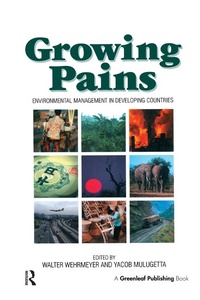
Growing Pains
Environmental Management in Developing Countries
Published on 19. October 2017
288 pages
978-1-351-28311-3 (ISBN)
Description

Environmental management is a global phenomenon, embracing all businesses in all countries, whether or not there already exists an organised response to managing environmental impacts.
Today, there are gross inequalities between the world's richest and poorest nations in terms of income distribution, consumption patterns, access to resources and environmental impact. Yet both the developed north and the developing south are committed, at least in words, to achieving sustainable development.
Public awareness of environmental issues in the North has been rising in recent years and further degradation is now largely minimized through more stringent regulatory regimes, voluntary agreements and growing consumer and stakeholder pressure on corporations. Still, the north is continuing to lead an environmentally unsustainable lifestyle as environmental improvements are nullified by overall increases in consumption levels. In the south, a billion people still do not have access to the most basic needs. Poor countries need to accelerate their consumption growth if they are to ensure that the lives of their people are enriched. However, with rapid economic growth and corresponding increases in consumption now under way, their environmental impact is soon to become substantially greater. In a world that strives towards stemming global crises such as climate change, the path already taken by the rich and high-growth economies over the past century cannot be repeated by the south if the desired objective is to create a future that is truly sustainable.
Growing Pains examines environmental management in the south from a number of perspectives. It is designed to stimulate the discussion about the role that corporations and national and international organizations play in sustainable development. It does not offer panaceas, as each country has its own problems and opportunities; and, after almost 50 years of failed panacea-oriented economic development policy transfer from the north to the south, it is time to abandon hope for universal solutions and instead look to individual approaches that work.
The book is divided into five themes: globalization; the role of business; a focus on national strategies; trade and the environment; and the organizational and structural challenges of sustainable development.
With contributions from an outstanding collection of authors in both the developed and developing worlds including UNIDO; the Thailand Environment Institute, Arthur D. Little, Inc., Shell Peru; IUCN, the Russian Academy of Sciences and IIED, this important and unique new book presents a body of work that will provide essential reading for businesses working in developing countries, environmental and developmental NGOs and researchers engaged in the debate and sharing of best practice in this increasingly critical subject area.
Today, there are gross inequalities between the world's richest and poorest nations in terms of income distribution, consumption patterns, access to resources and environmental impact. Yet both the developed north and the developing south are committed, at least in words, to achieving sustainable development.
Public awareness of environmental issues in the North has been rising in recent years and further degradation is now largely minimized through more stringent regulatory regimes, voluntary agreements and growing consumer and stakeholder pressure on corporations. Still, the north is continuing to lead an environmentally unsustainable lifestyle as environmental improvements are nullified by overall increases in consumption levels. In the south, a billion people still do not have access to the most basic needs. Poor countries need to accelerate their consumption growth if they are to ensure that the lives of their people are enriched. However, with rapid economic growth and corresponding increases in consumption now under way, their environmental impact is soon to become substantially greater. In a world that strives towards stemming global crises such as climate change, the path already taken by the rich and high-growth economies over the past century cannot be repeated by the south if the desired objective is to create a future that is truly sustainable.
Growing Pains examines environmental management in the south from a number of perspectives. It is designed to stimulate the discussion about the role that corporations and national and international organizations play in sustainable development. It does not offer panaceas, as each country has its own problems and opportunities; and, after almost 50 years of failed panacea-oriented economic development policy transfer from the north to the south, it is time to abandon hope for universal solutions and instead look to individual approaches that work.
The book is divided into five themes: globalization; the role of business; a focus on national strategies; trade and the environment; and the organizational and structural challenges of sustainable development.
With contributions from an outstanding collection of authors in both the developed and developing worlds including UNIDO; the Thailand Environment Institute, Arthur D. Little, Inc., Shell Peru; IUCN, the Russian Academy of Sciences and IIED, this important and unique new book presents a body of work that will provide essential reading for businesses working in developing countries, environmental and developmental NGOs and researchers engaged in the debate and sharing of best practice in this increasingly critical subject area.
Reviews / Votes
It is essential reading for all those working on poverty eradication and sustainable development. - 'International Affairs' || This new unique book, with contributions from an outstanding collection of authors in both the developed and developing worlds provides essential reading for theoreticians, ... government ministers and policy planners, chief executive officers in the private sector and their advisers, and heads of institutions. - 'Social and Environmental Accounting' |
| It is undoubtedly essential reading for businesses working in developing countries and those involved in international environmental cooperation, both in the field and in its management. It has high value as background reading for students and researchers in environmental management. - 'International Journal of Environment and Pollution' |
| ... the central message throughout the book is that solutions exist at the local level pertaining to local actors, and as such governmental and multilateral institutions, such as the World Bank, should revise their policies. - 'Indigenous Knowledge and Development Monitor' |
| ... a book which is thought-provoking and, in the ever-growing field of literature on environmental management and best practice, stands out as a comprehensive piece of work ... promoted as an essential read for businesses working in developing countries, environmental NGOs and researchers engaging in the debate ... it would also work as a text for development economics students. - 'Progress in Development Studies '
More details
Language
English
Place of publication
London
United Kingdom
Publishing group
Taylor & Francis Ltd
Target group
College/higher education
File size
12,99 MB
ISBN-13
978-1-351-28311-3 (9781351283113)
Copyright in bibliographic data and cover images is held by Nielsen Book Services Limited or by the publishers or by their respective licensors: all rights reserved.
Schweitzer Classification
Other editions
Additional editions
Book
11/1999
1st Edition
Greenleaf Publishing
€215.41
Shipment within 3-4 weeks
Book
11/1999
1st Edition
Greenleaf Publishing
€67.03
Shipment within 3-4 weeks
Persons
Edited by WALTER WEHRMEYER and YACOB MULUGETTA.
Content
Foreword Carlos Magarinos, Director-General, United Nations Industrial Development Organisation Introduction Walter Wehrmeyer and Yacob Mulugetta, University of Surrey, UK Section 1: Globalisation 1. The environmental challenge of going global Gilbert S. Hedstrom, Ronald A.N. McLeanBernhard H. Metzger, Arthur D. Little, Inc., USA 2. An essay on biodiversity and globalisation Frank Vorhies, IUCN: The World Conservation Organisation, Switzerland 3. Joint implementation of climate change? Distortions in practice and effects on developing countries Neil E. Harrison, University of Wyoming, USA 4. Financial globalisation and sustainable development in Mexico David Barkin, Universidad Autonoma Metropolitana, Mexico Section 2: Focus on business 5. The Effect of Environmental Regulations on Industrial Competitiveness of Selected Industries in Developing Countries Ralph (Skip) Luken, United Nations Industrial Development Organisation, Austria 6. Multinational Corporations' Environmental Performance in Developing Countries: The Aluminum Company of America Dennis A. Rondinelli, University of North Carolina, USA Gyula Vastag, Michigan State University, East Lansing, Michigan, USA 7. ISO 14001: The Severe Challenge for China. An Overview on the Problems China Faced in the Implementation and Certification of ISO 14001 Di Chang-Xing (Mike), ERM Certification and Verification Service, China 8. Environmental Management, Crime and Information: A Russian Case Study Alexey A. Voinov, University of Maryland, USA Irina P. Glazyrina, GEF Project, Russia Bruno Pavoni and Nadezhda A. Zharova, University of Venice, Italy Section 3: National focus 9. Driving forces and barriers to the implementation of sound environmental management in the Andean Region of Latin America Percy Garcia, Julia Gonzalez and Dixon Thompson, University of Calgary, Canada 10. Environmental management in uncertain economies Alexey A. Voinov, University of Maryland, USA Irina P. Glazyrina, GEF Project, Russia Bruno Pavoni and Nadezhda A. Zharova, University of Venice, Italy 11. Just green marketing? State, business and environmental management in Egypt Jeannie Sowers, Princeton University, USA 12. Environmental management in Thailand: Achievements, barriers and future trends Mandar Parasnis, Thailand Environment Institute 13. The Colombian road to environmental management Emilio Latorre, Universidad del Valle, Colombia Section 4: Trade and the environment 14. Trade liberalisation and the developing world: The environmental impact of the Uruguay Round Matthew A. Cole, University of Birmingham, UK 15. Reaping the benefits: Trade opportunities for developing-country producers from sustainable consumption and production Nick Robins and Sarah Roberts, International Institute for Environment and Development, UK 16. Multinational corporations' impacts on the environment and communities in the developing world: A synthesis of the contemporary debate Titus Moser and Damian Miller, Cambridge University, UK 17. Logging versus Recycling: Problems in the industrial ecology of pulp manufacturing in South-East Asia David A. Sonnenfeld, Washington State University, USA Section 5: Environmental management and sustainable development 18. Environmental management and organisational change: The impact of the world ban Ans Kolk, University of Amsterdam, Netherlands 19. Sustainable development and the environment: Lessons from the development experience of Kerala State in India Govindan Parayil, Hong Kong University of Science and Technology 20. Searching for sustainability in the Marshall Islands: Development dreams clash with ecological reality Barbara A. Ribbens, Western Illinois University, USA Eric Ribbens, University of Evansville, USA 21. The role of stakeholder participation: Linkages to stakeholder impact assessment and social capital in Camisea, Peru Murray Jones, Shell Prospecting & Development, Peru 22. Indonesia in the 21st Century: environment at the crossroads Peter Koffel, Murdoch University, Australia 23. Competing discourses of environmental and water management in post-apartheid South Africa Patrick Bond, University of the Witwatersrand, South Africa Robyn Stein, attorney in environmental and water law, South Africa
