

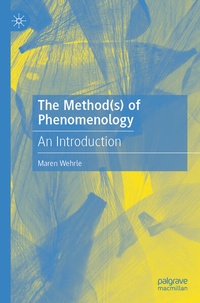
The Method(s) of Phenomenology
Description

This textbook presents the phenomenological method(s) not only theoretically, but also in their current intra- and interdisciplinary applications. "Back to the things themselves as they are given in experience" - this is the motto of phenomenology starting from Edmund Husserl. For this we have to question the self-evident and bracket all presuppositions. But how can we do this? How do we arrive at an unprejudiced description? How can the general be determined in the concrete? And how can we inquire into the conditions of experience? This will be explained with reference to historical texts and illustrated using contemporary examples.
The present text is an updated and re-worked version of "Phänomenologie. Eine Einführung" (Berlin: Springer-Verlag, J.B. Metzler 2022). The translation was done with the help of artificial intelligence. A subsequent manual revision was done primarily in terms of content.
More details
Other editions
Additional editions
Person
Maren Wehrle, is Associate Professor at the Erasmus School of Philosophy, Erasmus University Rotterdam. Her research focuses on phenomenology, feminist philosophy, philosophical anthropology, and cognitive psychology. She has written a monograph and numerous articles (including in Husserl Studies) on Edmund Husserl and the importance of his insights for interdisciplinary research, applied and critical phenomenology, and is co-editor of the Husserl Handbook (J.B. Metzler 2017).
Content
Acknowledgement.- Preface: To the Things and Back.- 1. Introduction: To the Things Themselves? .- 2. Methods of Phenomenology.- 3. Phenomenology in Action.- Index.
