

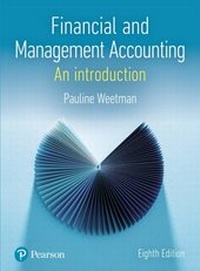
Financial and Management Accounting
Description

Financial & Management Accounting: An Introduction, 8th edition is a core textbook in the field, written by leading expert teacher in Accounting, Pauline Weetman.
An essential learning resource for undergraduates on Business Studies degrees, Accounting courses, or MBA students and professionals, this comprehensive introduction will provide the foundation you need for your course, presenting a more critical approach to the subject.
The eighth edition of the text retains all the features that have contributed to the book's popularity: with its clear and accessible writing style, focus on the accounting equation, and extensive use of real-world case studies, the book aims to guide you through the 'why' and not just the 'what' of financial and management accounting.
Key features include:
- Definitions and terminology aligned with the 2018 IASB Conceptual Framework
- Content fully up-to-date with the International Financial Reporting Standards (IFRS)
- New case studies giving examples from real-world companies
- Focus on specific knowledge outcomes with end-of-chapter self-evaluation
- Questions graded according to difficulty, allowing you to test your understanding
- Activities aligned to each section of a chapter, encouraging students to explore and consider issues from different viewpoints
With a range of activities throughout the chapters that encourage you to explore and consider issues from different viewpoints, this market-leading text is a fundamental learning resource and introduction to the field.
All prices
More details
Other editions
Additional editions
Person
Pauline Weetman BA, BSc (Econ), Ph.D., CA, FRSE, is Professor Emerita of Accounting at the University of Edinburgh and has extensive experience in teaching at Undergraduate and Postgraduate levels, with previous chairs held at Stirling, Heriot-Watt, Strathclyde and Glasgow Universities.
She received the Distinguished Academic Award of the British Accounting Association in 2005. She has convened the examining board of the Institute of Chartered Accountants of Scotland and was formerly Director of Research at ICAS.
Content
FINANCIAL ACCOUNTING
Part 1 A conceptual framework: setting the scene
- Who needs accounting?
- A systematic approach to financial reporting: the accounting equation
- Financial statements from the accounting equation
- Ensuring the quality of financial statements
Part 2 Reporting the transactions of a business
- Accounting information for service businesses
- Accounting information for trading businesses
Part 3 Recognition in financial statements
- Published financial statements
- Non-current (fixed) assets
- Current assets
- Current liabilities
- Provisions and non-current (long-term) liabilities
- Ownership interest
Part 4 Analysis and issues in reporting
- Ratio analysis
- Reporting corporate performance
- Reporting cash flows
MANAGEMENT ACCOUNTING
Part 5 Setting the scene and defining the basic tools of management accounting
- Functions of management accounting
- Classification of costs
- Product costs: materials, labour and overheads
Part 6 Job costs and stock valuation
- Job costing
Part 7 Decision making
- Break-even analysis and short-term decision making
Part 8 Planning and control
- Preparing a budget
- Standard costs
- Performance evaluation and feedback reporting
Part 9 Capital investment appraisal and business strategy
- Capital investment appraisal
- Business strategy and management accounting
- Information extracted from annual report of Safe and Sure Group plc, used throughout Financial Accounting
- Solutions to numerical and technical questions in Financial Accounting
- Solutions to numerical and technical questions in Management Accounting
