

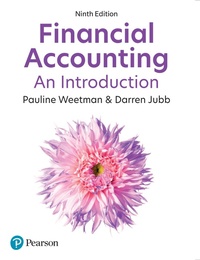
Financial Accounting: An Introduction
9th Edition
Published on 21. May 2024
809 pages
978-1-292-72536-9 (ISBN)
Description

Gain a deeper understanding of the main Financial Accounting principles with a core textbook on the subject. Financial Accounting: An Introduction, 9th edition by Pauline Weetman and Darren Jubb will offer you the resources you need to explore and acquire a deeper understanding of a wide range of concepts around the discipline.
Written by expert teachers in the field, this text is ideal for undergraduates in Business Studies degrees, Undergraduates in Accounting courses, students studying Accounting for MBA and Postgraduate courses, and Professional courses introducing Accounting for the first time.
This edition focuses on retaining all the features that have contributed to its popularity, including its focus on the accounting equations, a clear and accessible writing style, a frequent short activities throughout the book, and the extensive use of real-world case studies, offering you a deeper understanding of the topics.
Key features:
Definitions and terminology aligned with the 2018 IASB Conceptual Framework.
Fully up-to-date with the International Financial Reporting Standards (IFRS).
New case studies provide examples from real-world companies.
Activities aligned to each chapter section, encouraging students to explore and consider issues from different angles.
Experience-driven conversations throughout the book between two managers expanded for this edition and updated with an even greater practical emphasis.
Extensive coverage of fair value is provided throughout the text.
Exploration of the Strategic Report and Directors' Report.
Focus on specific knowledge outcomes with end-of-chapter self-evaluations.
Questions testing your understanding are graded according to difficulty.
With a strong emphasis on the 2018 Conceptual Framework of the International Accounting Standards Board, this text is an essential resource that will guide you through the 'whys' and not just the 'whats' of Financial Accounting.
Written by expert teachers in the field, this text is ideal for undergraduates in Business Studies degrees, Undergraduates in Accounting courses, students studying Accounting for MBA and Postgraduate courses, and Professional courses introducing Accounting for the first time.
This edition focuses on retaining all the features that have contributed to its popularity, including its focus on the accounting equations, a clear and accessible writing style, a frequent short activities throughout the book, and the extensive use of real-world case studies, offering you a deeper understanding of the topics.
Key features:
Definitions and terminology aligned with the 2018 IASB Conceptual Framework.
Fully up-to-date with the International Financial Reporting Standards (IFRS).
New case studies provide examples from real-world companies.
Activities aligned to each chapter section, encouraging students to explore and consider issues from different angles.
Experience-driven conversations throughout the book between two managers expanded for this edition and updated with an even greater practical emphasis.
Extensive coverage of fair value is provided throughout the text.
Exploration of the Strategic Report and Directors' Report.
Focus on specific knowledge outcomes with end-of-chapter self-evaluations.
Questions testing your understanding are graded according to difficulty.
With a strong emphasis on the 2018 Conceptual Framework of the International Accounting Standards Board, this text is an essential resource that will guide you through the 'whys' and not just the 'whats' of Financial Accounting.
More details
Edition
9th edition
Language
English
Place of publication
Harlow
United Kingdom
Target group
College/higher education
File size
12,41 MB
ISBN-13
978-1-292-72536-9 (9781292725369)
Copyright in bibliographic data and cover images is held by Nielsen Book Services Limited or by the publishers or by their respective licensors: all rights reserved.
Schweitzer Classification
Other editions
Additional editions
Book
05/2024
9th Edition
Pearson Education Limited
€79.99
Shipment within 10-20 days
Persons
Pauline Weetman BA, BSc (Econ), PhD, CA, FRSE, is Professor Emerita of Accounting at the University of Edinburgh, with extensive experience in teaching at undergraduate and postgraduate levels, with previous chairs held at various universities across Scotland, UK.
Darren Jubb is a lecturer in Accounting at the University of Dundee. He is a qualified Chartered Accountant with several years of experience teaching financial accounting and auditing at undergraduate and postgraduate levels.
Darren Jubb is a lecturer in Accounting at the University of Dundee. He is a qualified Chartered Accountant with several years of experience teaching financial accounting and auditing at undergraduate and postgraduate levels.
Content
Preface
Part 1 Corporate Reporting: Annual Report and Accounts
Users' needs for information
What influences the annual report?
The accounting equation: a systematic approach to financial reporting
Financial statements from the accounting equation
Ensuring the quality of financial statements
Part 2 Reading and interpreting company reports
Published financial statements
Ratio analysis
Ratios - worked example
Part 3 Reporting the transactions of a business
Accounting information for service businesses
Accounting information for trading businesses
Part 4 Recognition in financial statements
Non-current (fixed) assets
Current assets
Current liabilities
Provisions and non-current (long-term) liabilities
Ownership interest
Index
Acknowledgements
Part 1 Corporate Reporting: Annual Report and Accounts
Users' needs for information
What influences the annual report?
The accounting equation: a systematic approach to financial reporting
Financial statements from the accounting equation
Ensuring the quality of financial statements
Part 2 Reading and interpreting company reports
Published financial statements
Ratio analysis
Ratios - worked example
Part 3 Reporting the transactions of a business
Accounting information for service businesses
Accounting information for trading businesses
Part 4 Recognition in financial statements
Non-current (fixed) assets
Current assets
Current liabilities
Provisions and non-current (long-term) liabilities
Ownership interest
Index
Acknowledgements
