

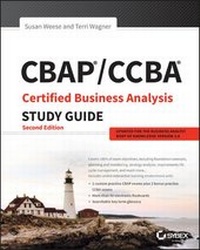
CBAP / CCBA Certified Business Analysis Study Guide
2nd Edition
Published on 20. December 2016
552 pages
978-1-119-24885-9 (ISBN)
Description

The bestselling CBAP/CCBA study guide, updated for exam v3.0
The CBAP/CCBA Certified Business Analysis Study Guide, Second Edition offers 100% coverage of all exam objectives for the Certified Business Analysis Professional (CBAP) and Certification of Competency in Business Analysis (CCBA) exams offered by the International Institute of Business Analysis (IIBA). Detailed coverage encompasses all six knowledge areas defined by the Guide to Business Analysis Body of Knowledge (BABOK): Planning and Monitoring, Elicitation, Requirements Management and Communication, Enterprise Analysis, Requirements Analysis, and Solution Assessment and Validation, including expert guidance toward all underlying competencies. Real-world scenarios help you align your existing experience with the BABOK, and topic summaries, tips and tricks, practice questions, and objective-mapping give you a solid framework for success on the exam. You also gain access to the Sybex interactive learning environment, featuring review questions, electronic flashcards, and four practice exams to help you gauge your understanding and be fully prepared exam day.
As more and more organizations seek to streamline production models, the demand for qualified Business Analysts is growing. This guide provides a personalized study program to help you take your place among those certified in essential business analysis skills.
* Review the BABOK standards and best practices
* Master the core Business Analysis competencies
* Test your preparedness with focused review questions
* Access CBAP and CCBA practice exams, study tools, and more
As the liaison between the customer and the technical team, the Business Analyst is integral to ensuring that the solution satisfies the customer's needs. The BABOK standards codify best practices for this essential role, and the CBAP and CCBA certifications prove your ability to perform them effectively. The CBAP/CCBA Certified Business Analysis Study Guide, Second Edition provides thorough preparation customizable to your needs, to help you maximize your study time and ensure your success.
More details
Other editions
Additional editions
Susan Weese | Terri Wagner
CBAP / CCBA Certified Business Analysis Study Guide
Book
01/2017
2nd Edition
Sybex Inc.,U.S.
€56.00
Shipment within 15-20 days
Persons
Susan Weese, CBAP, PgMP, PMP, founded Rhyming Planet Inc., an IT project management/business analysis consulting firm. She has more than 25 years of software and project management experience, and currently designs, builds and delivers standard and customized project, process, and requirements development training courses.
Terri Wagner, MA, PMP, CSM, is an owner and managing member of Mentor Source, Inc., a project management consulting and training company. She is coauthor and technical editor for several project management and business analysis books including Project Manager Street Smarts, published by Sybex.
Content
1 - Cover [Seite 1]
2 - Title Page [Seite 3]
3 - Copyright [Seite 4]
4 - Contents [Seite 9]
5 - Introduction [Seite 15]
5.1 - What You Will Learn [Seite 15]
5.2 - What Is Covered in This Book [Seite 16]
5.3 - How to Become CBAP®/CCBAT Certified [Seite 18]
5.3.1 - More on the CBAP® Exam [Seite 18]
5.3.2 - More on the CCBAT Exam [Seite 18]
5.3.3 - What's on the Exams [Seite 19]
5.3.4 - Types of Questions [Seite 19]
5.4 - How to Use This Book [Seite 24]
5.5 - Interactive Online Learning Environment and Test Bank [Seite 25]
5.5.1 - Test Taking Tips And Advice [Seite 25]
5.6 - How to Contact the Author [Seite 26]
5.7 - CBAP®/CCBAT: Certified Business Analysts Study Guide BABOK® Guide Version 3.0 Knowledge Areas and Underlying Competencies [Seite 27]
6 - Assessment Test [Seite 30]
7 - Answers to Assessment Test [Seite 37]
8 - Chapter 1 Foundation Concepts [Seite 41]
8.1 - What Is Business Analysis? [Seite 42]
8.1.1 - The Business Analyst's Role [Seite 43]
8.1.2 - Essential Skills of Effective Business Analysts [Seite 44]
8.1.3 - The Business Analyst and the Project Manager [Seite 46]
8.1.4 - Dealing with Key Stakeholders [Seite 47]
8.2 - Reviewing the Business Analysis Core Concept Model (BACCMT) [Seite 48]
8.3 - Exploring the Business Analysis Knowledge Areas [Seite 49]
8.3.1 - Knowledge Area: Business Analysis Planning and Monitoring [Seite 50]
8.3.2 - Knowledge Area: Strategy Analysis [Seite 51]
8.3.3 - Knowledge Area: Requirements Life Cycle Management [Seite 51]
8.3.4 - Knowledge Area: Elicitation and Collaboration [Seite 51]
8.3.5 - Knowledge Area: Requirements Analysis and Design Definition [Seite 52]
8.3.6 - Knowledge Area: Solution Evaluation [Seite 52]
8.3.7 - How Are the Knowledge Areas Organized? [Seite 53]
8.4 - Exploring Requirements [Seite 54]
8.4.1 - Distinguishing Between Requirements and Design [Seite 55]
8.4.2 - Defining the Requirements Management Process [Seite 56]
8.4.3 - Classifying Requirements [Seite 56]
8.5 - Understanding How This Applies to Your Projects [Seite 62]
8.6 - Perspectives on Business Analysis [Seite 64]
8.7 - Summary [Seite 65]
8.8 - Exam Essentials [Seite 66]
8.9 - Key Terms [Seite 67]
8.10 - Review Questions [Seite 69]
9 - Chapter 2 Controlled Start: Business Analysis Planning and Monitoring [Seite 73]
9.1 - Business Analysis Planning and Monitoring [Seite 74]
9.1.1 - The Business Analyst's Task List [Seite 75]
9.1.2 - When Does Business Analysis Planning and Monitoring Take Place? [Seite 76]
9.1.3 - Plan the Business Analysis Approach [Seite 78]
9.1.4 - Plan Stakeholder Engagement [Seite 89]
9.1.5 - Plan Business Analysis Governance [Seite 99]
9.1.6 - Plan Business Analysis Information Management [Seite 106]
9.1.7 - Identify Business Analysis Performance Improvements [Seite 114]
9.2 - How This Applies to Your Projects [Seite 122]
9.3 - Summary [Seite 123]
9.4 - Exam Essentials [Seite 124]
9.5 - Key Terms [Seite 125]
9.6 - Review Questions [Seite 127]
10 - Chapter 3 Controlled Start: Strategy Analysis [Seite 131]
10.1 - Strategy Analysis [Seite 132]
10.1.1 - The Business Analyst's Task List [Seite 134]
10.1.2 - When Does Strategy Analysis Take Place? [Seite 135]
10.1.3 - Analyze Current State [Seite 135]
10.1.4 - Define Future State [Seite 147]
10.1.5 - Assess Risks [Seite 159]
10.1.6 - Define Change Strategy [Seite 166]
10.2 - How This Applies to Your Projects [Seite 176]
10.3 - Summary [Seite 178]
10.4 - Exam Essentials [Seite 179]
10.5 - Key Terms [Seite 179]
10.6 - Review Questions [Seite 181]
11 - Chapter 4 Overarching Tasks: Requirements Life Cycle Management [Seite 185]
11.1 - Requirements Life Cycle Management [Seite 186]
11.1.1 - The Business Analyst's Task List [Seite 188]
11.1.2 - When Does Requirements Life Cycle Management Take Place? [Seite 189]
11.1.3 - Trace Requirements [Seite 190]
11.1.4 - Maintain Requirements [Seite 196]
11.1.5 - Prioritize Requirements [Seite 200]
11.1.6 - Assess Requirements Changes [Seite 207]
11.1.7 - Approve Requirements [Seite 214]
11.2 - How This Applies to Your Projects [Seite 219]
11.3 - Summary [Seite 220]
11.4 - Exam Essentials [Seite 221]
11.5 - Key Terms [Seite 222]
11.6 - Review Questions [Seite 224]
12 - Chapter 5 Controlled Middle: Elicitation and Collaboration [Seite 229]
12.1 - Requirements Elicitation [Seite 230]
12.1.1 - The Business Analyst's Task List [Seite 232]
12.1.2 - When Does Elicitation Take Place? [Seite 233]
12.1.3 - Prepare for Elicitation [Seite 233]
12.1.4 - Conduct Elicitation [Seite 241]
12.1.5 - Confirm Elicitation Results [Seite 250]
12.1.6 - Communicate Business Analysis Information [Seite 253]
12.1.7 - Manage Stakeholder Collaboration [Seite 257]
12.2 - How This Applies to Your Projects [Seite 262]
12.3 - Summary [Seite 265]
12.4 - Exam Essentials [Seite 265]
12.5 - Key Terms [Seite 267]
12.6 - Review Questions [Seite 268]
13 - Chapter 6 Controlled Middle: Requirements Analysis and Design Definition [Seite 273]
13.1 - Requirements Analysis and Design Definition [Seite 274]
13.1.1 - The Business Analyst's Task List [Seite 276]
13.1.2 - When Does Requirements Analysis and Design Definition Take Place? [Seite 276]
13.1.3 - Specify and Model Requirements [Seite 277]
13.1.4 - Verify Requirements [Seite 296]
13.1.5 - Validate Requirements [Seite 301]
13.1.6 - Define Requirements Architecture [Seite 305]
13.1.7 - Define Design Options [Seite 312]
13.1.8 - Analyze Potential Value and Recommend Solution [Seite 318]
13.2 - How This Applies to Your Projects [Seite 323]
13.3 - Summary [Seite 324]
13.4 - Exam Essentials [Seite 325]
13.5 - Key Terms [Seite 327]
13.6 - Review Questions [Seite 329]
14 - Chapter 7 Controlled End: Solution Evaluation [Seite 333]
14.1 - Solution Evaluation [Seite 334]
14.1.1 - The Business Analyst's Task List [Seite 336]
14.1.2 - When Does Solution Evaluation Take Place? [Seite 336]
14.1.3 - Measure Solution Performance [Seite 337]
14.1.4 - Analyze Performance Measures [Seite 342]
14.1.5 - Assess Solution Limitations [Seite 348]
14.1.6 - Assess Enterprise Limitations [Seite 352]
14.1.7 - Recommend Actions to Increase Solution Value [Seite 359]
14.2 - How This Applies to Your Projects [Seite 364]
14.3 - Summary [Seite 368]
14.4 - Exam Essentials [Seite 368]
14.5 - Key Terms [Seite 369]
14.6 - Review Questions [Seite 371]
15 - Chapter 8 Underlying Competencies [Seite 375]
15.1 - Essential Skills of Effective Business Analysts [Seite 376]
15.1.1 - When Are the Underlying Competencies Used? [Seite 377]
15.1.2 - Analytical Thinking and Problem-Solving Skills [Seite 378]
15.1.3 - Behavioral Characteristics [Seite 382]
15.1.4 - Business Knowledge [Seite 385]
15.1.5 - Tools and Technology [Seite 388]
15.1.6 - Communication Skills [Seite 389]
15.1.7 - Interaction Skills [Seite 392]
15.2 - How This Applies to Your Projects [Seite 398]
15.3 - Summary [Seite 400]
15.4 - Exam Essentials [Seite 400]
15.5 - Key Terms [Seite 402]
15.6 - Review Questions [Seite 404]
16 - Chapter 9 Five Perspectives on Business Analysis [Seite 409]
16.1 - The Agile Perspective [Seite 411]
16.1.1 - Change Scope [Seite 411]
16.1.2 - Business Analysis Scope [Seite 412]
16.1.3 - Approaches and Techniques [Seite 413]
16.1.4 - Underlying Competencies [Seite 416]
16.1.5 - Knowledge Area Impacts [Seite 416]
16.2 - The Business Intelligence Perspective [Seite 419]
16.2.1 - Change Scope [Seite 420]
16.2.2 - Business Analysis Scope [Seite 421]
16.2.3 - Approaches and Techniques [Seite 422]
16.2.4 - Underlying Competencies [Seite 424]
16.2.5 - Knowledge Area Impacts [Seite 424]
16.3 - The Information Technology Perspective [Seite 428]
16.3.1 - Change Scope [Seite 429]
16.3.2 - Business Analysis Scope [Seite 431]
16.3.3 - Approaches and Techniques [Seite 432]
16.3.4 - Underlying Competencies [Seite 432]
16.3.5 - Knowledge Area Impacts [Seite 433]
16.4 - The Business Architecture Perspective [Seite 437]
16.4.1 - Change Scope [Seite 438]
16.4.2 - Business Analysis Scope [Seite 439]
16.4.3 - Reference Models and Techniques [Seite 440]
16.4.4 - Underlying Competencies [Seite 442]
16.4.5 - Knowledge Area Impacts [Seite 442]
16.5 - The Business Process Management Perspective [Seite 447]
16.5.1 - Change Scope [Seite 447]
16.5.2 - Business Analysis Scope [Seite 449]
16.5.3 - Frameworks, Methodologies, and Techniques [Seite 451]
16.5.4 - Underlying Competencies [Seite 453]
16.5.5 - Knowledge Area Impacts [Seite 455]
16.6 - Understanding How This Applies to Your Projects [Seite 458]
16.7 - Summary [Seite 458]
16.8 - Exam Essentials [Seite 459]
16.9 - Key Terms [Seite 459]
16.10 - Review Questions [Seite 461]
17 - Appendix A Advice on Completing Your Exam Application [Seite 465]
17.1 - The Competency-Based Certification Model [Seite 466]
17.2 - CBAP® Experience Requirements [Seite 467]
17.3 - CCBAT Experience Requirements [Seite 469]
17.4 - Calculate Your Experience Hours [Seite 470]
17.5 - Additional Exam Eligibility Requirements [Seite 471]
17.6 - The Exam Application Process [Seite 473]
18 - Appendix B Knowledge Areas, Tasks, and Elements [Seite 475]
18.1 - Review the Six Knowledge Areas [Seite 476]
18.2 - Knowledge Areas, Tasks, and Elements [Seite 477]
19 - Appendix C Mapping Techniques, Stakeholders, and Deliverables to Knowledge Areas and Tasks [Seite 483]
19.1 - Techniques [Seite 484]
19.2 - Stakeholders [Seite 495]
19.3 - Deliverables [Seite 499]
20 - Appendix D Summary of Business Analysis Techniques [Seite 507]
20.1 - Business Analysis Techniques [Seite 508]
20.1.1 - Quick Review of Techniques [Seite 508]
21 - Appendix E Summary of Business Analysis Outputs [Seite 513]
21.1 - Business Analysis Outputs [Seite 514]
22 - Appendix F Answers to Review Questions [Seite 519]
22.1 - Chapter 1: Foundation Concepts [Seite 520]
22.2 - Chapter 2: Controlled Start: Business Analysis Planning and Monitoring [Seite 521]
22.3 - Chapter 3: Controlled Start: Strategy Analysis [Seite 523]
22.4 - Chapter 4: Overarching Tasks: Requirements Life Cycle Management [Seite 524]
22.5 - Chapter 5: Controlled Middle: Elicitation and Collaboration [Seite 526]
22.6 - Chapter 6: Controlled Middle: Requirements Analysis and Design Definition [Seite 527]
22.7 - Chapter 7: Controlled End: Solution Evaluation [Seite 528]
22.8 - Chapter 8: Underlying Competencies [Seite 530]
22.9 - Chapter 9: Five Perspectives on Business Analysis [Seite 531]
23 - Index [Seite 535]
24 - Advert [Seite 554]
25 - EULA [Seite 555]
2 - Title Page [Seite 3]
3 - Copyright [Seite 4]
4 - Contents [Seite 9]
5 - Introduction [Seite 15]
5.1 - What You Will Learn [Seite 15]
5.2 - What Is Covered in This Book [Seite 16]
5.3 - How to Become CBAP®/CCBAT Certified [Seite 18]
5.3.1 - More on the CBAP® Exam [Seite 18]
5.3.2 - More on the CCBAT Exam [Seite 18]
5.3.3 - What's on the Exams [Seite 19]
5.3.4 - Types of Questions [Seite 19]
5.4 - How to Use This Book [Seite 24]
5.5 - Interactive Online Learning Environment and Test Bank [Seite 25]
5.5.1 - Test Taking Tips And Advice [Seite 25]
5.6 - How to Contact the Author [Seite 26]
5.7 - CBAP®/CCBAT: Certified Business Analysts Study Guide BABOK® Guide Version 3.0 Knowledge Areas and Underlying Competencies [Seite 27]
6 - Assessment Test [Seite 30]
7 - Answers to Assessment Test [Seite 37]
8 - Chapter 1 Foundation Concepts [Seite 41]
8.1 - What Is Business Analysis? [Seite 42]
8.1.1 - The Business Analyst's Role [Seite 43]
8.1.2 - Essential Skills of Effective Business Analysts [Seite 44]
8.1.3 - The Business Analyst and the Project Manager [Seite 46]
8.1.4 - Dealing with Key Stakeholders [Seite 47]
8.2 - Reviewing the Business Analysis Core Concept Model (BACCMT) [Seite 48]
8.3 - Exploring the Business Analysis Knowledge Areas [Seite 49]
8.3.1 - Knowledge Area: Business Analysis Planning and Monitoring [Seite 50]
8.3.2 - Knowledge Area: Strategy Analysis [Seite 51]
8.3.3 - Knowledge Area: Requirements Life Cycle Management [Seite 51]
8.3.4 - Knowledge Area: Elicitation and Collaboration [Seite 51]
8.3.5 - Knowledge Area: Requirements Analysis and Design Definition [Seite 52]
8.3.6 - Knowledge Area: Solution Evaluation [Seite 52]
8.3.7 - How Are the Knowledge Areas Organized? [Seite 53]
8.4 - Exploring Requirements [Seite 54]
8.4.1 - Distinguishing Between Requirements and Design [Seite 55]
8.4.2 - Defining the Requirements Management Process [Seite 56]
8.4.3 - Classifying Requirements [Seite 56]
8.5 - Understanding How This Applies to Your Projects [Seite 62]
8.6 - Perspectives on Business Analysis [Seite 64]
8.7 - Summary [Seite 65]
8.8 - Exam Essentials [Seite 66]
8.9 - Key Terms [Seite 67]
8.10 - Review Questions [Seite 69]
9 - Chapter 2 Controlled Start: Business Analysis Planning and Monitoring [Seite 73]
9.1 - Business Analysis Planning and Monitoring [Seite 74]
9.1.1 - The Business Analyst's Task List [Seite 75]
9.1.2 - When Does Business Analysis Planning and Monitoring Take Place? [Seite 76]
9.1.3 - Plan the Business Analysis Approach [Seite 78]
9.1.4 - Plan Stakeholder Engagement [Seite 89]
9.1.5 - Plan Business Analysis Governance [Seite 99]
9.1.6 - Plan Business Analysis Information Management [Seite 106]
9.1.7 - Identify Business Analysis Performance Improvements [Seite 114]
9.2 - How This Applies to Your Projects [Seite 122]
9.3 - Summary [Seite 123]
9.4 - Exam Essentials [Seite 124]
9.5 - Key Terms [Seite 125]
9.6 - Review Questions [Seite 127]
10 - Chapter 3 Controlled Start: Strategy Analysis [Seite 131]
10.1 - Strategy Analysis [Seite 132]
10.1.1 - The Business Analyst's Task List [Seite 134]
10.1.2 - When Does Strategy Analysis Take Place? [Seite 135]
10.1.3 - Analyze Current State [Seite 135]
10.1.4 - Define Future State [Seite 147]
10.1.5 - Assess Risks [Seite 159]
10.1.6 - Define Change Strategy [Seite 166]
10.2 - How This Applies to Your Projects [Seite 176]
10.3 - Summary [Seite 178]
10.4 - Exam Essentials [Seite 179]
10.5 - Key Terms [Seite 179]
10.6 - Review Questions [Seite 181]
11 - Chapter 4 Overarching Tasks: Requirements Life Cycle Management [Seite 185]
11.1 - Requirements Life Cycle Management [Seite 186]
11.1.1 - The Business Analyst's Task List [Seite 188]
11.1.2 - When Does Requirements Life Cycle Management Take Place? [Seite 189]
11.1.3 - Trace Requirements [Seite 190]
11.1.4 - Maintain Requirements [Seite 196]
11.1.5 - Prioritize Requirements [Seite 200]
11.1.6 - Assess Requirements Changes [Seite 207]
11.1.7 - Approve Requirements [Seite 214]
11.2 - How This Applies to Your Projects [Seite 219]
11.3 - Summary [Seite 220]
11.4 - Exam Essentials [Seite 221]
11.5 - Key Terms [Seite 222]
11.6 - Review Questions [Seite 224]
12 - Chapter 5 Controlled Middle: Elicitation and Collaboration [Seite 229]
12.1 - Requirements Elicitation [Seite 230]
12.1.1 - The Business Analyst's Task List [Seite 232]
12.1.2 - When Does Elicitation Take Place? [Seite 233]
12.1.3 - Prepare for Elicitation [Seite 233]
12.1.4 - Conduct Elicitation [Seite 241]
12.1.5 - Confirm Elicitation Results [Seite 250]
12.1.6 - Communicate Business Analysis Information [Seite 253]
12.1.7 - Manage Stakeholder Collaboration [Seite 257]
12.2 - How This Applies to Your Projects [Seite 262]
12.3 - Summary [Seite 265]
12.4 - Exam Essentials [Seite 265]
12.5 - Key Terms [Seite 267]
12.6 - Review Questions [Seite 268]
13 - Chapter 6 Controlled Middle: Requirements Analysis and Design Definition [Seite 273]
13.1 - Requirements Analysis and Design Definition [Seite 274]
13.1.1 - The Business Analyst's Task List [Seite 276]
13.1.2 - When Does Requirements Analysis and Design Definition Take Place? [Seite 276]
13.1.3 - Specify and Model Requirements [Seite 277]
13.1.4 - Verify Requirements [Seite 296]
13.1.5 - Validate Requirements [Seite 301]
13.1.6 - Define Requirements Architecture [Seite 305]
13.1.7 - Define Design Options [Seite 312]
13.1.8 - Analyze Potential Value and Recommend Solution [Seite 318]
13.2 - How This Applies to Your Projects [Seite 323]
13.3 - Summary [Seite 324]
13.4 - Exam Essentials [Seite 325]
13.5 - Key Terms [Seite 327]
13.6 - Review Questions [Seite 329]
14 - Chapter 7 Controlled End: Solution Evaluation [Seite 333]
14.1 - Solution Evaluation [Seite 334]
14.1.1 - The Business Analyst's Task List [Seite 336]
14.1.2 - When Does Solution Evaluation Take Place? [Seite 336]
14.1.3 - Measure Solution Performance [Seite 337]
14.1.4 - Analyze Performance Measures [Seite 342]
14.1.5 - Assess Solution Limitations [Seite 348]
14.1.6 - Assess Enterprise Limitations [Seite 352]
14.1.7 - Recommend Actions to Increase Solution Value [Seite 359]
14.2 - How This Applies to Your Projects [Seite 364]
14.3 - Summary [Seite 368]
14.4 - Exam Essentials [Seite 368]
14.5 - Key Terms [Seite 369]
14.6 - Review Questions [Seite 371]
15 - Chapter 8 Underlying Competencies [Seite 375]
15.1 - Essential Skills of Effective Business Analysts [Seite 376]
15.1.1 - When Are the Underlying Competencies Used? [Seite 377]
15.1.2 - Analytical Thinking and Problem-Solving Skills [Seite 378]
15.1.3 - Behavioral Characteristics [Seite 382]
15.1.4 - Business Knowledge [Seite 385]
15.1.5 - Tools and Technology [Seite 388]
15.1.6 - Communication Skills [Seite 389]
15.1.7 - Interaction Skills [Seite 392]
15.2 - How This Applies to Your Projects [Seite 398]
15.3 - Summary [Seite 400]
15.4 - Exam Essentials [Seite 400]
15.5 - Key Terms [Seite 402]
15.6 - Review Questions [Seite 404]
16 - Chapter 9 Five Perspectives on Business Analysis [Seite 409]
16.1 - The Agile Perspective [Seite 411]
16.1.1 - Change Scope [Seite 411]
16.1.2 - Business Analysis Scope [Seite 412]
16.1.3 - Approaches and Techniques [Seite 413]
16.1.4 - Underlying Competencies [Seite 416]
16.1.5 - Knowledge Area Impacts [Seite 416]
16.2 - The Business Intelligence Perspective [Seite 419]
16.2.1 - Change Scope [Seite 420]
16.2.2 - Business Analysis Scope [Seite 421]
16.2.3 - Approaches and Techniques [Seite 422]
16.2.4 - Underlying Competencies [Seite 424]
16.2.5 - Knowledge Area Impacts [Seite 424]
16.3 - The Information Technology Perspective [Seite 428]
16.3.1 - Change Scope [Seite 429]
16.3.2 - Business Analysis Scope [Seite 431]
16.3.3 - Approaches and Techniques [Seite 432]
16.3.4 - Underlying Competencies [Seite 432]
16.3.5 - Knowledge Area Impacts [Seite 433]
16.4 - The Business Architecture Perspective [Seite 437]
16.4.1 - Change Scope [Seite 438]
16.4.2 - Business Analysis Scope [Seite 439]
16.4.3 - Reference Models and Techniques [Seite 440]
16.4.4 - Underlying Competencies [Seite 442]
16.4.5 - Knowledge Area Impacts [Seite 442]
16.5 - The Business Process Management Perspective [Seite 447]
16.5.1 - Change Scope [Seite 447]
16.5.2 - Business Analysis Scope [Seite 449]
16.5.3 - Frameworks, Methodologies, and Techniques [Seite 451]
16.5.4 - Underlying Competencies [Seite 453]
16.5.5 - Knowledge Area Impacts [Seite 455]
16.6 - Understanding How This Applies to Your Projects [Seite 458]
16.7 - Summary [Seite 458]
16.8 - Exam Essentials [Seite 459]
16.9 - Key Terms [Seite 459]
16.10 - Review Questions [Seite 461]
17 - Appendix A Advice on Completing Your Exam Application [Seite 465]
17.1 - The Competency-Based Certification Model [Seite 466]
17.2 - CBAP® Experience Requirements [Seite 467]
17.3 - CCBAT Experience Requirements [Seite 469]
17.4 - Calculate Your Experience Hours [Seite 470]
17.5 - Additional Exam Eligibility Requirements [Seite 471]
17.6 - The Exam Application Process [Seite 473]
18 - Appendix B Knowledge Areas, Tasks, and Elements [Seite 475]
18.1 - Review the Six Knowledge Areas [Seite 476]
18.2 - Knowledge Areas, Tasks, and Elements [Seite 477]
19 - Appendix C Mapping Techniques, Stakeholders, and Deliverables to Knowledge Areas and Tasks [Seite 483]
19.1 - Techniques [Seite 484]
19.2 - Stakeholders [Seite 495]
19.3 - Deliverables [Seite 499]
20 - Appendix D Summary of Business Analysis Techniques [Seite 507]
20.1 - Business Analysis Techniques [Seite 508]
20.1.1 - Quick Review of Techniques [Seite 508]
21 - Appendix E Summary of Business Analysis Outputs [Seite 513]
21.1 - Business Analysis Outputs [Seite 514]
22 - Appendix F Answers to Review Questions [Seite 519]
22.1 - Chapter 1: Foundation Concepts [Seite 520]
22.2 - Chapter 2: Controlled Start: Business Analysis Planning and Monitoring [Seite 521]
22.3 - Chapter 3: Controlled Start: Strategy Analysis [Seite 523]
22.4 - Chapter 4: Overarching Tasks: Requirements Life Cycle Management [Seite 524]
22.5 - Chapter 5: Controlled Middle: Elicitation and Collaboration [Seite 526]
22.6 - Chapter 6: Controlled Middle: Requirements Analysis and Design Definition [Seite 527]
22.7 - Chapter 7: Controlled End: Solution Evaluation [Seite 528]
22.8 - Chapter 8: Underlying Competencies [Seite 530]
22.9 - Chapter 9: Five Perspectives on Business Analysis [Seite 531]
23 - Index [Seite 535]
24 - Advert [Seite 554]
25 - EULA [Seite 555]
