

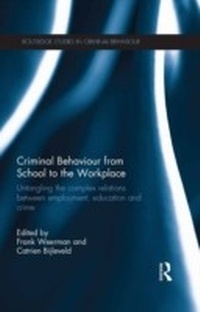
Criminal Behaviour from School to the Workplace
Untangling the Complex Relations Between Employment, Education and Crime
1st Edition
Published on 17. December 2013
240 pages
978-1-136-70053-8 (ISBN)
Description

This volume focuses on the complex relation between offending and the transition from school to the workplace: how employment and education are related to breaking the law and getting in contact with the criminal justice system. The contributors report results from several large scale and sophisticated studies conducted in the Netherlands that gathered rich data on employment, education and criminal behaviour. Each of the studies focuses on a particular period during the life course and particular risk categories. Taken together, they contribute to our understanding of how getting out of school, getting into a job and doing illegal things are intertwined over the life-course, and how these relations differ with age and gender.
The background of this volume is our interest in the often-studied relation between offending and employment, or more generally, between offending and the transition from school to work, including dropping out, part-time work and joblessness. The available literature casts little doubt that employment and education are indeed related to less crime and offending. However, this relation is much more complex than it appears at first hand.
The volume is primarily aimed at researchers and students in the fields of criminology, sociology and economics. However, it may also be of use for non-academic professionals, in particular policy makers and practitioners in the field of criminal justice, probation/rehabilitation, and youth/schools.
The background of this volume is our interest in the often-studied relation between offending and employment, or more generally, between offending and the transition from school to work, including dropping out, part-time work and joblessness. The available literature casts little doubt that employment and education are indeed related to less crime and offending. However, this relation is much more complex than it appears at first hand.
The volume is primarily aimed at researchers and students in the fields of criminology, sociology and economics. However, it may also be of use for non-academic professionals, in particular policy makers and practitioners in the field of criminal justice, probation/rehabilitation, and youth/schools.
Reviews / Votes
This book has brought together a top-notch cast of contributors to explore the interconnections among delinquency, education, and employment. Through sophisticated data analysis and cutting-edge theoretical work, this book has the potential to make a significant contribution to what we know about how education and employment are linked to delinquency. Without a doubt, anyone seriously interested in understanding the development of delinquency needs to read this book and have it as a handy reference.Kevin Beaver, Florida State University, USA.
This book greatly advances our knowledge about the transition from adolescence to adulthood and about relationships between school, work and offending. It contains very high quality research and should be of great interest to criminologists and social scientists all over the world.
David P. Farrington, Emeritus Professor of Psychological Criminology and Leverhulme Trust Emeritus Fellow, Cambridge University, UK.
This volume offers a very important contribution to the area of life course Criminology. It includes unique and sophisticated studies on the complex relation between offending and the transition from school to the workplace in the Netherlands.
Paul Nieuwbeerta, Professor of Criminology, Leiden University, The Netherlands.
This volume makes a sterling contribution to life course criminology. It has a clear advantage in using various and complex datasets that cover different periods during the life course, thus providing a comprehensive understanding of the complex relation between offending and the transition from school to the workplace.
Anders Nilsson, Professor of Criminology, Stockholm University, Sweden.
More details
Series
Language
English
Place of publication
London
United Kingdom
Publishing group
Taylor & Francis Ltd
Target group
College/higher education
Illustrations
32 s/w Abbildungen, 32 s/w Zeichnungen, 44 s/w Tabellen
44 Tables, black and white; 32 Line drawings, black and white; 32 Illustrations, black and white
File size
8,64 MB
ISBN-13
978-1-136-70053-8 (9781136700538)
Copyright in bibliographic data and cover images is held by Nielsen Book Services Limited or by the publishers or by their respective licensors: all rights reserved.
Schweitzer Classification
Other editions
Additional editions
Frank Weerman | Catrien Bijleveld
Criminal Behaviour from School to the Workplace
Untangling the Complex Relations Between Employment, Education and Crime
Book
07/2015
1st Edition
Routledge
€63.20
Shipment within 10-20 days
Frank Weerman | Catrien Bijleveld
Criminal Behaviour from School to the Workplace
Untangling the Complex Relations Between Employment, Education and Crime
Book
12/2013
1st Edition
Routledge
€231.60
Shipment within 15-20 days
Persons
Frank Weerman is senior researcher at the NSCR. His research interests are juvenile delinquency and criminological theory, with a focus on the role of peers in delinquent behaviour. He coordinated the "NSCR School Project", a longitudinal study among secondary school students, and was also involved in the longitudinal Study of Peers, Activities and Neighbourhoods (SPAN).
Catrien Bijleveld is senior researcher at the NSCR and professor of Research Methods in Criminology at the VU University Amsterdam. She has been appointed as member of the Royal Netherlands Academy of Sciences (KNAW). Her research activities focus on criminal careers, effects of (experimental) interventions, juvenile sex offenders, historical trends in punishment and offending and intergenerational continuity in offending.
Catrien Bijleveld is senior researcher at the NSCR and professor of Research Methods in Criminology at the VU University Amsterdam. She has been appointed as member of the Royal Netherlands Academy of Sciences (KNAW). Her research activities focus on criminal careers, effects of (experimental) interventions, juvenile sex offenders, historical trends in punishment and offending and intergenerational continuity in offending.
Content
1.Employment, education and crime: a complex field of research, 2. The development of delinquency in adolescence: employment, gender, SES and ethnicity, 3. The Relationship between School Performance, Early School Leaving, and Delinquency during and after Secondary School, 4. School, work and delinquency among older adolescents. Exploring the consequences of different tracks in education and employment after secondary school, 5. School, intensive work, excessive alcohol use and delinquency during emerging adulthood, 6. Pathways to adulthood and the relation between employment, education and criminal behaviour: a latent class analysis, 7. Educational level, employment, financial support and crime: A longitudinal study of disadvantaged youths, 8. The effect of unemployment on crime for high risk families in the Netherlands between 1920 and 2005, 9. Conclusion and discussion: main insights and remaining questoins, Appendix A: The Dutch school system, Appendix B: Employment and the Dutch welfare state.
