

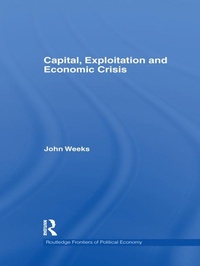
Capital, Exploitation and Economic Crisis
1st Edition
Published on 15. March 2011
208 pages
978-1-136-80802-9 (ISBN)
Description

In 2008 the capitalist world was swept by the severest crisis since the Great Depression of the 1930s. Mainstream economics neither anticipated nor could account for this disastrous financial crisis, which required massive state intervention throughout the capitalist world. Karl Marx did anticipate this type of financial collapse, arguing that it was derivative from the 'fetishism of commodities' inherent in the capitalist mode of production. This book substantiates the foregoing claim by a journey from Marx's analysis of commodities to the capitalist crisis of the twenty-first century.
The book demonstrates that Marx's framework (1) demonstrates that capitalism is but one historical form of class society among many; (2) explains the transition from pre-capitalist to capitalist society; (3) reveals the concrete operation of a capitalist economy; and (4) shows why others would explain the capitalist economy in alternative theoretical frameworks. The central element in his framework from which all else derives is 'the theory of value'. This book is not an exercise in the history of thought. It is an attempt to analyze the nature of contemporary capitalist society. While Marx's analysis of capitalism has implications for political action, these need not lead one to embrace revolution in place of reform, though it can and has provided the analytical foundation for both. Marx's analysis of capitalism is a coherent whole, and meaningful insights cannot be obtained by extracting elements from it.
Weeks starts out by looking at the nature of capitalism and an analysis circulation, money and credit unfold from the theory of value. The nature and inherent necessity of competition are demonstrated in chapter eight. A consequence of competition, expressed in the movement of capital, is technical change, the contradictory impact of which is explained in chapter nine. This is brought together with the other elements of value theory (money, credit and competition) in chapter ten, where economic crises are treated in detail. The final chapter applies the theory of crisis to the extreme financial disturbances of the 2000s.
This book should be of interest to students and researchers of economics, politics and sociology.
The book demonstrates that Marx's framework (1) demonstrates that capitalism is but one historical form of class society among many; (2) explains the transition from pre-capitalist to capitalist society; (3) reveals the concrete operation of a capitalist economy; and (4) shows why others would explain the capitalist economy in alternative theoretical frameworks. The central element in his framework from which all else derives is 'the theory of value'. This book is not an exercise in the history of thought. It is an attempt to analyze the nature of contemporary capitalist society. While Marx's analysis of capitalism has implications for political action, these need not lead one to embrace revolution in place of reform, though it can and has provided the analytical foundation for both. Marx's analysis of capitalism is a coherent whole, and meaningful insights cannot be obtained by extracting elements from it.
Weeks starts out by looking at the nature of capitalism and an analysis circulation, money and credit unfold from the theory of value. The nature and inherent necessity of competition are demonstrated in chapter eight. A consequence of competition, expressed in the movement of capital, is technical change, the contradictory impact of which is explained in chapter nine. This is brought together with the other elements of value theory (money, credit and competition) in chapter ten, where economic crises are treated in detail. The final chapter applies the theory of crisis to the extreme financial disturbances of the 2000s.
This book should be of interest to students and researchers of economics, politics and sociology.
Reviews / Votes
'Imperative reading for those engaged in Marx's political economy and its application to contemporary capitalism.' - Prof. Ben Fine, School of Oriental and African Studies (SOAS), UK'The first edition of Capital, Exploitation and Economic Crisis was the best critical introduction to Marxist economic theory. John Weeks has now restated and strengthened his original argument, in particular by engaging in detail with more mainstream neoclassical and Keynesian economics, and he has brought it up to date with a final chapter on the global economic and financial crisis that started in 2007. An indispensable book for anyone trying to understand Marx and capitalism'. - Prof. Alex Callinicos, King's College London, UK
'The book was to have been a trivial revision of his previous book, Capital and Exploitation (1982), but in fact has become a substantially new book...A great deal can be learned from a close reading of its insightful explanations and often provocative arguments. In particular, the author's treatment of net product and gross product is a catalyst for future scholarly research in this area.' - Cheol-Soo Park, Pratt Institute, Brooklyn, NY 'Imperative reading for those engaged in Marx's political economy and its application to contemporary capitalism.'- Prof. Ben Fine, School of Oriental and African Studies (SOAS), UK
'The first edition of Capital, Exploitation and Economic Crisis was the best critical introduction to Marxist economic theory. John Weeks has now restated and strengthened his original argument, in particular by engaging in detail with more mainstream neoclassical and Keynesian economics, and he has brought it up to date with a final chapter on the global economic and financial crisis that started in 2007. An indispensable book for anyone trying to understand Marx and capitalism.'- Prof. Alex Callinicos, King's College London, UK
'The book was to have been a trivial revision of his previous book, Capital and Exploitation (1982), but in fact has become a substantially new book...A great deal can be learned from a close reading of its insightful explanations and often provocative arguments. In particular, the author's treatment of net product and gross product is a catalyst for future scholarly research in this area.' - Cheol-Soo Park, Pratt Institute, Brooklyn, NY
More details
Series
Language
English
Place of publication
London
United Kingdom
Publishing group
Taylor & Francis Ltd
Target group
College/higher education
Illustrations
6 s/w Tabellen, 4 s/w Zeichnungen
6 Tables, black and white; 4 Line drawings, black and white
File size
2,01 MB
ISBN-13
978-1-136-80802-9 (9781136808029)
Copyright in bibliographic data and cover images is held by Nielsen Book Services Limited or by the publishers or by their respective licensors: all rights reserved.
Schweitzer Classification
Other editions
Additional editions
John Weeks
Capital, Exploitation and Economic Crisis
Book
05/2014
1st Edition
Routledge
€79.47
Shipment within 10-20 days
John Weeks
Capital, Exploitation and Economic Crisis
Book
02/2011
1st Edition
Routledge
€217.50
Shipment within 15-20 days
Person
John Weeks is Professor Emeritus of Economics at the University of London, UK.
Content
Introduction 1. Value as Embodied Labor 2. Value as a Social Relation(Annex to Chapter 1 and 2: Marx and Engels on the Law of Value) 3. Exploitation and Surplus Value 4. The Circuit of Capital (Annex to Chapter 4: Marxian and Mainstream Economic Categories) 5. Commodity Money 6. Capital and Money (Annex to Chapter 6: The Neoclassical Quantity Theory) 7. Credit, Crises and Capital 8. Competition among Capitals 9. Fixed Capital and Circulation (Annex to Chapter 9: Marx and Demand Failures) 10. Accumulation and Crises 11. First Crisis of the Twenty-first Century
