

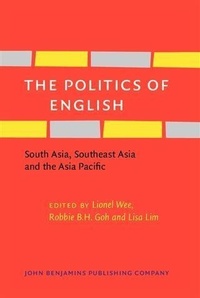
The Politics of English
South Asia, Southeast Asia and the Asia Pacific
1st Edition
Published on 28. March 2013
IX, 322 pages
978-90-272-7213-3 (ISBN)
Description

This volume brings together contributions that explore the increasingly important roles that English plays in Asia, including its contribution to economic growth, national imaginaries and creative writing. These are issues that are political in a broad sense, but the diversity of Asian contexts also means that the social, political and cultural ramifications of the spread of English into Asia will have to be understood in relation to the challenges facing specific societies. The chapters in the book collectively illustrate this diversity by focusing on countries from South Asia, Southeast Asia and the Asia Pacific. Each country has two contributions devoted to it: one paper provides an overview of the country's language policy and its positioning of English, and another provides a critical discussion of creative expressions involving the use of English. Taken together, the papers in the volume detail the most recent developments concerning the politics of English in Asia.
More details
Other editions
Additional editions
Lionel Wee | Robbie B.H. Goh | Lisa Lim
The Politics of English
South Asia, Southeast Asia and the Asia Pacific
Book
03/2013
John Benjamins Publishing Co
€100.70
Shipment within 10-15 days
Persons
Content
- The Politics of English
- Editorial page
- Title page
- LCC data
- Table of contents
- Preface
- 1. Language policies, language ideologies and local language practices
- Language planning and the regulation of interaction
- Language plans, discursive overflows
- Language as already local
- Language as semiotic resource
- Conclusion
- References
- Part I. South Asia
- 2. The politics of Hinglish
- The journey of Hinglish: From Stardust to Star TV
- Hinglish according to the Indian English and the diaspora film
- Hinglish: Democraticizing or widening social difference?
- References
- 3. Globalization and multilingualism: Text types in the linguistic ecology of Delhi
- Hindi vis-à-vis English in India
- Globalization and multilingualism: A review
- Code mixing in texts in the public domain
- Methods and data sources
- Data and discussion: Monoliterate texts
- Signs of biliteracy
- Orthographic hybridity
- Code mixing within an utterance
- Hybridity in transliteration
- Conclusions
- References
- 4. Kadura of privileged power, instrument of rural empowerment? The politics of English in Sri Lanka
- Colonial period: English privilege
- Nationalism and independence: Sinhala protectionism, ethnic polarization
- The nationist period
- Liberation: Rural empowerment
- Implications
- Concluding thoughts
- References
- 5. The interface of language, literature and politics in Sri Lanka
- References
- Part II. Southeast Asia
- 6. Governing English in Singapore: Some challenges for Singapore's language policy
- Independence: Aiming for ethnic harmony and economic prosperity
- Language policy in Singapore
- Denying English the status of a mother tongue
- Pitting English against Singlish
- Coming to terms with Standard Singaporean English
- Conclusion: Allowing greater autonomy in language choices
- References
- 7. Uncertain locale: The dialectics of space and the cultural politics of English in Singapore
- "English" and "Chinese" positionalities in Singapore: The colonial legacy
- Singapore Chineseness: "Impurity", fragmentation, dislocation
- English, cosmopolitanism, class: Linguistic identity, mockery and self-loathing
- Conclusion: Linguistic space, dislocation, and the nation state
- References
- 8. The encroachment of English in Malaysian cultural expression
- References
- 9. Negotiating bilingual identities in the Malay community
- Language and identity: Theory and practice
- The sociolinguistic setting
- Study design
- Participants' narratives
- Discussion: Community ideologies and practices
- Learners' responses and roles
- Evolving bilingual identities
- Implications
- References
- 10. The grip of English and Philippine language policy
- Tracing the grip of English in the Philippines
- Competing in the global economy
- Mitigating the grip of English
- Some concerns
- Conclusion
- References
- 11. Nimble tongues: Philippine English and the feminization of labour
- The feminization of non-standard Philippine English
- Nimble fingers, nimble tongues
- English and the care of the world
- Conclusion
- References
- Part III. Asia Pacific
- 12. English vs. English conversation: Language teaching in modern Japan
- Introduction: Japan's language policy
- School English, courses of study, and unsuccessful results
- Beyond school English, Eikaiwa "English conversation" and English ideology
- Eigo and seiyô konpurekkusu: An inferiority complex about English and the west
- Katakanago: Katakana words and Japanese English
- Suggestions for English conversation ideology and identity
- Conclusion: English and English conversation for the future of Japan
- References
- 13. Language policy and practice in English loanwords in Japanese
- The historical ubiquity of loanwords in Japan
- The "problematizing" of English loanwords
- The treatment of loanwords in newspapers
- Government officials' use of loanwords
- The perceived power asymmetry of English loanword use in Japan
- Third place languages and third space boundaries
- References
- 14. English speakers in Korea: A short literary history
- English and Korean colonial modernity
- The sexual politics of English in the post-Korean War period
- The return of the repressed
- References
- 15. English, class and neoliberalism in South Korea
- Neoliberal reforms of Korean education
- English and class in recent Korean education policy
- Indexicality of English and naturalization of the neoliberal order
- References
- 16. Conclusion
- Re-thinking the foundations of English language education
- Reconciling national language pride with English language usage
- Responding rationally to inter-country 'competitiveness'
- Conclusion
- References
- Contributors
- Index
