

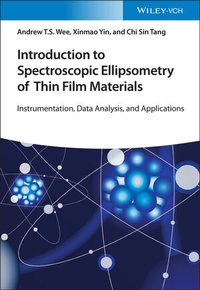
Introduction to Spectroscopic Ellipsometry of Thin Film Materials
Instrumentation, Data Analysis and Applications
1st Edition
Published on 8. March 2022
208 pages
978-3-527-83394-8 (ISBN)
Description

This book serves as an updated summary on the use of Spectrometric Ellipsometry with its practical usage in probing interfacial properties, electronic structures and quasiparticle properties of different classes of thin-film materials.
More details
Other editions
Additional editions
Andrew T. S. Wee | Xinmao Yin | Chi Sin Tang
Introduction to Spectroscopic Ellipsometry of Thin Film Materials
Instrumentation, Data Analysis and Applications
Book
04/2022
1st Edition
Wiley-VCH
€109.00
Shipment within 5-7 days
Persons
Andrew T. S. Wee is a class of 62 Professor of Physics, and Director of the Surface Science Laboratory at the National University of Singapore (NUS). His research interests are in surface and nanoscale science, scanning tunnelling microscopy (STM) and synchrotron radiation studies of the molecule-substrate interface, graphene and related 2D materials. He was a Commonwealth Fellow as well as a Rhodes Scholar at the University of Oxford, where he received his DPhil (1990). He holds a Bachelor of Arts (Honours) in Physics (1994) as well as a master degree from the University of Cambridge. He is an Associate Editor of the journal ACS Nano and serves or has served on several other journal editorial boards.
Xinmao Yin is Professor of Physics at the Shanghai University, China (from 2021). His research is focused on quantum materials and broad energy range optical spectroscopic techniques. He completed his degrees of the bachelor and PhD in Zhejiang University in 2010 and National University of Singapore in 2014, respectively. His expertise is in the field of condensed matter physics and optical spectroscopy, with primary strength in studying the electronic and spin structures of materials using optical spectroscopic techniques at different energy range. He specializes in studying materials such as 2D transition metal dichalcogenides, High-Tc superconducting cuprates, and colossal magnetoresistance manganites and their interfaces. He is expert in the various optical analysis techniques (ellipsometry, reflectivity, absorption, etc.) and the synchrotron-based spectroscopy (XAS, XMCD, XRD, XPS, ARPES etc.). Using these spectroscopic techniques, the underlying physical mechanism of macroscopic and microscopic properties governing superconductivity, ferromagnetism, phase transition, as well as spin changes, plasma and exciton excitations have been studied.
Chi Sin Tang is scientist at the Institute of Materials Research and Engineering, Agency for Science Technology and Research (A*STAR), Singapore. He holds a Bachelor of Science (Honours) in Physics (2012) as well as a post-graduate diploma in Education from Nanyang Technological University. An expert user of optical techniques such as Spectroscopic Ellipsometry and synchrotron-based spectroscopic measurements that include X-ray Absorption Spectroscopy and Photoemission Spectroscopy, his research interests mainly focus on the electronic and optical properties of low-dimensional materials such as two-dimensional transition metal dichalcogenides, unconventional oxide thin-films and the effects of interfacial interactions.
Xinmao Yin is Professor of Physics at the Shanghai University, China (from 2021). His research is focused on quantum materials and broad energy range optical spectroscopic techniques. He completed his degrees of the bachelor and PhD in Zhejiang University in 2010 and National University of Singapore in 2014, respectively. His expertise is in the field of condensed matter physics and optical spectroscopy, with primary strength in studying the electronic and spin structures of materials using optical spectroscopic techniques at different energy range. He specializes in studying materials such as 2D transition metal dichalcogenides, High-Tc superconducting cuprates, and colossal magnetoresistance manganites and their interfaces. He is expert in the various optical analysis techniques (ellipsometry, reflectivity, absorption, etc.) and the synchrotron-based spectroscopy (XAS, XMCD, XRD, XPS, ARPES etc.). Using these spectroscopic techniques, the underlying physical mechanism of macroscopic and microscopic properties governing superconductivity, ferromagnetism, phase transition, as well as spin changes, plasma and exciton excitations have been studied.
Chi Sin Tang is scientist at the Institute of Materials Research and Engineering, Agency for Science Technology and Research (A*STAR), Singapore. He holds a Bachelor of Science (Honours) in Physics (2012) as well as a post-graduate diploma in Education from Nanyang Technological University. An expert user of optical techniques such as Spectroscopic Ellipsometry and synchrotron-based spectroscopic measurements that include X-ray Absorption Spectroscopy and Photoemission Spectroscopy, his research interests mainly focus on the electronic and optical properties of low-dimensional materials such as two-dimensional transition metal dichalcogenides, unconventional oxide thin-films and the effects of interfacial interactions.
Content
1. Spectroscopic Ellipsometry: Basic Principles
2. Strongly Correlated Systems: Cuprates & Manganites
3. Two-dimensional Transition Metal Dichalcogenides
4. Single layer graphene systems
5. Nickelate Systems
6. Future Development and Applications of Spectroscopic Ellipsometry
2. Strongly Correlated Systems: Cuprates & Manganites
3. Two-dimensional Transition Metal Dichalcogenides
4. Single layer graphene systems
5. Nickelate Systems
6. Future Development and Applications of Spectroscopic Ellipsometry
