

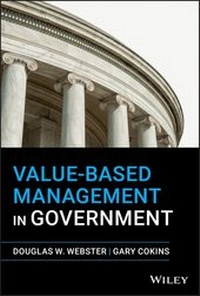
Value-Based Management in Government
Description

Countless books on proposed management practices have been written and published over the past century. Some of these have focused on specific management practices for government. In more recent decades, the topics of strategic planning, performance management, cost management and risk management have been extensively covered. However, little has been offered as an approach to integrate these and numerous other management methods and practices in a manner that maximizes the delivery of value to the organization's key stakeholders. A general management framework is presented in this book in a manner particularly applicable to government organizations.
Value-Based Management in Government introduces a new, integrating framework for management practices that optimizes the balancing of results sought; resources supplied and allocated; and risks accepted. These considerations are all balanced for the purpose of delivering maximum stakeholder value. The book offers guidance on how strategic planning, performance management, cost/resource management, and risk management must all be integrated as part of a portfolio management framework across the organization. The book also discusses the role of information technology (IT) in providing data for insights and decision-making, and the importance of organizational change management to implement the needed organizational and behavioral changes.
Beginning by explaining the concept of Value-Based Management for the public sector and government, the text goes on to explore topics such as the evolutionary stages of maturity of management accounting, the benefit of attributes (e.g., value-add versus nonvalue-add) in cost data, predictive planning with expense projections, risk management, and various performance measurements (e.g., key performance indicators [KPIs] ). This authoritative book:
* Discusses a framework for balancing and integrating cost, performance, and risk
* Explains IT systems integration issues related to activity-based cost management (ABC/M)
* Addresses why some ABC/M implementation projects fail to meet expectations
* Describes how quality management efforts can be measured in financial terms
* Explores the wider uses of predictive accounting (e.g., driver-based budgeting, what-if scenario analysis)
* Provides organizational change management insights and recommendations needed to achieve the required changes in management decision-making.
Value-Based Management in Government is an important source of information for leaders, executives, managers, and employee teams working within or with government organizations.
More details
Other editions
Additional editions
Persons
DR. DOUGLAS W. WEBSTER is a past chief financial officer (CFO) of both the US Department of Education and US Department of Labor, overseeing financial management of budgets exceeding $60 billion. As a management consultant, he has led consulting engagements at over two dozen federal agencies in strategic planning, risk management, cost management, and organizational change management.
GARY COKINS is an internationally recognized expert on advanced cost management and performance improvement. His career was in consulting with Deloitte, KPMG, EDS, and SAS. He is the founder of Analytics-Based Performance Management, an advisory firm, and he has written numerous books on activity-based costing and management, including Performance Management and Predictive Business Analytics.
Content
About the Authors vii
Acknowledgments ix
Foreword xi
Preface xiii
Part One: Value-Based Management in Government Concepts and Components 1
Chapter 1 Challenges and Solutions to Address Dissatisfaction of Citizens and Taxpayers 3
Chapter 2 Generating Value in a World of Uncertainty 9
Part Two: Strategy Management and Governance 27
Chapter 3 Strategy Setting and Execution: Setting and Linking Goals and Capabilities 29
Chapter 4 The Strategy Map and Its Balanced Scorecard 39
Part Three: Enterprise Performance Management 59
Chapter 5 Exceptional EPM Systems are an Exception 61
Part Four: The Three Rs: Risk, Results, and Resources 71
Chapter 6 Risk Management 73
Chapter 7 Results Management 93
Chapter 8 Resource and Cost Management 101
Part Five: Management Accounting in Government 123
Chapter 9 Understanding ABC/M: A Few Basic Truths 125
Chapter 10 If ABC/M is the Answer, What is the Question? 137
Chapter 11 Fundamentals: What is ABC/M? 155
Chapter 12 Using ABC/M Attributes to Assess Quality and Value-Add 167
Chapter 13 Driver-Based Budgeting and Rolling Financial Forecasts 183
Chapter 14 Implementing ABC/M with Rapid Prototyping 213
Part Six: How Information Technology Impacts VBM 231
Chapter 15 Information Technology as an Enabler 233
Part Seven: Influencing Behavior for VBM 237
Chapter 16 Organizational Change Management 239
Part Eight: The Future 249
Chapter 17 The Future of Public Sector VBM 251
Index 257
