

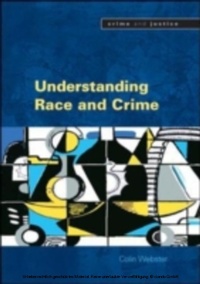
Understanding Race And Crime
1st Edition
Published on 1. July 2007
255 pages
978-0-335-23039-6 (ISBN)
Description

The book provides a conceptual framework in which racism, race and crime might be better understood. It traces the historical origins of how thinking about crime came to be associated with racism and how fears and anxieties about race and crime become rooted in places destabilized by rapid social change.
More details
Other editions
Additional editions
Colin Webster
Understanding Race and Crime
Book
07/2007
Open University Press
€59.60
Article exhausted; check different version
Content
- Font cover
- Half Title
- Title
- Copyright
- Contents
- Series editor's foreword
- Acknowledgements
- Chapter 1 Conceptualising 'race' and crime: racialisation and criminalisation
- Biological and cultural racism
- Race and ethnicity
- Criminalisation and racialisation
- The problem of 'racism'
- Race relations and situational racism
- Focusing on white ethnicity and perpetrators
- The importance of context
- Structure, themes and purposes of the book
- Further reading
- Chapter 2 Origins: criminology, eugenics and 'the criminal type'
- A transformation in how 'race' is thought about?
- The beginnings of race and crime thinking in criminal anthropology
- The criminal type
- Emergence of eugenic ideas in Britain
- Applied eugenics in America
- Eugenics in National Socialist Germany
- The legacy of biological criminology and eugenics
- Criticisms of biological criminology and eugenics
- Understanding the origins of race and crime in criminology and eugenics
- Further reading
- Chapter 3 Context: race, place and fear of crime
- Conceptualising fear of crime: the racialisation of fear
- Fear of crime: prevalence
- Youngstown, Ohio: American deindustrialisation, class and race
- Detroit, Chicago and Harlem: segregation, inequality and the meaning of 'whiteness'
- Camden, North London: narratives of crime and decline
- Competition over local resources: the availability of affordable housing and ethnic enmity
- Bow and Battersea: why are some places more racist than others?
- Neighbourhood feelings vary by age
- South London: cultural syncretism?
- Understanding race, place and fear of crime
- Further reading
- Chapter 4 Offending and victimisation
- Introduction: are cross-national comparisons possible?
- Offending patterns in England and Wales
- Case study: street robbery
- Victimisation patterns in England and Wales
- Offending patterns in the United States
- Victimisation patterns in the United States
- Offending and victimisation patterns together in the United States
- Offending and victimisation patterns in Australia
- European offending and victimisation patterns
- Conclusions from cross-national data on offending and victimisation
- The immigration and crime thesis: intergenerational crime patterns?
- Understanding offending and victimisation
- Further reading
- Chapter 5 Racist violence
- Introduction: the British context of reform
- Historical background to racist violence in Britain
- A peculiarly American form of 'popular justice': lynching and extralegal punishment in the United States
- Case study: the racist murder of Stephen Lawrence
- Macpherson and its aftermath: policing racist victimisation and the law
- Extent of racist victimisation: patterns and trends
- Have understanding and policy towards racist victimisation improved?
- Understanding racist violence
- Further reading
- Notes
- Chapter 6 Race, policing and disorder
- Introduction: the centrality of policing in black and minority ethnic groups' experiences
- Lore and disorder: history of minority-police conflict in Britain
- Policing black and minority ethnic communities in Britain
- 'Suspect populations'
- Attitudes towards the police
- Contact with the police: stop and search
- Arrests
- Police beliefs
- Police racism
- Policing black and minority ethnic communities in the United States
- Policing black and minority ethnic communities in Australia
- Explaining conflict and hostility between black and minority ethnic young people and the police
- Case study: the British 'Asian' disorders of 1995 and 2001
- Explaining the Asian disorders: 'parallel lives'?
- Understanding race, policing and disorder
- Further reading
- Chapter 7 Race, criminal justice and penality: difference or discrimination?
- Race and criminal justice in England and Wales
- Overrepresentation
- Disproportionality in the criminal justice system: difference or discrimination?
- Perceptions of fairness and equality
- Race and criminal justice in the United States
- Overrepresentation
- Disproportionality in the criminal justice system: difference or discrimination?
- A note on the death penalty in the United States: the case of Alabama
- Race and criminal justice in other countries
- The historical and social context of criminal and youth justice in Britain
- Change and continuity in the lives of black and Asian young people
- 'Offender' populations and their context
- Understanding race, criminal justice and penality
- Further reading
- Chapter 8 'Race', class, masculinities and crime: family, schooling and peer groups
- Introduction: risk factors
- Race, class and family structure
- Family, masculinity and emasculation
- The masculinity and crime thesis
- Masculinities, race and schooling
- School disaffection, failure and truancy
- Race, class and peer groups
- Understanding 'race', class, masculinities and crime
- Further reading
- Chapter 9 The African-American 'underclass' and the American Dream
- Introduction: the existence of an 'underclass'
- The isolation of the black ghetto: a history of segregation
- The integration of the black ghetto
- The paradox of the black ghetto
- Understanding the ghetto
- The feared and resented ghetto: beyond urban ethnography
- Understanding the African-American 'underclass': the 'balance sheet' of segregation?
- Further reading
- Chapter 10 State crime: the racial state and genocide
- Introduction: criminology's neglect of mass killing
- The Nazi genocide
- 'Ordinary' perpetrators
- The Nazi genocide
- The decision-making process in Nazi Jewish policy
- The Nazi genocide
- 'Ordinary' perpetrators
- The Nazi genocide
- The decision-making process in Nazi Jewish policy
- The Rwandan genocide
- The legacy of racism: pre-colonial and colonial 'beginnings'
- Racism and 'Rwandan ideology'
- The end of colonialism and the advent of the Hutu republic, 1959- 90
- Preparation for genocide
- Brief lull before the storm
- Who were the actors? Organisers, killers, victims and bystanders
- Killing patterns
- Understanding the racial state and genocide
- Glossary of Rwandan acronyms and names
- Further reading
- Note
- Chapter 11 Understanding race and crime: some concluding thoughts
- Race, criminality, normalcy and visibility
- Racialised geography of fear
- Disproportionality of offending and victimisation
- Racist violence
- Policing black and minority ethnic communities
- Disproportionality in the criminal justice system
- Race, class, masculinities and crime
- Race and the American Dream
- The racial state
- The myth of 'race'
- References
- Index
- Back cover
