

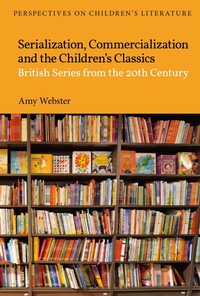
Serialization, Commercialization and the Children's Classics
British Series from the 20th Century
1st Edition
Published on 12. December 2024
232 pages
978-1-350-43411-0 (ISBN)
Description

An exploration of the serialization of children's classics by contemporary publishers, this book digs into the impact of the practice and provides new ways of reading the corpus of British children's literature from the 20th century. Amy Webster demonstrates how publishers select texts for their series, which texts they omit, which outliers are sometimes included and how a core group of works from the golden age of children's literature emerged. The text also examines how texts are abridged and transformed from publisher to publisher through close readings of The Wind in the Willows and Alice's Adventures in Wonderland; and how the repackaging of works within a series highlight issues and choices tied to key paratextual elements. Analysing data through distant reading and close reading of series from Ladybird, Longman, Puffin and Walker Illustrated editions, this book sheds light on how modern classics series are marked by variation and instability but also a reductive homogeneity.
Through her use of quantitative and text-focused research, Webster reveals how commercial motivations have created a gulf between the canonical concepts of the classic and how the term functions as a marketing tool in British children's publishing. With notions of what counts as a classic compromised and complicated, this book leads the call for a critical approach towards both the term 'classic' and to reading children's classics that acknowledges how they are tied to the commercial enterprises of the children's book business.
Through her use of quantitative and text-focused research, Webster reveals how commercial motivations have created a gulf between the canonical concepts of the classic and how the term functions as a marketing tool in British children's publishing. With notions of what counts as a classic compromised and complicated, this book leads the call for a critical approach towards both the term 'classic' and to reading children's classics that acknowledges how they are tied to the commercial enterprises of the children's book business.
More details
Series
Edition
1. Auflage
Language
English
Place of publication
London
United Kingdom
Publishing group
Bloomsbury Publishing PLC
Target group
Professional and scholarly
Illustrations
37 bw illus
ISBN-13
978-1-350-43411-0 (9781350434110)
Copyright in bibliographic data and cover images is held by Nielsen Book Services Limited or by the publishers or by their respective licensors: all rights reserved.
Schweitzer Classification
Other editions
Additional editions
Amy Webster
Serialization, Commercialization and the Children's Classics
British Series from the 20th Century
Book
01/2025
Bloomsbury Academic
€126.28
Shipment within 15-20 days
Person
Amy Webster is Senior Lecturer in Education Studies, Bishop Grosseteste University, UK. She is part of the University's Literature and Literacies research unit and co-edits the university's newsletter on children's literature. Her articles and essays have been published in The SAGE Encyclopaedia of Children and Childhood Studies and FEAST and has presented many papers across the UK and Europe. She completed an MPhil and PhD at the Centre for Research in Children's Literature at the University of Cambridge.
Content
List of Figures
List of Tables
Introduction
Chapter 1: Probing the problem of 'the classic'
Complexities and critiques of the classic
The classic in children's literature
Classics and canons
Prizing and reading practices
Serialising children's classics: A room of not so familiar friends
Studying British series of children's classics at a distance and up close
Compiling the data set
Precursors to the classic series
Chapter 2: Presence
Analysing the data set
Core classics and copyright
Non-recurring titles
The move towards homogenisation
Variation in series of modern classics
Trends in authorship
Chapter 3: Pruning
Adapting children's classics
Analysing abridgement: Counting words and reading contraction
A case study of a children's classic
Ladybird: Series of classics for younger readers
Longman: The children's classics as a reading scheme
Chapter 4: Product
Repackaging children's classics
The publisher's peritext
A Ladybird story
Puffin's 'complete and unabridged' classics
Walker's Illustrated Classics: 'The classics have never looked so good'
Conclusion: The commercial dimension of the children's classics
References
Appendix
Appendix A: Accessing the dataset online
Appendix B: Series of classics and modern classics listed chronologically by start publishing date
Appendix C: Books in series listed numerically by book ID
Appendix D: Authors in series listed numerically by author ID
Appendix E: Series that books appear in listed numerically by Book ID
Index
List of Tables
Introduction
Chapter 1: Probing the problem of 'the classic'
Complexities and critiques of the classic
The classic in children's literature
Classics and canons
Prizing and reading practices
Serialising children's classics: A room of not so familiar friends
Studying British series of children's classics at a distance and up close
Compiling the data set
Precursors to the classic series
Chapter 2: Presence
Analysing the data set
Core classics and copyright
Non-recurring titles
The move towards homogenisation
Variation in series of modern classics
Trends in authorship
Chapter 3: Pruning
Adapting children's classics
Analysing abridgement: Counting words and reading contraction
A case study of a children's classic
Ladybird: Series of classics for younger readers
Longman: The children's classics as a reading scheme
Chapter 4: Product
Repackaging children's classics
The publisher's peritext
A Ladybird story
Puffin's 'complete and unabridged' classics
Walker's Illustrated Classics: 'The classics have never looked so good'
Conclusion: The commercial dimension of the children's classics
References
Appendix
Appendix A: Accessing the dataset online
Appendix B: Series of classics and modern classics listed chronologically by start publishing date
Appendix C: Books in series listed numerically by book ID
Appendix D: Authors in series listed numerically by author ID
Appendix E: Series that books appear in listed numerically by Book ID
Index
