

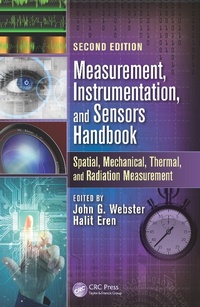
Measurement, Instrumentation, and Sensors Handbook
Spatial, Mechanical, Thermal, and Radiation Measurement
2nd Edition
Published on 19. December 2017
1640 pages
978-1-351-83334-9 (ISBN)
Description

The Second Edition of the bestselling Measurement, Instrumentation, and Sensors Handbook brings together all aspects of the design and implementation of measurement, instrumentation, and sensors. Reflecting the current state of the art, it describes the use of instruments and techniques for performing practical measurements in engineering, physics, chemistry, and the life sciences and discusses processing systems, automatic data acquisition, reduction and analysis, operation characteristics, accuracy, errors, calibrations, and the incorporation of standards for control purposes.
Organized according to measurement problem, the Spatial, Mechanical, Thermal, and Radiation Measurement volume of the Second Edition:
Contains contributions from field experts, new chapters, and updates to all 96 existing chapters
Covers instrumentation and measurement concepts, spatial and mechanical variables, displacement, acoustics, flow and spot velocity, radiation, wireless sensors and instrumentation, and control and human factors
A concise and useful reference for engineers, scientists, academic faculty, students, designers, managers, and industry professionals involved in instrumentation and measurement research and development, Measurement, Instrumentation, and Sensors Handbook, Second Edition: Spatial, Mechanical, Thermal, and Radiation Measurement provides readers with a greater understanding of advanced applications.
Organized according to measurement problem, the Spatial, Mechanical, Thermal, and Radiation Measurement volume of the Second Edition:
Contains contributions from field experts, new chapters, and updates to all 96 existing chapters
Covers instrumentation and measurement concepts, spatial and mechanical variables, displacement, acoustics, flow and spot velocity, radiation, wireless sensors and instrumentation, and control and human factors
A concise and useful reference for engineers, scientists, academic faculty, students, designers, managers, and industry professionals involved in instrumentation and measurement research and development, Measurement, Instrumentation, and Sensors Handbook, Second Edition: Spatial, Mechanical, Thermal, and Radiation Measurement provides readers with a greater understanding of advanced applications.
Reviews / Votes
"Engineers, involved with instrumentation and measurement, will find this book an outstanding 'go to' resource, with very broad coverage and detailed descriptions of modern measurement methods and techniques."-IEEE Electrical Insulation Magazine, January/February 2015
More details
Edition
2nd edition
Language
English
Place of publication
London
United Kingdom
Publishing group
Taylor & Francis Ltd
Target group
College/higher education
Product notice
Reflowable
Illustrations
178 Tables, black and white; 905 Illustrations, black and white
File size
79,51 MB
ISBN-13
978-1-351-83334-9 (9781351833349)
Copyright in bibliographic data and cover images is held by Nielsen Book Services Limited or by the publishers or by their respective licensors: all rights reserved.
Schweitzer Classification
Other editions
Additional editions
John G. Webster | Halit Eren
Measurement, Instrumentation, and Sensors Handbook
Spatial, Mechanical, Thermal, and Radiation Measurement
Book
09/2017
2nd Edition
CRC Press
€148.55
Article not available at the moment
John G. Webster | Halit Eren
Measurement, Instrumentation, and Sensors Handbook
Spatial, Mechanical, Thermal, and Radiation Measurement
Book
01/2014
2nd Edition
CRC Press
€374.50
Shipment within 15-20 days
Persons
John G. Webster received his BS from Cornell University, Ithaca, New York, USA and M.Sc and Ph.D from University of Rochester, New York, USA. A fellow of the Institute of Electrical and Electronics Engineers, Instrument Society of America, American Institute of Medical and Biological Engineering, Biomedical Engineering Society, and Institute of Physics, he served on the IEEE-EMBS Administrative Committee and NIH Surgery and Bioengineering Study Section, authored/co-authored and edited/co-edited numerous books and publications, and received the IEEE-EMBS Career Achievement Award. A highly cited researcher for King Abdulaziz University, Jeddah, Saudi Arabia, he is currently a professor emeritus at University of Wisconsin-Madison, USA.
Halit Eren received his BS, M.Sc, and Ph.D from University of Sheffield, UK. He also obtained an MBA from Curtin University, Perth, Western Australia. He has served as an instrumentation engineer at Etibank, as well as an assistant professor for Hacettepe University and Middle East Technical University, all in Turkey. An author and co-editor of several books and publications, he was associate professor at Polytechnic University, Hong Kong and visiting professor at University of Wisconsin-Madison, USA. A senior member of IEEE taking roles in Region 10 activities and various committees for organizing conferences, he is currently teaching and conducting research at Curtin University.
Halit Eren received his BS, M.Sc, and Ph.D from University of Sheffield, UK. He also obtained an MBA from Curtin University, Perth, Western Australia. He has served as an instrumentation engineer at Etibank, as well as an assistant professor for Hacettepe University and Middle East Technical University, all in Turkey. An author and co-editor of several books and publications, he was associate professor at Polytechnic University, Hong Kong and visiting professor at University of Wisconsin-Madison, USA. A senior member of IEEE taking roles in Region 10 activities and various committees for organizing conferences, he is currently teaching and conducting research at Curtin University.
Content
Instrumentation and Measurement Concepts. Spatial Variables. Displacement. Mechanical Variables. Acoustics. Flow and Spot Velocity. Thermal and Temperature Measurement. Radiation. Wireless Instrumentation. Control and Human Factors. Appendix: Units and Conversions.
