

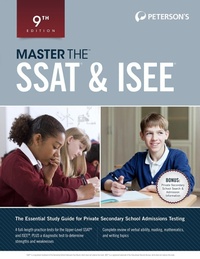
Master the SSAT & ISEE
9th Edition
Published on 30. September 2014
531 pages
978-0-7689-3946-0 (ISBN)
Description

Peterson's Master the SSAT® & ISEE® is the guide for preparing students and their parents for the SSAT® and the ISEE®. Complete with the most up-to-date information on the upper-level exams, the book is vitally important to anyone preparing for private secondary school admissions testing. Students have access to test-taking strategies for each of the question types, along with exam day specific advice. Four practice tests, plus a diagnostic test, provide students with a realistic idea of what to expect when the test date arrives. Additionally, students and parents both encounter tips on all aspects of the ptivate secondary school search process: how to identify schools that are a good fit, how to apply for financial aid, and all of the other challenges of finding the right private secondary school for you or your child.
More details
Other editions
Additional editions
Peterson's
Master the SSAT & ISEE
Book
08/2014
9th Edition
Peterson's Guides,U.S.
€37.32
Article exhausted; check different version
Content
- Intro
- Contents
- Before You Begin
- How to Use This Book
- What to Study
- Special Study Features
- An Important Note for Eighth- and Ninth-Graders
- Parents' Guide to Private Secondary School
- You're Well on Your Way to Success
- Give Us Your Feedback
- Top 10 Strategies to Raise Your Score
- High School Entrance Exam Basics
- All About the Tests
- What Are the High School Entrance Exams?
- How Do I Find Out Which Exam I Must Take?
- If I Have a Choice of Exams, How Do I Choose?
- What Kinds of Questions Are Asked on High School Entrance Exams?
- How Are the Exams Structured?
- What Do the Answer Sheets Look Like?
- How Are the Exams Scored?
- SSAT Questions
- What Can You Expect on the Test?
- How Does the SSAT Measure Verbal Ability?
- How Does the SSAT Measure Quantitative Ability?
- How Does the SSAT Measure Reading Ability?
- What Is the Writing Sample?
- ISEE Questions
- What Can You Expect on the Test?
- How Does the ISEE Measure Verbal Ability?
- How Does the ISEE Measure Quantitative Ability?
- How Does the ISEE Measure Reading Comprehension?
- How Does the ISEE Measure Mathematics Achievement?
- What Is the Essay Question?
- Diagnosing Strengths and weaknesses
- Practice Test 1: Diagnostic Test
- Section 1: Synonyms (SSAT and ISEE)
- Section 2: Verbal Analogies (SSAT Only)
- Section 3: Sentence Completions (ISEE Only)
- Section 4: Reading Comprehension (SSAT and ISEE)
- Section 5: Quantitative Ability (SSAT and ISEE)
- Section 6: Quantitative Comparisons (ISEE Only)
- Answer Keys and Explanations
- Evaluating Your Score and Planning Your Study Time
- Vocabulary Review
- Word Arithmetic (SSAT and ISEE)
- Why Do They Test My Vocabulary?
- How Are Words Built?
- How Do Word Parts Work?
- List of Common Word Parts
- Word List
- Exercises: Word Arithmetic
- Answer Explanations
- Verbal Ability Review
- Synonyms (SSAT and ISEE)
- What Do Synonym Questions Look Like?
- How Do You Answer Synonym Questions?
- Test Yourself Quizzes
- Answer Keys
- Exercises: Synonyms
- Answer Key and Explanations
- Verbal Analogies (SSAT Only)
- What Makes a Verbal Analogy?
- What Do Verbal Analogy Questions Look Like?
- How Do You Solve Verbal Analogies?
- What Do Smart Test-Takers Know?
- Answer Keys
- Exercises: Mixed Relationships
- Answer Key and Explanations
- Sentence Completions (ISEE Only)
- What Makes a Sentence Completion?
- How Do You Answer Sentence Completion Questions?
- What Do Smart Test-Takers Know?
- Test Yourself Quizzes
- Answer Keys
- Exercises: Sentence Completions
- Answer Key and Explanations
- Reading Review
- Reading Comprehension (SSAT and ISEE)
- Why Is My Reading Ability Being Tested?
- What Kinds of Questions Will Be Asked?
- How Do You Answer Reading Comprehension Questions?
- What Do Smart Test-Takers Know?
- Test Yourself Quizzes
- Answer Keys
- Exercises: Main Idea
- Answer Key and Explanations
- Exercises: Details
- Answer Key and Explanations
- Exercises: Vocabulary
- Answer Key and Explanations
- Exercises: Inference
- Answer Key and Explanations
- Mathematics Review
- Mathematics (SSAT and ISEE)
- What Mathematics Must I Know?
- How Do I Estimate the Answer?
- When Must I Calculate?
- Test Yourself Quizzes
- Answer Keys
- Exercises: Mathematics
- Answer Key and Explanations
- Quantitative Ability (SSAT and ISEE)
- What Makes Multiple-Choice Math Easier?
- How Do You Solve Multiple-Choice Quantitative Ability Questions?
- What Do Smart Test-Takers Know?
- Test Yourself Quizzes
- Answer Keys
- Exercises: Quantitative Ability
- Answer Key and Explanations
- Quantitative Comparisons (ISEE Only)
- What Are These Strange-Looking Questions?
- How Do You Solve Quantitative Comparisons?
- What Do Smart Test-Takers Know?
- Test Yourself Quizzes
- Answer Keys
- Exercises: Quantitative Comparisons
- Answer Key and Explanations
- Writing Sample Review
- Writing Mechanics (SSAT and ISEE)
- What Are Writing Mechanics?
- What Are the Rules of Spelling?
- Spelling Demons
- What Are the Rules of Punctuation?
- What Are the Rules for Capitalization?
- What Are the Rules of Grammar?
- What Is Correct English Usage?
- How Can I Improve My Writing?
- Exercises: Spelling
- Answer Key and Explanations
- Exercises: Principles of Grammar
- Answer Explanations
- The Essay (SSAT and ISEE)
- What Is the Purpose of the Essay?
- How Do You Write an Essay Under Time Pressure?
- What Do Smart Test-Takers Know?
- Exercises: Essay Writing 1
- Exercises: Essay Writing 2
- Sample Responses 1
- Sample Responses 2
- Four Practice Tests
- Practice Test 2: SSAT (Upper Level)
- Part I: Writing Sample
- Part II: Multiple Choice
- Answer Keys and Explanations
- Score Yourself
- Practice Test 3: SSAT (Upper Level)
- Part I: Writing Sample
- Part II: Multiple Choice
- Answer Keys and Explanations
- Score Yourself
- Practice Test 4: ISEE (Upper Level)
- Section 1: Verbal Reasoning
- Section 2: Quantitative Reasoning
- Section 3: Reading Comprehension
- Section 4: Mathematics Achievement
- Section 5: Essay
- Answer Keys and Explanations
- Score Yourself
- Practice Test 5: ISEE (Upper Level)
- Section 1: Verbal Reasoning
- Section 2: Quantitative Reasoning
- Section 3: Reading Comprehension
- Section 4: Mathematics Achievement
- Section 5: Essay
- Answer Keys and Explanations
- Score Yourself
- Appendixes
- Appendix A: List of Synonyms
- Appendix B: Parents' Guide to Private Schools
- Why Choose an Independent School?
- Another Option: Independent Day Schools
- Why Boarding School: Reasons I Chose This Path and Why You Might, Too
- Why a Therapeutic or Special Needs School?
- Finding the Perfect Match
- Plan a Successful School Search
- Understanding the Admission Application Form
- About Admission Tests and the SSAT
- Paying for a Private Education
- Appendix C: Private Schools At-a-Glance
