

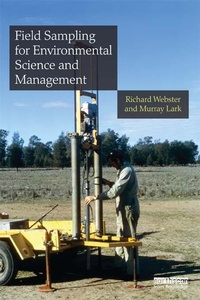
Field Sampling for Environmental Science and Management
1st Edition
Published on 10. September 2012
200 pages
978-1-136-47035-6 (ISBN)
Description

Scientists and consultants need to estimate and map properties of the terrestrial environment. These include plant nutrients and parasites in soil, gaseous emissions from soil, pollutant metals and xenobiotics in waste and contaminated land, salt in groundwater and species abundances above ground. The scale varies from small experimental plots to catchments, and the land may be enclosed in fields or be open grassland, forest or desert. Those who sample the variables to obtain the necessary data need guidance on the design and analysis of sampling methods for their conclusions and recommendations to be valid.
This book provides that guidance, backed by sound rationale and statistical theory. It concentrates on design-based sampling for estimates of mean values of environmental properties, emphasizing replication and randomization. It starts with simple random sampling and then progresses to more efficient designs, such as spatially stratified random sampling, stratification by classes and cluster sampling. It includes a section on purposive sampling in classical soil survey, which is relevant to other environmental properties such as vegetation. It also describes the effects of bulking on errors and the use of ancillary information and regression to improve estimates. The authors draw the important distinction between design-based sampling for estimating means and model-based methods (geostatistics) for local spatial prediction and mapping, and focus on the latter. They describe designs suitable for computing variograms and prediction by kriging, as well as a staged approach, so that sampling is neither inadequate nor excessive, and designs adapt as knowledge is accumulated. Including numerous worked case studies of sampling in agriculture, ecology and environmental science, the book will be of immediate practical value.
This book provides that guidance, backed by sound rationale and statistical theory. It concentrates on design-based sampling for estimates of mean values of environmental properties, emphasizing replication and randomization. It starts with simple random sampling and then progresses to more efficient designs, such as spatially stratified random sampling, stratification by classes and cluster sampling. It includes a section on purposive sampling in classical soil survey, which is relevant to other environmental properties such as vegetation. It also describes the effects of bulking on errors and the use of ancillary information and regression to improve estimates. The authors draw the important distinction between design-based sampling for estimating means and model-based methods (geostatistics) for local spatial prediction and mapping, and focus on the latter. They describe designs suitable for computing variograms and prediction by kriging, as well as a staged approach, so that sampling is neither inadequate nor excessive, and designs adapt as knowledge is accumulated. Including numerous worked case studies of sampling in agriculture, ecology and environmental science, the book will be of immediate practical value.
Reviews / Votes
"The book is written in a very educational style with a practical lay-out allowing easy access. Every chapter is introduced by a box overviewing its key points and most contain practical worked examples using real-world data. A sample data set is also provided. Most of the material discussed is backed-up by previously published papers by the authors and hence extra information is available if needed. The book clearly achieves its objective. It is highly recommended to all researchers whohave to sample and find the standard text books too complicated. It is also a perfect book for students in many disciplines."-Marc Van Meirvenne, Ghent UniversityMore details
Edition
1. Auflage
Language
English
Place of publication
London
United Kingdom
Publishing group
Taylor & Francis Ltd
Target group
College/higher education
Professional and scholarly
Illustrations
87 s/w Abbildungen, 39 s/w Tabellen, 50 s/w Zeichnungen
39 Tables, black and white; 50 Line drawings, black and white; 87 Illustrations, black and white
File size
3,62 MB
ISBN-13
978-1-136-47035-6 (9781136470356)
Copyright in bibliographic data and cover images is held by Nielsen Book Services Limited or by the publishers or by their respective licensors: all rights reserved.
Schweitzer Classification
Other editions
Additional editions
Richard Webster | Murray Lark
Field Sampling for Environmental Science and Management
Book
07/2012
Earthscan Ltd
€206.10
Shipment within 3-4 weeks
Richard Webster | Murray Lark
Field Sampling for Environmental Science and Management
Book
07/2012
Earthscan Ltd
€88.08
Shipment within 3-4 weeks
Persons
Richard Webster is a Lawes Trust Senior Fellow at Rothamsted Research, Harpenden, UK, and former Editor-in-Chief of the European Journal of Soil Science. He is author of one book and co-author of two others on applied statistics.
Murray Lark is an Environmental Statistician at the British Geological Survey, Nottingham, UK.
Murray Lark is an Environmental Statistician at the British Geological Survey, Nottingham, UK.
Content
1. Introduction. 2. Aims and Concepts. 3. Simple Random Sampling. 4. Efficiency, Economy and Logistics. 5. Prediction from Spatial Classifications. 6. Sampling from Designed Experiments. 7. Sampling for Regression and Calibration. 8. Nested Sampling and Analysis. 9. Geostatistics - Model-based Prediction
