

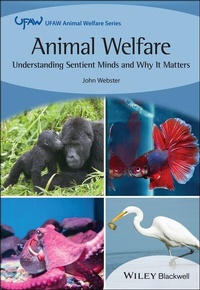
Animal Welfare
Description

An Accessible Overview of the Concept of Sentience Throughout the Animal Kingdom and Why It Matters to Humans
Animal Welfare explores the concept of sentience and the development of sentient minds throughout the animal kingdom. The work provides improved definitions and analysis of the ideas of sentience, cognition, and consciousness, along with evidence of advanced mental formulation in birds, fish, and invertebrates. Considerations between humans and animals are also discussed, such as outcome-based ethics in relation to humans' duties of care and the rights and wrongs of domestication. The work is divided into three parts and covers key topics such as:
* Specifics of animal sentience, from pain and suffering, to fear and dread, all the way to animals' social life and the comfort/joy/hope/despair they experience
* What we know about the sentience of different classes of animals in the waters, air, savannah/plains, and forests
* Considerations on human interactions based on animal sentience, including death (killing), animal farms, animals in laboratories, wild animals in captivity, and animals in sports and entertainment
* Analysis on what humans can learn from animals based on what we know about their varying levels of sentience
Animal Welfare serves as an invaluable analysis of animal sentience for students, teachers, and professionals directly involved in the study, teaching, and applications of animal behavior, motivation, and welfare. Thanks to the wide-ranging implications of animal sentience, the work will also appeal to everyone with a broader interest in animal behavior and human/animal interactions.
More details
Other editions
Additional editions
Person
John Webster, MA, Vet MB, PhD, DVM (Hon), is a retired Professor of Animal Husbandry at the University of Bristol, Bristol, UK. He established the Bristol Unit for Study of Animal Welfare and Behavior and is a founding member of the UK Farm Animal Welfare Council (FAWC).
Published as a part of the prestigious Wiley Blackwell - UFAW Animal Welfare series. UFAW, founded in 1926, is an internationally recognized, independent, scientific, and educational animal welfare charity.
For full details of all titles available in the series, please visit our website at www.wiley.com/go/ufaw.
Content
About the Author xi
Preface xiii
Acknowledgements and Apologies xv
Part 1 The Sentient Mind: Skills and Strategies 1
1 Setting the Scene 3
Human Attitudes to Animals 5
Animal Behaviour Science 7
Rules of Engagement 9
2 Sentience and the Sentient Mind 13
Sentience, Consciousness and the Mind 14
The Five Skandhas of Sentience 14
Understanding the Sentient Mind 17
Pain and Suffering 21
Fear and Dread 23
Coping with Challenge: Stress and Boredom 24
Social Life 26
Comfort and Joy 28
Hope and Despair 29
Sex and Love 29
Summary 30
3 Special Senses and Their Interpretation 32
Vision 33
Hearing 35
Smell and Taste 36
Cutaneous Sensation, Touch 37
Magnetoreception 38
Interpreting the Special Senses 38
Theory of Mind, or Metarepresentation 40
Summary 41
4 Survival Strategies 42
Foraging 43
Hunting Behaviour: The Predator and the Prey 48
Spatial Awareness and Navigation 50
Breeding Behaviour and Parental Care 52
5 Social Strategies 55
Sentient Social Life 57
Social Hierarchies: The Pecking Order 58
Communication 59
Cooperation and Empathy 60
Social Learning, Education and Culture 61
Territorial Behaviour and Tribalism 62
Part 2 Shaping Sentient Minds: Adaptation to the Environment 65
6 Animals of the Waters 67
Pain and Fear 69
Survival Skills: Hunting, Hiding and Problem Solving 71
Migration 72
Communication and Social Behaviour 74
7 Animals of the Air 77
Feeding Strategies 78
Migration 80
Sentience and Breeding Behaviour 82
Social Behaviour, Culture and Education 83
Bats 84
8 Animals of the Savannah and Plains 86
Environmental Challenges 87
Animals of the Open Plains 88
Sheep 88
Goats 90
Cattle 91
Wild Bovidae 92
Feral Horses 93
Elephants 93
Predators 96
9 Animals of the Forest 97
The Boreal Forest 97
Cervidae 98
Beavers 100
Bears 101
The Tropical Rain Forests 102
Snakes 103
Primates 104
10 Close Neighbours 106
History of Domestication 107
Artificial Selection and Unnatural Breeding 108
Domestication, Sentience and Wellbeing 109
Pigs 110
Dogs 113
Cats 114
Dairy Cows 115
Horses and Donkeys 118
Chickens 121
Opportunist Neighbours: Rats and Urban Foxes 123
Coda 124
Part 3 Why it matters: Nature's Social Union 125
11 Our Duty of Care 127
Sentience Revisited 128
Outcome-based
Ethics 131
Death and Killing 133
Farms, Farmed Animals and Food 135
Animals in Laboratories 136
Wild Animals in Captivity 138
Animals in Sport and Entertainment 140
Pets 143
What can We Learn from the Animals? 144
Further Reading 147
General Reading 151
Index 152
1
Setting the Scene
Some years ago, I took part in a late night, 'bear-pit' style television debate on the rights and wrongs of fishing. My role was to present scientific evidence as to whether fish can experience pain and fear. In brief, the evidence shows they can. After I had outlined the results of this work, a member of the audience got up and said 'This is all rubbish. These scientists don't know what they are talking about. I have been fishing all my life and I know for certain that fish don't feel anything'. He then added 'What sort of fish were they anyway? and when I said 'carp' he said: 'Ah well, carp are clever buggers'. These four words encapsulate the need for this book. We sort of assume animals have minds. We may even think we understand the meaning of sentience but most of us don't give it much thought, because, for most of us, most animals don't much matter.
Figure 1.1 Cordelia at play. (from Webster, 1994)
This book is written for those for whom it matters a lot. My central aim is to equip you to seek a better understanding of the minds of sentient animals. To this end, it will not only give an outline review of existing knowledge relating to the mental processes that determine animal behaviour and welfare but also offer suggestions and guidance on how to approach subjects where we know little or have been relying on easy preconceptions. Those of us who embark on the scientific study of animal welfare, their needs, their behaviour and their motivation, are cautioned to avoid the fallacy of anthropomorphism: the fallacy of ascribing human characteristics to other animals. However, I suggest at the outset, that it is valid to apply a principle of reverse anthropomorphism that asks not 'how would this chicken, cow, horse' feel if it were me but how would I feel if I were one of them?' As we shall see, thought experiments based on the principle of reverse anthropomorphism provide the basis for most studies in motivation analysis.
This voyage into the minds of sentient minds is going to be quite a journey. The nature of sentience is far too complex to be encapsulated within a one-line definition, such as 'the capacity to experience feelings'. Chapter 2 examines in detail the meaning and nature of consciousness and the sentient mind within the animal kingdom. To keep this enquiry as simple as possible, I shall consider the animal mind almost entirely as an abstract concept, within the brain and powered by the brain (mostly), but as an intangible compendium of information bank, instruction manual, filter and digital processor of incoming sensations and information. It is not too far-fetched to make the analogy with the digital computer and describe the brain as the hardware and the mind as the software. The neurophysiology involved in driving the hardware has its own beauty, but that is another story.
Through evolution by natural selection, animals have acquired behavioural skills appropriate to their design (phenotype) and natural environment. All animals are equipped at birth with a basic set of mental software: instructions genetically coded as a result of generations of adaptation to the physical and social challenges of the environments in which they evolved. This, which I shall hereafter refer to as their mental birth-right, is instinctive and hard wired. In some species that we may define as primitive, their responses to stimuli may always be restricted to invariant, hard-wired, pre-programmed responses to sensations induced by environmental stimuli. According to one's definition, this alone may be sufficient to classify them as sentient. However, throughout the animal kingdom, from the octopus to the great apes, we find overwhelming evidence of species that exhibit sentience to a higher degree. They build on this instinctive birthright and develop their minds. They learn to recognise, interpret and memorise new experiences in the form of feelings, good, bad or indifferent, and develop patterns of behaviour designed to promote their wellbeing measured, in all cases, in terms of primitive needs such as the relief of hunger and pain and, within the deeper, inner circles of sentience, feelings of companionship, comfort and joy. The ability to operate on the basis of knowledge acquired from experience, rather than pure instinct, enriches the physical and mental skills the sentient animal can recruit to cope with the challenges of life and promote an emotional sense of wellbeing. It also carries the potential for suffering when coping becomes too difficult.
The physical and mental skills and resources present at birth are those acquired through adaptation of their ancestors to the ancestral environment, because these were the skills that mattered the most. Animals that demonstrate deeper degrees of sentience have the capacity to develop these inborn, instinctive skills throughout their lifetime and teach these new skills to subsequent generations. Differing demands of differing environments mean that each species exhibits a portfolio of skills most appropriate to their special needs. It follows that, in our eyes, individual species may appear to be brilliant at some things and dumb at others. Raptor birds that hunt by day develop an exquisite visual ability to locate their prey whereas bats that hunt at night use radar based on ultrasound. The albatross can navigate its way home to its nest across the barren expanses of the Southern Ocean but will fail to recognise its chick if it has blown out of the nest. Domestication distorts the process of natural selection in two ways. We compel these animals to adapt to an environment largely determined by us, and this may be very different from that of their ancestors. We also introduce the entirely unnatural business of breeding: we tinker with the physical and mental phenotype of our animals to suit our needs for food, fashion, recreation or unqualified love.
We cannot observe animals through our eyes and conclude that any one species is better, or more highly developed than another. Each species adapts to meet its own special needs and the skills required to meet these needs vary in their nature and complexity. Pigs are good at being pigs, sheep are good at being sheep. Rats are very good at being rats because they have had to develop the physical and mental skills necessary for survival in a complex and frequently hostile environment. Sharks are very good at being sharks but, because they have thrived for millennia in a food-rich, stable environment, they have never really had to think. Many dogs are not very good at being dogs because they have not had the chance to grow up in an environment of dogs.
Human Attitudes to Animals
Most of this book is devoted to an exploration of the minds of sentient animals, their feelings, thoughts and motivation to behaviour seen so far as possible, through their own eyes. Human attitudes to animals would be irrelevant were it not for the fact that our actions, based on our attitudes, can have such a profound effect on their lives. In an earlier book, 'Animal Welfare: A Cool Eye towards Eden' (76) I wrote 'Man has dominion over the animals whether we like it or not. Wherever we share space on the planet, and this includes all but the most inaccessible regions of land, sea and air, it is we that determine where and how they shall live. We may elect to put a battery hen in a cage or establish a game reserve to protect the tiger but in each case the decision is ours, not theirs. We make a pet of the hamster but poison the rat. These human decisions are driven by the same incentives that motivate non-human animals since they reflect the will of us as individuals and as a species to survive and achieve a sense of well-being. We need good food and we seek highly nutritious eggs at little cost. We need good hygiene and seek to remove rats that carry germs. We choose to provide for our pets in sickness and in health because they enrich the lives of us and our children. We admire the tiger not only for its fearful symmetry but as a symbol of freedom itself, so we offer it more freedom than we give the laying hen. However, in either case it is impossible to escape the conclusion that both are living on our terms.'
The history of human attitudes to animals (and to other humans) is awash with ignorance and inhumanity. The European Judeo-Christian belief was inscribed in Genesis as 'every beast of the earth and every fowl of the air.I have given for meat'. The attitude of other religions to non-human animals varies. Of the Eastern religions, Taoism and Buddhism recognise the sentience of our fellow mortals and treat them with respect. More of this later. So far as I can gather, Confucianism regards non-human animals as commodities or tools, and therefore 'off the page' so far as philosophy is concerned. Islam and Judaism display rituals of respect for their food animals at the point of slaughter but these bring no comfort to the conscious animal while it bleeds to death. The Hindu veneration of the Holy Cow is driven more by fear of divine retribution than any concern for animal welfare.
The French philosopher Rene Descartes (1596-1650) sought to justify the Judeo-Christian attitude by asserting that humans are fundamentally different from all other animals because we alone possess mind, or consciousness. His notorious phrase Cogito ergo sum...
