

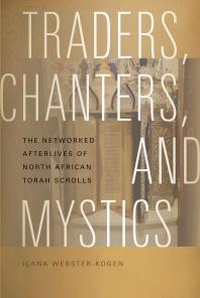
Traders, Chanters, and Mystics
Description

For Jews all over the world, the Torah scroll is the height of holiness, framed as the carefully designed and produced word of God. Jews give great attention to the care of Torah scrolls, ensuring they are maintained and protected so that they can be used for ritually chanting the Torah portion regularly. Traders, Chanters, and Mystics: The Networked Afterlives of North African Torah Scrolls is an interdisciplinary ethnography of these ritual objects (or subjects) and their role in embedding neighborly relations into Jewish life over centuries. Drawing on Actor-Network Theory, the book foregrounds Torah scrolls not simply as vessels of text but as agents with social lives and affect-as subjects that act within networks of devotion, memory, and migration. In analyzing the scroll's diverse afterlives-how they are celebrated and venerated, how they are chanted from in new surroundings (primarily in France), and how they are collected by Jews and non-Jews-Webster-Kogen offers a new reading of Jewish embeddedness in North African culture and history. Scrolls's afterlives constitute patrimony and restitution, and they can be approached as musical instrument or mystical medium. Anchored in France's Sephardic-majority Jewish communities, this study emphasizes liturgical continuity, offering new insights into ritual, migration, and the entangled afterlives of sacred objects in postcolonial contexts.
More details
Other editions
Additional editions
Person
ILANA WEBSTER-KOGEN is the Joe Loss Reader in Jewish Music at SOAS, University of London, where she is Head of the School of Languages, Cultures and Linguistics. Her first book, Citizen Azmari: Making Ethiopian Music in Tel Aviv, won the Society for Ethnomusicology's Jewish Music section publication prize. Her work has been published in academic journals such as Ethnomusicology Forum,Contemporary Jewry, and theJournal of African Cultural Studies.
Content
- Cover
- Half-title
- Titlepage
- Copyright
- Contents
- Illustrations
- Figures
- Tables
- Note on Transliteration
- Traders, Chanters, and Mystics
- Introduction
- Algerian Synagogue, Marais District, Paris, October 2022
- Is the Torah Scroll a Living Object?
- Scrolls
- The Jews of North Africa in France
- Fieldwork in the Mediatized World of Moroccan Cantillation
- Traders, Chanters, Mystics
- Part I Mystics
- One the Anthropomorphic Lives of North African Torah Scrolls
- Writing
- Hachnasat Sefer Torah
- Renewal
- Birth / Death / Renewal
- Death
- Conclusion
- Two on Organology, Tikkun, and Baraka
- Object Agency
- Organology
- Mysticism
- Baraka
- Conclusion
- Part II Chanters
- Three the Submerged Afterlife of Arab/jewish Ritual Aesthetics in France
- Arabic Music Theory in Parisian Synagogues
- Kavanah
- Saltanah
- Basics of Moroccan Cantillation
- The Torah's Calendar and Nonstandard Readings
- Learning the Text: Musical Skills, Textual Skills
- Improvisation
- Cantillation, Recitation, Piyyutim, Tarab
- Conclusion
- Four Networks of Intensification in North African Cantillation
- A Scroll of One's Own
- Creating Drama
- Decalogue
- Melody
- Feedback
- Chironomy
- Display (hagba'a and Hakafa)
- Simhat Torah: the Error Exception
- Conclusion
- Part III Traders
- Five Widows, Caravans, and Goatskins a Biography of Torah Scroll Supply Chains
- Rissani-Sijilmassa
- The Pereira Scroll
- Dynamics of Family Life
- Traders
- Rabbis
- Artisans
- Conclusion
- Six Curated Afterlives the Illicit Worlds of Torah Scroll Collecting and Display
- Evangelical Collecting Practices: Framing a Torah Scroll Afterlife
- Illicit Collecting Practices and Rumors
- Jewish Patrimony in North Africa
- The Synagogue
- Exhibitions: Juifs D'órient (Paris)
- Jewish Museum: Anu (Tel Aviv)
- Patrimony Museums: Beit Al Dakira (Essaouira)
- Museum of the Bible
- Conclusion
- Epilogue Restitution as Afterlife
- Porte De Pantin, Paris, February 22, 2016
- Acknowledgments
- Glossary
- Notes
- One the Anthropomorphic Lives of North African Torah Scrolls
- Two on Organology, Tikkun, and Baraka
- Three the Submerged Afterlife of Arab/jewish Ritual Aesthetics in France
- Four Networks of Intensification in North African Cantillation
- Five Widows, Caravans, and Goatskins: a Biography of Torah Scroll Supply Chains
- Six Curated Afterlives: the Illicit Worlds of Torah Scroll Collecting and Display
- Epilogue Restitution as Afterlife
- Bibliography
- Archives and Collections
- Print Resources
- Web Resources
- Index
- Music / Culture
- About the Author
