

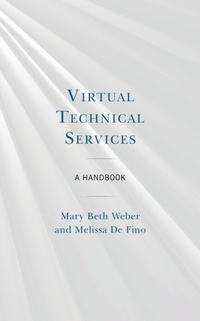
Virtual Technical Services
A Handbook
1st Edition
Published on 25. April 2022
166 pages
979-8-7651-8237-6 (ISBN)
Description

Prior to the COVID pandemic, there was little published information to guide technical services operations on how to deal with crises and emergencies. Viewed as a backroom operation by administration, little thought historically has been given to how these employees might protect equipment and resources and continue to provide services that seamlessly support the rest of the library.
Virtual Technical Services: A Handbook is the first to address emergency and crisis planning specifically for technical services. The authors address how to create an emergency plan and how to prepare for an uncertain future that will undoubtedly include other threats to our health and safety. We discuss how the pivot to remote work can revolutionize technical services librarianship and allow us to better serve the needs of a 21st Century library.
As the WFH period extended longer than anticipated, libraries and other organizations realized both the challenges and benefits of working remotely. WFH is about more than just doing one's job, and we focus on employees as individuals with needs that include work/life balance, self-care, and the flexibility to meet life circumstances including childcare, eldercare, and appointments. A unique feature of our book is the focus on employee well-being, including burnout and self-care. Prior to COVID-19, employee well-being was typically not emphasized as part of personnel management. The risks to our health and safety and being removed from the physical workplace provided the opportunity to re-examine priorities and reframe them to forge a stronger and more collaborative relationship between employers and employees. Technical services personnel, in particular, are subject to burnout as their operations are frequently understaffed and they face competing demands of serving both libraries' physical needs and supporting electronic and digital resources.
Management in a remote work environment has challenges that are not present in an on-site operation. Communication, setting expectations, and documentation and training take on added significance when WFH, as does accountability. Our book addresses these aspects of management through a WFH lens.
The book also covers the return to work after a shift to remote, whether it is completely on-site, hybrid, or some combination. Normalization, determining staffing levels, employee accommodations, and an adjustment period are discussed. Since most technical services personnel have not previously had to pivot to remote on short notice and for an extended period, the book addresses these issues for libraries as they make decisions about repopulating their workplaces.
Virtual Technical Services: A Handbook is the first to address emergency and crisis planning specifically for technical services. The authors address how to create an emergency plan and how to prepare for an uncertain future that will undoubtedly include other threats to our health and safety. We discuss how the pivot to remote work can revolutionize technical services librarianship and allow us to better serve the needs of a 21st Century library.
As the WFH period extended longer than anticipated, libraries and other organizations realized both the challenges and benefits of working remotely. WFH is about more than just doing one's job, and we focus on employees as individuals with needs that include work/life balance, self-care, and the flexibility to meet life circumstances including childcare, eldercare, and appointments. A unique feature of our book is the focus on employee well-being, including burnout and self-care. Prior to COVID-19, employee well-being was typically not emphasized as part of personnel management. The risks to our health and safety and being removed from the physical workplace provided the opportunity to re-examine priorities and reframe them to forge a stronger and more collaborative relationship between employers and employees. Technical services personnel, in particular, are subject to burnout as their operations are frequently understaffed and they face competing demands of serving both libraries' physical needs and supporting electronic and digital resources.
Management in a remote work environment has challenges that are not present in an on-site operation. Communication, setting expectations, and documentation and training take on added significance when WFH, as does accountability. Our book addresses these aspects of management through a WFH lens.
The book also covers the return to work after a shift to remote, whether it is completely on-site, hybrid, or some combination. Normalization, determining staffing levels, employee accommodations, and an adjustment period are discussed. Since most technical services personnel have not previously had to pivot to remote on short notice and for an extended period, the book addresses these issues for libraries as they make decisions about repopulating their workplaces.
More details
Other editions
Additional editions
Book
05/2022
Rowman & Littlefield Publishers
€52.20
Shipment within 3-4 weeks
Persons
Mary Beth Weber has worked in library technical services in academic libraries for over 30 years. She has held various technical services positions, and is an expert on cataloging nonprint materials, acquisitions workflows, and non-MARC metadata for digital collections. She also has extensive managerial experience.
Weber has authored numerous books, including Describing Electronic, Digital and Other Media Using AACR2 and RDA, and Rethinking Library Technical Services: Redefining our Profession for the Future. She has given presentations on cataloging, mentoring, and publishing for various organizations. She is a member of Rutgers University Libraries Faculty Mentoring Program Committee and participated in ALCTS' inaugural mentoring program.
Weber is an active member of the Association for Library Collections and Technical Services (ALCTS), an ALA division (soon to be CORE). She served two terms as the editor of ALCTS' online newsletter, and is currently editor-in-chief of Library Resources and Technical Services (LRTS), ALCTS' official scholarly peer-reviewed journal. Weber was awarded the ALCTS Presidential Citation in 2011 for her service as the ALCTS Newsletter Editor. She received the ALCTS Honors award in 2015 for her contributions as LRTS Editor.
Weber is currently the head of Central Technical Services at Rutgers University Libraries and oversees a staff that includes both faculty librarians and support staff. In this capacity, she has dealt with crises such as the aftermath of 9/11 and Hurricane Sandy, and has successfully resolved other challenging management issues. She earned her Bachelor of Arts in Art History and English (double major), and holds a Masters of Library Science degree from Clarion University of Pennsylvania.
Melissa De Fino has been a technical services librarian for sixteen years. She is the metadata librarian for special collections and audiovisual materials at Rutgers University Libraries. Her research focuses on the ever-changing landscape of technical services librarianship.
Weber has authored numerous books, including Describing Electronic, Digital and Other Media Using AACR2 and RDA, and Rethinking Library Technical Services: Redefining our Profession for the Future. She has given presentations on cataloging, mentoring, and publishing for various organizations. She is a member of Rutgers University Libraries Faculty Mentoring Program Committee and participated in ALCTS' inaugural mentoring program.
Weber is an active member of the Association for Library Collections and Technical Services (ALCTS), an ALA division (soon to be CORE). She served two terms as the editor of ALCTS' online newsletter, and is currently editor-in-chief of Library Resources and Technical Services (LRTS), ALCTS' official scholarly peer-reviewed journal. Weber was awarded the ALCTS Presidential Citation in 2011 for her service as the ALCTS Newsletter Editor. She received the ALCTS Honors award in 2015 for her contributions as LRTS Editor.
Weber is currently the head of Central Technical Services at Rutgers University Libraries and oversees a staff that includes both faculty librarians and support staff. In this capacity, she has dealt with crises such as the aftermath of 9/11 and Hurricane Sandy, and has successfully resolved other challenging management issues. She earned her Bachelor of Arts in Art History and English (double major), and holds a Masters of Library Science degree from Clarion University of Pennsylvania.
Melissa De Fino has been a technical services librarian for sixteen years. She is the metadata librarian for special collections and audiovisual materials at Rutgers University Libraries. Her research focuses on the ever-changing landscape of technical services librarianship.
Content
Introduction
Chapter 1: Creating a Plan
Chapter 2: Remote Work
Chapter 3: Well-Being
Chapter 4: Management of Remote Technical Services Operations: Resources for Managing Employees
Chapter 5: Resumption of Operations: Planning the Return to the Workplace
Chapter 6: Future Considerations
Bibliography
About the Authors
Chapter 1: Creating a Plan
Chapter 2: Remote Work
Chapter 3: Well-Being
Chapter 4: Management of Remote Technical Services Operations: Resources for Managing Employees
Chapter 5: Resumption of Operations: Planning the Return to the Workplace
Chapter 6: Future Considerations
Bibliography
About the Authors
