

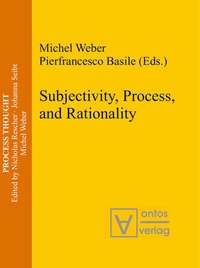
Subjectivity, Process, and Rationality
Description

This volume gathers prominent international scholars to celebrate the complex legacy of Reiner Wiehl, whose work has been instrumental in bringing together the European tradition of prima philosophia as represented by Plato, Spinoza, Kant and Hegel, with the adventurous speculative renewal of the twentieth century by Alfred North Whitehead. Grouped into four sections (Process and Universals, Nature and Subjectivity, Ethics and Civilization, Psychology and Phenomenology) the fifteen papers collected in this book cover a range of topics which is as wide and as intertwined as Wiehl's own expertise. The common thread running through all contributions is the problematic nature of subjectivity and especially of its process slant, which easily eludes the static and abstract schemes of rationality.
More details
Other editions
Additional editions
Content
2 - Preface [Seite 8]
3 - Process and Universals [Seite 13]
3.1 - Process Philosophy and theProblem of UniversalsReiner Wiehl [Seite 15]
3.2 - Abstraction and Individuation inWhitehead and Wiehl: AComparative Historical ApproachAnderson Weekes [Seite 41]
4 - Nature and Subjectivity [Seite 123]
4.1 - PrehensionJohn B. Cobb, Jr. [Seite 125]
4.2 - Whitehead, Hume and thePhenomenology of CausationPierfrancesco Basile [Seite 138]
4.3 - Subjectivity, System andIntersubjectivityJoseph A. Bracken [Seite 161]
4.4 - Maxwell's Field and Whitehead'sEvents: The Adventure of aRevolutionary IdeaLeemon B. McHenry [Seite 179]
5 - Ethics and Civilization [Seite 193]
5.1 - Morality and ScientificNaturalism:Overcoming the ConflictsDavid Ray Griffin [Seite 195]
5.2 - Can Specific Rules be Deducedfrom Moral Principles?John W. Lango [Seite 223]
5.3 - Ethical QuantitiesNicholas Rescher [Seite 243]
5.4 - The Wand of the EnchanterGeorge Allan [Seite 250]
5.5 - Creativity, Efficacy and Vision:Ethics and Psychologyin an Open UniverseMichel Weber [Seite 265]
6 - Psychology andPhenomenology [Seite 285]
6.1 - Truthfulness and Memory:Philosophical Notes on TraumaMichael Hampe [Seite 286]
6.2 - Empathy and Reliability:Albert Fraenkel as seen by hisPatients Hesse and JaspersBernd Weidmann [Seite 304]
6.3 - On Gadamer, Phenomenologyand Historical RelativismAlon Segev [Seite 313]
6.4 - Max Scheler on Love and Hate:A Phenomenological ApproachHelmut Maaßen [Seite 337]
7 - About the Authors [Seite 346]
8 - Analytical Tableof Contents [Seite 351]
