

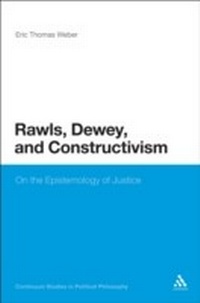
Rawls, Dewey, and Constructivism
On the Epistemology of Justice
1st Edition
Published on 22. July 2010
176 pages
978-1-4411-2069-4 (ISBN)
Description

In Rawls, Dewey, and Constructivism, Eric Weber examines and critiques John Rawls' epistemology and the unresolved tension - inherited from Kant - between Representationalism and Constructivism in Rawls' work.
Weber argues that, despite Rawls' claims to be a constructivist, his unexplored Kantian influences cause several problems. In particular, Weber criticises Rawls' failure to explain the origins of conceptions of justice, his understanding of "persons" and his revival of Social Contract Theory. Drawing on the work of John Dewey to resolve these problems, the book argues for a rigorously constructivist approach to the concept of justice and explores the practical implications of such an approach for Education.
Weber argues that, despite Rawls' claims to be a constructivist, his unexplored Kantian influences cause several problems. In particular, Weber criticises Rawls' failure to explain the origins of conceptions of justice, his understanding of "persons" and his revival of Social Contract Theory. Drawing on the work of John Dewey to resolve these problems, the book argues for a rigorously constructivist approach to the concept of justice and explores the practical implications of such an approach for Education.
Reviews / Votes
"Eric Weber provides a well considered and carefully crafted analysis of the work of John Rawls from a Pragmatist perspective. Chapter six alone, 'Dewey and Rawls on Education,' is worth the price of admission." - Larry A. Hickman, Center for Dewey Studies, Southern Illinois University, USA "Eric Thomas Weber's comparative study identifies a deep Kantian tension between constructivism and representationalism in Rawls. His well informed, very clear and persuasive critique of Rawls highlights the many resources of Dewey's constructivism and constructivist epistemology for democratic political philosophy." - Tom Rockmore, Duquesne University, USA Eric Thomas Weber's excellent book raises a constructivist challenge against Rawls's constructivism... In his short, tightly-argued book, Weber further develops the constructivist criticism of Rawls in creatively comparing and contrasting the views of Rawls and Dewey. ... Weber's critique is respectful rather than polemical, remaining robust but also judicious and collegial throughout... What distinguishes this work is its comprehensive identification of Kant as the primary source of epistemological ambiguity in Rawls and the subsequent force of Weber's rich illustration of the merits of Deweyan philosophy in plugging these deficiencies and more. 'Weber's Rawls, Dewey and Constructivism provides a welcome addition tothe Rawls literature by offering a Deweyan critique of,and alternative to, Rawlsian constructivism....In the contemporary political and economic climate, Weber's call for strengthening the American tradition of public, humanistic education is refreshing.' * H' Net Review * "Eric Thomas Weber's excellent book raises a constructivist challenge against Rawls's constructivism...Weber's Deweyan critique of Rawls's constructivist conception of justice points to the difficulty in grasping Kantian constructivism. In Rawls's writings, the reference to Kantian constructivism is so vague as to be essentially meaningless. That is one of the implications of this very useful book." - Notre Dame Philosophical Reviews * Notre Dame Philosophical Reviews *More details
Series
Edition
1. Auflage
Language
English
Place of publication
New York
United States
Target group
Professional and scholarly
ISBN-13
978-1-4411-2069-4 (9781441120694)
Copyright in bibliographic data and cover images is held by Nielsen Book Services Limited or by the publishers or by their respective licensors: all rights reserved.
Schweitzer Classification
Other editions
Additional editions
Book
04/2012
Continuum Publishing Corporation
€55.50
Shipment within 15-20 days
Person
Eric Thomas Weber is assistant professor of Public Policy Leadership at the University of Mississippi, USA. He has published in Human Studies, Review of Policy Research, Skepsis, William James Studies, Contemporary Pragmatism, and Transactions of the Charles S. Peirce Society. He is the author of Rawls, Dewey, and Constructivism (Continuum, 2010).
Content
1. Introduction \ 2. Social Contract Theory, Old and New \ 3. Worlds Apart: On Moral Realism and Two Constructivisms \ 4. Freedom and Phenomenal Persons \ 5. Rawls's Epistemological Tension: The Original Position, Reflective Equilibrium, and Objectivity \ 6. Dewey and Rawls on Education \ Bibliography \ Index
