

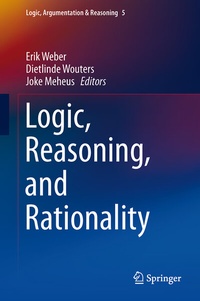
Logic, Reasoning, and Rationality
Description

This book contains a selection of the papers presented at the Logic, Reasoning and Rationality 2010 conference (LRR10) in Ghent. The conference aimed at stimulating the use of formal frameworks to explicate concrete cases of human reasoning, and conversely, to challenge scholars in formal studies by presenting them with interesting new cases of actual reasoning.
According to the members of the Wiener Kreis, there was a strong connection between logic, reasoning, and rationality and that human reasoning is rational in so far as it is based on (classical) logic. Later, this belief came under attack and logic was deemed inadequate to explicate actual cases of human reasoning. Today, there is a growing interest in reconnecting logic, reasoning and rationality. A central motor for this change was the development of non-classical logics and non-classical formal frameworks.
The book contains contributions in various non-classical formal frameworks, case studies that enhance our apprehension of concrete reasoning patterns, and studies of the philosophical implications for our understanding of the notions of rationality.
More details
Other editions
Additional editions
Content
Preface; Erik Weber, Joke Meheus & Dietlinde Wouters.- Chapter 1. Adaptive Logics as a Necessary Tool for Relative Rationality. Including a Section on Logical Pluralism; Diderik Batens.- Chapter 2. A New Approach to Epistemic Logic; Giovanna Corsi and Gabriele Tassi.- Chapter 3. Explaining Capacities: Assessing the Explanatory Power of Models in the Cognitive Sciences; Raoul Gervais.- Chapter 4. Data-driven Induction in Scientific Discovery. A Critical Assessment Based on Kepler's Discoveries; Albrecht Heeffer.- Chapter 5. Dovetailing Belief Base Revision with (Basic) Truth Approximation; Theo A.F. Kuipers.- Chapter 6. A Method of Generating Modal Logics Defining Jaskowski's Discussive D2 Consequence; Marek Nasieniewski and Andrzej Pietruszczak.- Chapter 7. Frontier Theory of Inquiry: Apparent Conflicts between the Ghent Logical Program and the "Darwinian" Selectionist Program; Thomas Nickles.- Chapter 8. On the Propagation of Consistency in Some Systems of Paraconsistent Logic; Hitoshi Omori and Toshiharu Waragai.- Chapter 9. Degrees of Validity and the Logical Paradoxes; Francesco Orilia.- Chapter 10. Contradictory Concepts; Graham Priest.- Chapter 11. Bloody Analogical Reasoning; Dagmar Provijn.- Chapter 12. Another Look at Mathematical Style, as Inspired by Le Lionnais and the OuLiPo; Jean Paul Van Bendegem and Bart Van Kerkhove.- Chapter 13. Internalism Does Entail Scepticism; Jan Willem Wieland.- Chapter 14. Answering by Means of Questions in View of Inferential Erotetic Logic; Andrzej Wisniewski.
