

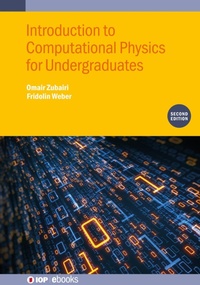
Introduction to Computational Physics for Undergraduates (Second Edition)
Description

This book provides an accessible introduction to computational physics, designed specifically for undergraduate students. Its purpose is to bridge the gap between theoretical physics and practical, computational approaches, equipping students with the tools and techniques needed to solve real-world physics problems through programming and numerical methods. Emphasizing hands-on learning, the book offers a comprehensive overview of essential topics, including numerical integration, differential equations, and data analysis, with applications across classical mechanics, electromagnetism, and quantum mechanics.
The scope of the book covers foundational computational methods that are broadly applicable within physics, highlighting how they can be used to model complex systems and analyze physical phenomena that are difficult to approach analytically. Each chapter builds on core physics concepts and introduces progressively advanced computational techniques, allowing students to develop both programming skills and a deep understanding of the physics behind the models they create.
This book's approach is highly practical, with a strong emphasis on coding exercises and projects that encourage students to actively engage with the material. Examples and exercises are carefully chosen to reinforce learning, and each chapter provides step-by-step guidance to solve problems using computational tools. By the end of the book, readers will have a solid grounding in both computational skills and physics applications, preparing them for more advanced studies or professional work in physics, engineering, or related fields. This resource is ideal for undergraduates seeking a hands-on approach to learning computational physics.
More details
Other editions
Additional editions

Persons
Fridolin Weber is a Distinguished Professor of Physics at San Diego State University and a Research Scientist at the University of California, San Diego. His research focuses on nuclear and particle processes in extreme astrophysical systems, such as neutron stars and supernovae. His interests also include quantum many-body theory applied to nuclear and dense quark matter, relativistic astrophysics, quantum gravity, and Einstein's theory of general relativity. He has published five books, co-authored over 250 papers, and given over 300 talks at national and international conferences and physics schools.
Omair Zubairi received his BSc and MSc in Physics from San Diego State University. He obtained his PhD in Computational Science from Claremont Graduate University and San Diego State University where he primarily worked on compact star physics. His other research interests include general relativity, numerical astrophysics and computational methods and techniques. Omair is a dedicated educator in physics and computational science. He has taught students from all backgrounds in many areas of physics from the introductory sequence to upper division courses where he incorporates numerical methods and computational techniques into each course. 'By allowing students to see and apply numerical simulations to various topics covered in lectures, they are able to gain invaluable insight into the problem at hand.
Content
Preface
Acknowledgements
Author biographies
1 The Linux/Unix operating system
2 Text editors
3 The Fortran 90 programming language
4 Numerical techniques
5 Problem solving methodologies
6 Worksheet assignments
7 Homework assignments
Appendix A: Cubic spline Fortran code
Appendix B: Summary of modern Fortran features
Appendix C: Plotting using Python
Appendix D: Fortran 90 sample program illustrating good programming
